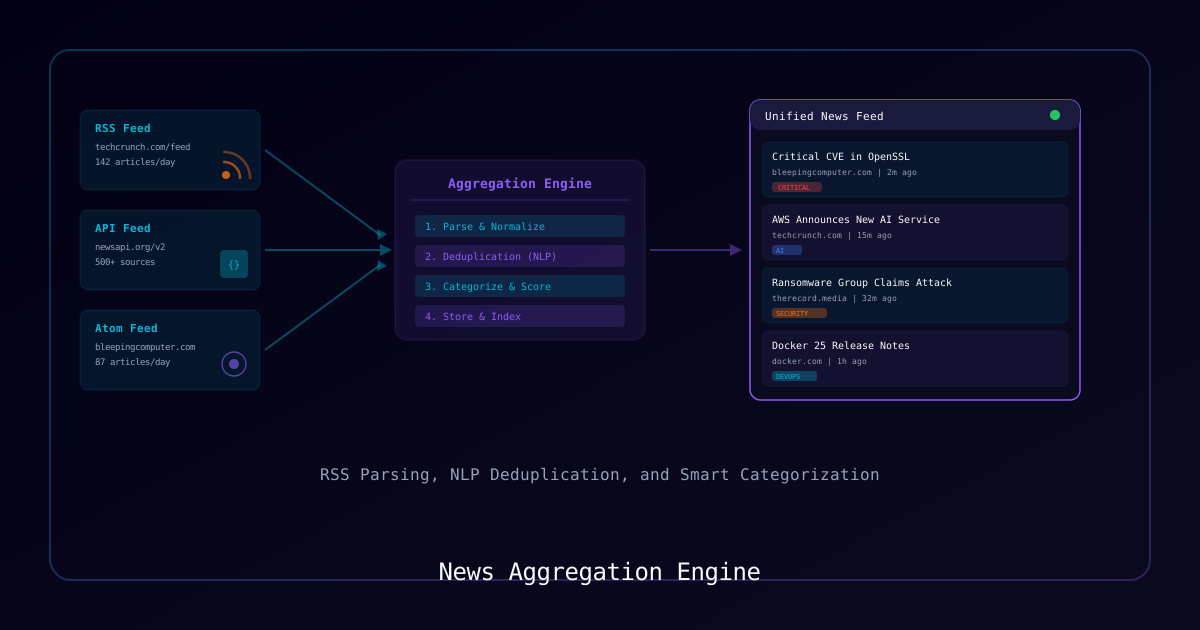
Overview
Aggregating news from multiple sources inevitably introduces duplicate articles — the same story reported by different outlets, or syndicated content appearing in multiple feeds. This guide builds a system that fetches, deduplicates, and scores articles from multiple RSS feeds.
Pipeline
RSS Feeds ──► Fetch & Parse ──► Normalize ──► Deduplicate ──► Score ──► Output
(10+) (parallel) (clean) (Jaccard) (rank) (JSON/MDX)Requirements
npm install xml2js node-fetchProcess
Step 1: Feed Configuration
// config/feeds.js
export const FEEDS = [
  {
    name: "The Hacker News",
    url: "https://feeds.feedburner.com/TheHackersNews",
    category: "security",
    weight: 1.2,  // Higher weight = more trusted source
  },
  {
    name: "BleepingComputer",
    url: "https://www.bleepingcomputer.com/feed/",
    category: "security",
    weight: 1.1,
  },
  {
    name: "TechCrunch",
    url: "https://techcrunch.com/feed/",
    category: "tech",
    weight: 1.0,
  },
  {
    name: "Ars Technica",
    url: "https://feeds.arstechnica.com/arstechnica/index",
    category: "tech",
    weight: 1.0,
  },
  // Add more feeds...
];Step 2: RSS Fetcher
// lib/fetcher.js
import { parseStringPromise } from "xml2js";

export async function fetchFeed(feed) {
  try {
    const response = await fetch(feed.url, {
      signal: AbortSignal.timeout(10000),
      headers: { "User-Agent": "CosmicBytez News Aggregator/1.0" },
    });

    if (!response.ok) throw new Error(`HTTP ${response.status}`);

    const xml = await response.text();
    const parsed = await parseStringPromise(xml, { trim: true });

    // Handle both RSS 2.0 and Atom formats
    const items = parsed.rss?.channel?.[0]?.item
      || parsed.feed?.entry
      || [];

    return items.map((item) => normalizeItem(item, feed));
  } catch (err) {
    console.warn(`Failed to fetch ${feed.name}: ${err.message}`);
    return [];
  }
}

function normalizeItem(item, feed) {
  // RSS 2.0 format
  if (item.title?.[0]) {
    return {
      title: cleanText(item.title[0]),
      link: item.link?.[0] || "",
      description: cleanText(item.description?.[0] || ""),
      pubDate: new Date(item.pubDate?.[0] || Date.now()),
      source: feed.name,
      category: feed.category,
      weight: feed.weight,
    };
  }

  // Atom format
  return {
    title: cleanText(item.title?.[0]?._ || item.title?.[0] || ""),
    link: item.link?.[0]?.$.href || "",
    description: cleanText(item.summary?.[0]?._ || item.summary?.[0] || ""),
    pubDate: new Date(item.updated?.[0] || item.published?.[0] || Date.now()),
    source: feed.name,
    category: feed.category,
    weight: feed.weight,
  };
}

function cleanText(text) {
  if (typeof text !== "string") return "";
  return text
    .replace(/<[^>]*>/g, "")      // Strip HTML tags
    .replace(/&[a-z]+;/gi, " ")   // Remove HTML entities
    .replace(/\s+/g, " ")         // Normalize whitespace
    .trim();
}

export async function fetchAllFeeds(feeds) {
  const results = await Promise.allSettled(
    feeds.map((feed) => fetchFeed(feed))
  );

  return results
    .filter((r) => r.status === "fulfilled")
    .flatMap((r) => r.value);
}Step 3: Jaccard Similarity Deduplication
// lib/deduplicator.js

/**
 * Calculate Jaccard similarity between two strings.
 * J(A,B) = |A ∩ B| / |A ∪ B|
 * Returns 0 (completely different) to 1 (identical).
 */
function jaccardSimilarity(textA, textB) {
  const tokensA = tokenize(textA);
  const tokensB = tokenize(textB);

  if (tokensA.size === 0 && tokensB.size === 0) return 1;
  if (tokensA.size === 0 || tokensB.size === 0) return 0;

  let intersection = 0;
  for (const token of tokensA) {
    if (tokensB.has(token)) intersection++;
  }

  const union = tokensA.size + tokensB.size - intersection;
  return intersection / union;
}

function tokenize(text) {
  return new Set(
    text
      .toLowerCase()
      .replace(/[^\w\s]/g, "")
      .split(/\s+/)
      .filter((w) => w.length > 2) // Skip short words
  );
}

/**
 * Remove duplicate articles based on title similarity.
 * When duplicates are found, keep the one from the highest-weighted source.
 */
export function deduplicate(articles, threshold = 0.6) {
  const unique = [];
  const seen = [];

  for (const article of articles) {
    let isDuplicate = false;

    for (let i = 0; i < seen.length; i++) {
      const similarity = jaccardSimilarity(article.title, seen[i].title);

      if (similarity >= threshold) {
        isDuplicate = true;
        // Keep the one with higher source weight
        if (article.weight > seen[i].weight) {
          // Replace existing with higher-weight source
          const idx = unique.indexOf(seen[i]);
          if (idx !== -1) {
            unique[idx] = { ...article, duplicateCount: (unique[idx].duplicateCount || 1) + 1 };
            seen[i] = article;
          }
        } else {
          // Just increment duplicate count
          const idx = unique.indexOf(seen[i]);
          if (idx !== -1) {
            unique[idx].duplicateCount = (unique[idx].duplicateCount || 1) + 1;
          }
        }
        break;
      }
    }

    if (!isDuplicate) {
      article.duplicateCount = 1;
      unique.push(article);
      seen.push(article);
    }
  }

  return unique;
}Step 4: Relevance Scoring
// lib/scorer.js

export function scoreArticles(articles) {
  const now = Date.now();

  return articles
    .map((article) => {
      let score = 0;

      // Recency: newer = higher score (exponential decay)
      const hoursAgo = (now - article.pubDate.getTime()) / (1000 * 60 * 60);
      score += Math.max(0, 100 - hoursAgo * 2);

      // Source trust weight
      score *= article.weight;

      // Duplicate count boost: covered by multiple sources = more important
      if (article.duplicateCount > 1) {
        score *= 1 + (article.duplicateCount - 1) * 0.2;
      }

      // Title engagement signals
      const titleLower = article.title.toLowerCase();
      if (titleLower.includes("critical") || titleLower.includes("zero-day")) {
        score *= 1.3;
      }
      if (titleLower.includes("vulnerability") || titleLower.includes("breach")) {
        score *= 1.2;
      }

      return { ...article, score: Math.round(score) };
    })
    .sort((a, b) => b.score - a.score);
}Step 5: Output Generator
// lib/output.js
import fs from "fs/promises";
import path from "path";

export async function generateMDX(articles, outputDir, maxArticles = 10) {
  const top = articles.slice(0, maxArticles);
  const date = new Date().toISOString().split("T")[0];

  const frontmatter = `---
title: "Tech & Security News Roundup — ${date}"
excerpt: "Top ${top.length} stories from ${new Set(top.map(a => a.source)).size} sources."
date: ${date}
author: "News Aggregator"
authorRole: "News Desk"
tags: ${JSON.stringify([...new Set(top.flatMap(a => [a.category]))])}
featured: true
category: "Roundup"
sources: ${JSON.stringify([...new Set(top.map(a => a.source))])}
---`;

  const body = top
    .map((a, i) => `
## ${i + 1}. ${a.title}

${a.description}

**Source:** ${a.source} | **Published:** ${a.pubDate.toLocaleDateString()}${
      a.duplicateCount > 1
        ? ` | *Reported by ${a.duplicateCount} sources*`
        : ""
    }

[Read full article →](${a.link})
`)
    .join("\n---\n");

  const content = `${frontmatter}\n\n${body}`;
  const filename = `news-roundup-${date}.mdx`;
  await fs.writeFile(path.join(outputDir, filename), content);

  return filename;
}Step 6: Main Script
// main.js
import { FEEDS } from "./config/feeds.js";
import { fetchAllFeeds } from "./lib/fetcher.js";
import { deduplicate } from "./lib/deduplicator.js";
import { scoreArticles } from "./lib/scorer.js";
import { generateMDX } from "./lib/output.js";

async function run() {
  console.log(`Fetching from ${FEEDS.length} feeds...`);
  const articles = await fetchAllFeeds(FEEDS);
  console.log(`  Fetched ${articles.length} articles`);

  const unique = deduplicate(articles, 0.6);
  console.log(`  After deduplication: ${unique.length} unique articles`);
  console.log(`  Removed ${articles.length - unique.length} duplicates`);

  const scored = scoreArticles(unique);
  const filename = await generateMDX(scored, "./content/news");
  console.log(`  Generated: ${filename}`);
}

run();Similarity Threshold Tuning
| Threshold | Behavior | Best For |
|---|---|---|
| 0.4 | Aggressive — catches loosely related articles | Few sources, noisy feeds |
| 0.6 | Balanced — catches same-story rewrites | General use |
| 0.8 | Conservative — only near-identical titles | Many unique sources |
Key Takeaways
- Jaccard similarity on tokenized titles is fast and effective for deduplication
- Source weights let you prefer trusted outlets when duplicates are found
- Articles covered by multiple sources deserve higher relevance scores
- Always set fetch timeouts — RSS feeds are unreliable
- Schedule the script (cron/GitHub Actions) for automated daily aggregation