The Cable That Made the Global Internet Possible Is Coming Home
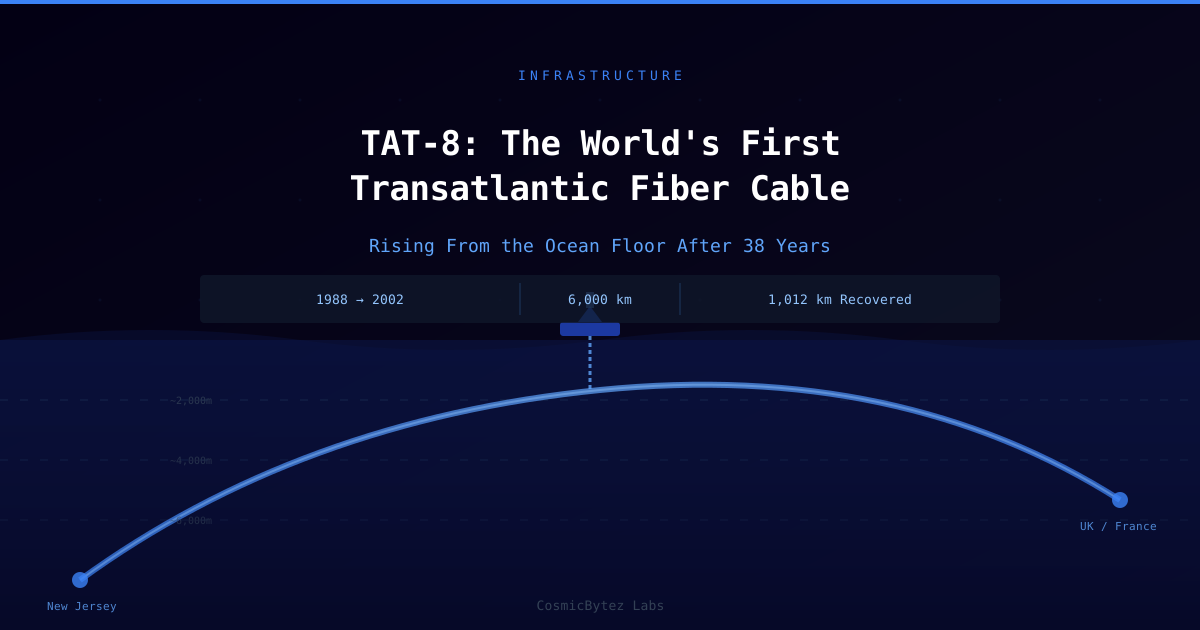
After lying silently on the ocean floor for 38 years, the TAT-8 — the world's first transatlantic fiber-optic cable — is being recovered from the deep Atlantic. The recovery operation, carried out by Subsea Environmental Services aboard the diesel-electric vessel MV Maasvliet, is pulling the historic cable from depths of up to 8,000 meters and transporting it to Leixões port, near Porto, Portugal, where it will be dismantled and recycled.
The cable entered service on December 14, 1988, and in the 14 years it operated before being decommissioned in 2002 it witnessed the fall of the Berlin Wall, the invention of the World Wide Web, and the end of the Cold War. It effectively wrote the blueprint that every undersea cable since has followed.
| Attribute | Value |
|---|---|
| Cable Name | TAT-8 (Trans-Atlantic Telephone 8) |
| First Service Date | December 14, 1988 |
| Decommissioned | 2002 (fault) |
| Total Length | ~6,000 km |
| Route | New Jersey → Cornwall, UK → Penmarch, France |
| Original Cost | |
| Capacity | 560 Mbit/s (~40,000 simultaneous calls) |
| Recovery Vessel | MV Maasvliet |
| Recovery Company | Subsea Environmental Services |
| Recovery Port | Leixões, Portugal |
| Distance Recovered (to date) | 1,012 km |
| Maximum Seabed Depth | ~8,000 meters |
How TAT-8 Changed Everything
Before TAT-8, transatlantic communications depended on copper coaxial cables — limited in bandwidth, expensive to maintain, and wholly inadequate for a world rapidly going digital. AT&T, British Telecom, and France Télécom jointly funded the project at a cost of $335 million (roughly $1 billion in today's dollars), making a bet that single-mode optical fiber could carry far more traffic across the Atlantic than anything before it.
They were right — and then some. TAT-8 used 1.3-micron wavelength fiber with repeaters spaced approximately 40 km apart and initially carried the equivalent of 40,000 telephone calls simultaneously. Despite designers expecting the capacity to last well into the 1990s, the cable reached saturation within 18 months of going live. Demand for transatlantic bandwidth had been catastrophically underestimated.
What Happens to a Retired Undersea Cable?
For decades after its 2002 retirement, TAT-8 simply rested on the seabed. Remarkably, when the recovery team began pulling it up, crew members noted the cable "still looked new" — deep-sea conditions (near-freezing temperatures, high pressure, no light, low biological activity) had preserved it almost perfectly.
The MV Maasvliet, on only its fourth voyage since leaving drydock in January 2025, has already recovered 1,012 kilometres of cable during one documented trip. The operation was briefly delayed by Hurricanes Dexter and Erin, adding two weeks to the recovery schedule.
Once ashore at Leixões, the cable is broken down into its constituent materials and shipped to Mertech Marine in South Africa for final processing:
| Material | Recycled Use |
|---|---|
| Steel (armour wires) | Repurposed as agricultural fencing |
| Copper (conductor) | High-grade copper recovery (valuable amid global copper shortage projections) |
| Polyethylene (insulation) | Converted to pellets in the Netherlands for non-food-grade plastics |
Nothing is wasted. For a cable that itself wasted nothing — every photon counted, every kilometre of fibre precisely engineered — it's an appropriate end.
Why This Story Matters for Infrastructure Security
The TAT-8 recovery is a reminder of just how physical the internet is — and how vulnerable that physical layer remains.
Today's transatlantic bandwidth is carried by roughly 400 active undersea cables globally. These cables carry an estimated 99% of all international internet traffic, yet they are regularly cut by ship anchors, fishing trawls, and submarine landslides. In recent years, suspected state-sponsored sabotage of Baltic Sea cables has heightened concern about the security of undersea cable infrastructure.
TAT-8's retirement and recovery illustrate the full lifecycle of this critical infrastructure: conception, deployment, operation, obsolescence, and eventually — decades later — careful extraction and recycling. Modern cables carry terabits per second where TAT-8 carried megabits, but they share the same fundamental vulnerability: they are thin lines of glass and metal on the ocean floor, unguarded across thousands of kilometres.
Impact Assessment
| Impact Area | Details |
|---|---|
| Historical Significance | End of an era — the cable that pioneered fibre optics at scale is gone |
| Material Recovery | Copper recovery is economically significant given global shortage forecasts |
| Infrastructure Awareness | Highlights the physical fragility of global internet backbone |
| Environmental | Responsible deep-sea cable recovery sets a precedent for future decommissioning |
| Industry Precedent | Establishes the recovery/recycling pipeline for the next wave of cable retirements |
Key Takeaways
- TAT-8 went live on December 14, 1988 as the world's first transatlantic fiber-optic cable, carrying 560 Mbit/s between New Jersey, the UK, and France.
- It was decommissioned in 2002 after a fault, but was left on the seabed until Subsea Environmental Services began recovering it in 2025.
- The recovery vessel MV Maasvliet has pulled up over 1,012 km of cable, with materials being recycled in South Africa and the Netherlands.
- Despite 38 years on the ocean floor at depths up to 8,000 m, the cable was found to be in near-pristine condition.
- The story underscores the physical reality of internet infrastructure — and why undersea cables are increasingly treated as critical national assets requiring active protection.
- As older cables are retired in coming decades, the TAT-8 recovery establishes an important precedent for responsible decommissioning of deep-sea telecommunications infrastructure.
Sources
- Tom's Hardware — The world's first transatlantic fiber-optic cable is being ripped up after 37 years on the sea floor
- Hackaday — TAT-8: The First Transatlantic Fiber Rises Again
- TechSpot — The world's first transatlantic fiber cable is being pulled off the ocean floor
- DNYUZ — Say Goodbye to the Undersea Cable That Made the Global Internet Possible