Phobos Ransomware Administrator Enters Guilty Plea in U.S. Federal Court
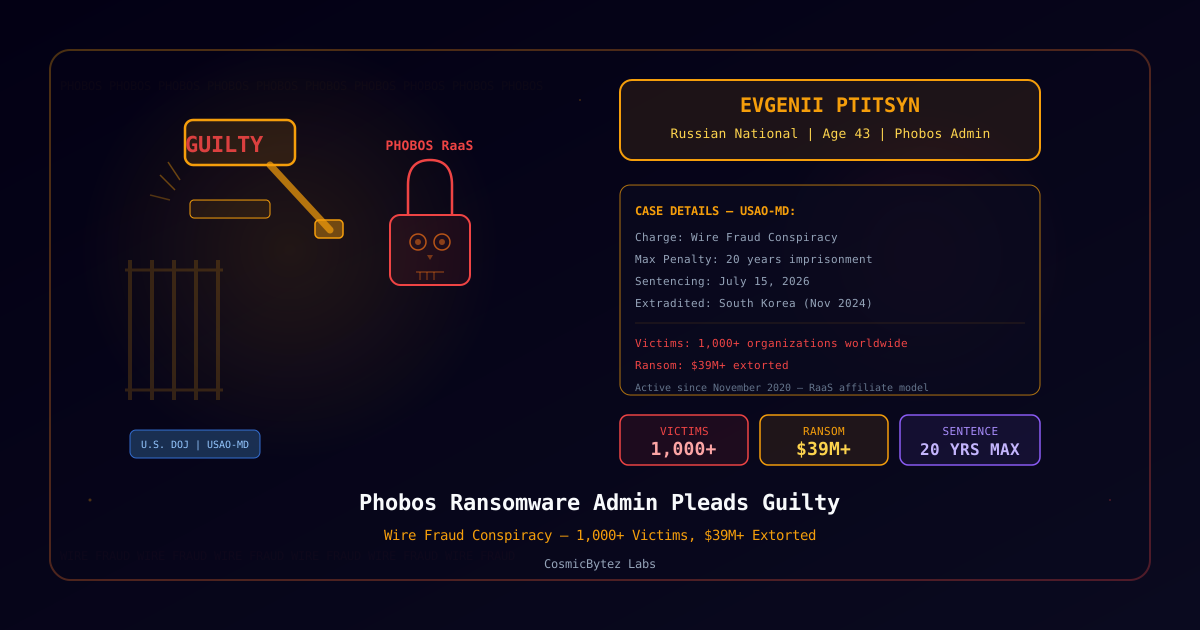
Evgenii Ptitsyn, a 43-year-old Russian national and administrator of the Phobos ransomware-as-a-service (RaaS) platform, has pleaded guilty to wire fraud conspiracy in the U.S. District Court for the District of Maryland. The plea, announced on March 5, 2026, brings a significant accountability milestone to a ransomware operation that targeted hospitals, schools, government agencies, and businesses across more than a dozen countries.
Ptitsyn faces a maximum sentence of 20 years in federal prison. Sentencing has been scheduled for July 15, 2026.
Case at a Glance
| Detail | Value |
|---|---|
| Defendant | Evgenii Ptitsyn |
| Age / Nationality | 43, Russian national |
| Role | Administrator, Phobos RaaS |
| Charge | Wire fraud conspiracy |
| Maximum Sentence | 20 years imprisonment |
| Sentencing Date | July 15, 2026 |
| Extradited From | South Korea (November 2024) |
| Prosecuting Office | USAO-MD (District of Maryland) |
| Victims | 1,000+ organizations globally |
| Ransom Extorted | $39 million+ |
| Platform Active | November 2020 – present |
What Was Phobos Ransomware?
A Fully Commoditized Ransomware-as-a-Service Platform
Phobos was a sophisticated RaaS platform — a criminal franchise model in which a central operator (Ptitsyn) developed and maintained the ransomware toolkit, then sold access to it to criminal "affiliates" who carried out attacks in exchange for a percentage of ransom proceeds.
The scheme was operational from at least November 2020 and continued through Ptitsyn's arrest. The platform operated via a darknet website where affiliates could subscribe, receive ransomware builds, and coordinate ransom negotiations and cryptocurrency payments back through the platform's infrastructure.
Phobos distinguished itself from more high-profile ransomware brands by targeting a wide range of victim sizes — including small businesses, local government entities, school districts, and healthcare providers that larger ransomware gangs typically passed over. This "no target too small" philosophy allowed the operation to accumulate a high victim volume.
How the RaaS Affiliate Model Worked
- Development: Ptitsyn and co-conspirators maintained the Phobos ransomware codebase and the backend infrastructure managing encryption keys and ransom transactions
- Affiliate recruitment: Access was sold or licensed to criminal actors through Telegram channels and darknet criminal forums, using online monikers
- Attack execution: Affiliates independently selected targets, gained initial access (typically via exposed RDP, phishing, or purchased credentials), and deployed Phobos to encrypt victim data
- Ransom collection: Victims were instructed to pay cryptocurrency ransoms via addresses managed through the central platform infrastructure; Ptitsyn's operation took a cut of each payment
- Decryption keys: On payment, the platform provided the affiliate with the decryption key to pass to the victim — maintaining the platform's "reliability" to incentivize victim payment
Scale and Impact
| Metric | Value |
|---|---|
| Total victims | 1,000+ public and private organizations |
| Total ransom extorted | $39 million+ |
| Countries affected | U.S. and global |
| Victim types | Hospitals, schools, local government, SMBs |
| Platform model | RaaS (affiliate-based) |
| Criminal channels used | Darknet website, Telegram, criminal forums |
The victim profile for Phobos is notable. Unlike high-profile groups like LockBit or BlackCat/ALPHV that targeted large enterprises to extract maximum ransoms, Phobos affiliates frequently hit under-resourced organizations — rural hospitals with limited IT staff, local school districts with minimal backup infrastructure, and small businesses without incident response capabilities. These targets were both easier to compromise and more likely to pay quickly.
Arrest and Extradition
Ptitsyn was arrested in South Korea prior to November 2024, when he was extradited to the United States to face charges in the District of Maryland. His arrest resulted from a coordinated international law enforcement effort that included cooperation from South Korean authorities.
He was initially charged with multiple counts including wire fraud, computer fraud, and extortion in connection with the Phobos operation. His guilty plea to the wire fraud conspiracy count was entered as part of the federal proceedings.
The extradition of a Russian national from South Korea — rather than through a traditional Western allied country — reflects the expanding geographic reach of U.S. cybercrime enforcement efforts and the willingness of Asian partner nations to cooperate on ransomware prosecutions.
Context: Growing DOJ Enforcement Against RaaS Operators
Ptitsyn's guilty plea is the latest in a series of high-profile DOJ prosecutions targeting RaaS platform administrators and affiliates:
- 2026-03-01: Two former incident responders pleaded guilty to participating in BlackCat/ALPHV ransomware attacks after using insider access to facilitate ransomware deployments
- 2025: Disruption of LockBit infrastructure with charges against affiliates in multiple countries
- 2024: Indictment and extradition proceedings against multiple Phobos affiliates in a coordinated international action
- 2024: Charges against administrators of Hive ransomware following FBI infiltration of the platform
The Phobos prosecution demonstrates that the DOJ is pursuing administrators — the architects of the RaaS ecosystem — not just frontline affiliates. Holding platform operators accountable is intended to deter the creation of new RaaS infrastructure by raising the personal legal risk for developers and administrators.
Recommendations
For Security Teams
- Restrict and monitor RDP aggressively — Phobos affiliates consistently exploited exposed Remote Desktop Protocol as a primary initial access vector; audit your attack surface and enforce network-level authentication plus MFA on all RDP endpoints
- Enforce MFA on all remote access — VPN, RDP, SSH, and cloud management consoles should all require phishing-resistant MFA
- Maintain tested, offline backups — Phobos ransomware targeted backup systems; maintain immutable, air-gapped, or offline backups verified through regular restoration tests
- Patch credential exposure — review accounts for credential reuse, enforce password manager policies, and monitor the dark web for leaked credentials from your domain
- Implement network segmentation — prevent lateral movement by isolating critical systems; Phobos affiliates relied on network traversal to maximize encryption coverage
- Deploy EDR with behavioral detection — signature-based AV is insufficient against modern ransomware; behavioral detections catch encryption activity in progress
For Under-Resourced Organizations
Phobos specifically targeted organizations that lack mature cybersecurity programs. If your organization has limited IT resources:
- Apply for CISA resources — CISA provides free cybersecurity assessments and tools for critical infrastructure sectors including healthcare and education
- Enable automatic patching — reduce the window of vulnerability on internet-facing systems
- Use cloud backup services — offsite, vendor-managed backups with versioning provide ransomware resilience without requiring dedicated infrastructure
- Contact MS-ISAC — the Multi-State Information Sharing and Analysis Center (MS-ISAC) provides free services to state, local, tribal, and territorial governments
Key Takeaways
- Phobos victimized 1,000+ organizations and extorted $39M+ — as a mid-tier RaaS platform, it demonstrates that significant criminal revenue does not require targeting only large enterprises
- The RaaS model distributes criminal liability — platform administrators like Ptitsyn enable hundreds of attacks without personally conducting them; prosecuting the administrator disrupts the entire ecosystem at once
- No target is too small — Phobos deliberately targeted hospitals, schools, and small businesses with limited cyber defenses; every organization is a potential ransomware target
- International extradition is increasingly viable — Ptitsyn's extradition from South Korea signals that Russian cybercriminals cannot always rely on non-extradition geography to evade U.S. prosecution
- RDP remains the most exploited initial access vector — organizations that have not locked down remote access are directly exposed to Phobos-style affiliate operations
- Accountability for RaaS administrators is escalating — the DOJ's sustained focus on operator-level prosecutions (not just affiliates) represents a strategic shift to disrupt the RaaS business model at its source
Sources
- Phobos ransomware admin pleads guilty to wire fraud conspiracy — BleepingComputer
- Russian Ransomware Administrator Pleads Guilty to Wire Fraud Conspiracy — U.S. Department of Justice
- Russian Ransomware Administrator Pleads Guilty to Wire Fraud Conspiracy — DataBreaches.net
- Russian Phobos Ransomware Operator Extradited to US — SecurityWeek
- Polish authorities arrest alleged Phobos ransomware affiliate — CyberScoop
- Phobos ransomware indictment sheds light on long-running, quietly successful scheme — The Record