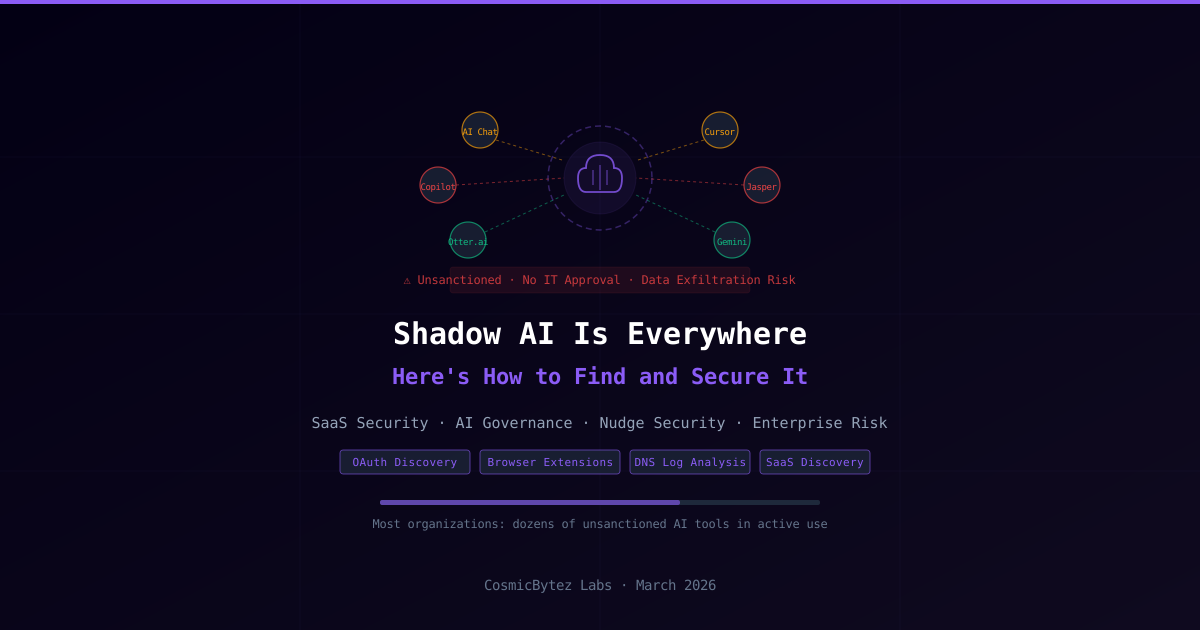
Shadow AI Is Spreading Faster Than Security Teams Can See
A new wave of unauthorized AI tool adoption is creating serious blind spots for enterprise security teams. As employees discover and integrate AI-powered SaaS tools — coding assistants, document summarizers, meeting transcription services, image generators, and AI-driven analytics platforms — without IT or security review, the risk profile of the organization quietly expands.
Nudge Security, a SaaS security management platform, highlighted this trend in a March 2026 report, describing how shadow AI has become a persistent governance challenge across organizations of all sizes — one that traditional CASB and DLP tools are increasingly poorly equipped to detect.
What Is Shadow AI?
Shadow AI refers to the use of AI-powered applications and services by employees without formal IT approval, procurement, or security review. It follows the pattern of shadow IT — the broader phenomenon of unsanctioned technology adoption — but carries distinct risks specific to AI:
| Shadow IT | Shadow AI |
|---|---|
| Unauthorized file sharing apps | Unauthorized AI document summarizers |
| Personal email for work files | AI tools trained on uploaded corporate data |
| Unmanaged cloud storage | LLM APIs receiving sensitive business context |
| Unapproved productivity apps | AI assistants with persistent memory of work content |
The AI dimension is particularly dangerous because many AI tools are trained on or retain the data submitted to them, creating a direct data exfiltration vector even without any malicious intent from the employee.
The Scale of the Problem
Nudge Security's research paints a clear picture of how rapidly shadow AI has penetrated enterprise environments:
- The average organization now has dozens of unsanctioned AI tools in active use across its SaaS footprint
- Most shadow AI adoption is driven by individual contributors or team leads, not IT departments
- HR, legal, finance, and customer service teams are among the heaviest adopters of unauthorized AI tools — precisely the teams handling the most sensitive data
- Employees often have no visibility into how submitted data is handled, retained, or used for model training by the AI vendor
Common shadow AI categories discovered in enterprise environments:
- AI writing assistants (Grammarly Business, Jasper, Copy.ai) — often receive full document content
- Meeting transcription and summarization (Otter.ai, Fireflies.ai, tl;dv) — often capture privileged business conversations
- Code generation tools (Cursor, Codeium, Tabnine) — may receive internal proprietary source code
- AI-powered analytics (various chatbot-adjacent tools) — may receive customer data or financial records
- Image and content generation (Midjourney, DALL·E integrations) — may receive product designs or confidential visuals
Why Traditional Security Tools Miss It
Standard security tooling struggles with shadow AI for several reasons:
CASB limitations: Cloud Access Security Brokers were built to detect known application signatures and block data uploads to unapproved storage services. AI tools often operate over standard HTTPS on common domains and are not in traditional CASB signature databases.
DLP blind spots: Data Loss Prevention tools can detect known sensitive data patterns (credit card numbers, SSNs, PII) leaving the perimeter, but they cannot evaluate whether an AI tool's terms of service permit using submitted content for model training.
No inventory baseline: Most organizations lack a complete inventory of SaaS tools in use. Without a baseline, there's nothing to flag AI tools against.
Rapid expansion: New AI tools launch weekly. Security teams cannot manually review and categorize them fast enough to stay ahead of employee adoption.
How to Find Shadow AI in Your Environment
Nudge Security recommends a multi-step discovery approach:
1. OAuth Token Discovery
Most AI SaaS tools request OAuth access to Google Workspace, Microsoft 365, or GitHub accounts. Security teams can audit granted OAuth tokens to surface unknown AI applications:
# Google Workspace Admin SDK — list all third-party app tokens
# Review for AI-related app names, unusual scopes, or recently granted access

# Microsoft 365 — audit OAuth app grants
# Admin Center > Azure AD > Enterprise Applications > All Applications
# Filter: App type = Third-party integrated apps
# Sort by: Last active (recent additions)2. Browser Extension Inventory
AI tools frequently distribute as browser extensions that operate within the browser session and have access to all page content — including internal web applications, SaaS tools, and confidential documents rendered in the browser. A browser extension management policy (via MDM or browser fleet management) can surface unknown AI extensions.
3. DNS and Proxy Log Analysis
Review DNS query logs or proxy logs for traffic to AI vendor domains:
# Sample domains to flag in DNS/proxy logs
openai.com, api.openai.com
anthropic.com, claude.ai
otter.ai, fireflies.ai, tldv.io
grammarly.com, jasper.ai, copy.ai
cursor.sh, codeium.com, tabnine.com
huggingface.coUnusual volume or new first-seen domains across employee machines can indicate shadow AI adoption.
4. SaaS Discovery Platforms
Dedicated SaaS discovery platforms — including Nudge Security, Torii, BetterCloud, and Zluri — use multiple signals (OAuth grants, browser extension data, expense report integrations, email domain analysis) to build comprehensive SaaS inventories that include AI tools.
Governance After Discovery
Discovering shadow AI is only the first step. Nudge Security recommends a governance framework that balances security with productivity:
Risk Classification
Classify discovered AI tools by data sensitivity exposure:
| Risk Level | Criteria | Response |
|---|---|---|
| Critical | Receives or trains on customer PII, financial data, source code | Block or require formal security review before use |
| High | Receives internal business documents, meeting content | Require IT approval and vendor DPA review |
| Medium | Receives generic business content without sensitive data | Monitor usage, implement acceptable use policy |
| Low | Productivity tools with no data upload (local inference, etc.) | Allow with policy acknowledgment |
Vendor Due Diligence Checklist
Before approving any AI tool for enterprise use, security teams should verify:
- Data retention policy: Does the vendor retain submitted content? For how long?
- Training opt-out: Can the organization opt out of submitted data being used for model training?
- Data residency: Where is submitted data processed and stored?
- SOC 2 / ISO 27001 certification: Does the vendor have current third-party security certifications?
- DPA availability: Will the vendor sign a Data Processing Agreement covering GDPR/CCPA obligations?
- Subprocessor disclosure: Does the vendor disclose which subprocessors receive customer data (e.g., which LLM API provider)?
Nudge vs. Block
Nudge Security's platform takes a behavioral approach to governance — rather than purely blocking unauthorized tools, it surfaces risky adoption to users and their managers with a risk explanation, encouraging voluntary migration to approved alternatives. This "nudge" model reduces the friction that typically drives shadow IT adoption in the first place.
Employee Communication and Policy
Technical controls alone cannot solve shadow AI. Clear communication matters:
- Publish an AI acceptable use policy — specify which AI tools are approved, what data can be submitted, and what the approval process is for new tools
- Create a fast-track AI review process — shadow AI adoption often accelerates because the official procurement process is too slow; a dedicated 48-72 hour AI tool review track reduces the incentive to bypass it
- Provide approved alternatives — if employees are using unauthorized AI writing tools, provide an approved, vetted alternative that meets their needs
- Train on AI data risks — many employees genuinely do not understand that their submitted prompts and documents may be retained or used for training; awareness training shifts the risk calculus
Why This Matters Now
The stakes of unmanaged shadow AI have risen sharply:
- Regulatory exposure: GDPR, CCPA, HIPAA, and sector-specific regulations create liability for organizations that share personal data with AI vendors without proper legal basis
- IP leakage: Source code, product roadmaps, and trade secrets submitted to AI tools may become training data for models that competitors also use
- Supply chain risk: AI tools have become a new attack surface — compromising an AI SaaS provider creates a path to extract data submitted by all enterprise customers
- Audit and litigation risk: If sensitive data submitted to an AI tool is later disclosed in a breach, organizations may face regulatory and legal exposure for inadequate oversight
Key Takeaways
- Shadow AI is pervasive — most organizations have dozens of unsanctioned AI tools in use, primarily driven by individual employees seeking productivity gains
- Traditional CASB and DLP tools miss it — AI tools require dedicated discovery approaches including OAuth audit, browser extension inventory, and DNS log analysis
- Nudge over block: A governance model that explains risk and offers approved alternatives outperforms pure blocking, which drives adoption underground
- Vendor due diligence is critical: Data retention, training opt-out, and DPA availability determine whether an AI tool is safe to use with enterprise data
- Act now: Regulatory pressure around AI data handling is increasing — organizations that establish governance frameworks today will be better positioned as compliance requirements mature
Sources
- Shadow AI is everywhere. Here's how to find and secure it. — BleepingComputer
- Nudge Security — SaaS Security Management Platform