LeakNet Ransomware Gang Adopts ClickFix and Deno to Bypass Enterprise Defenses
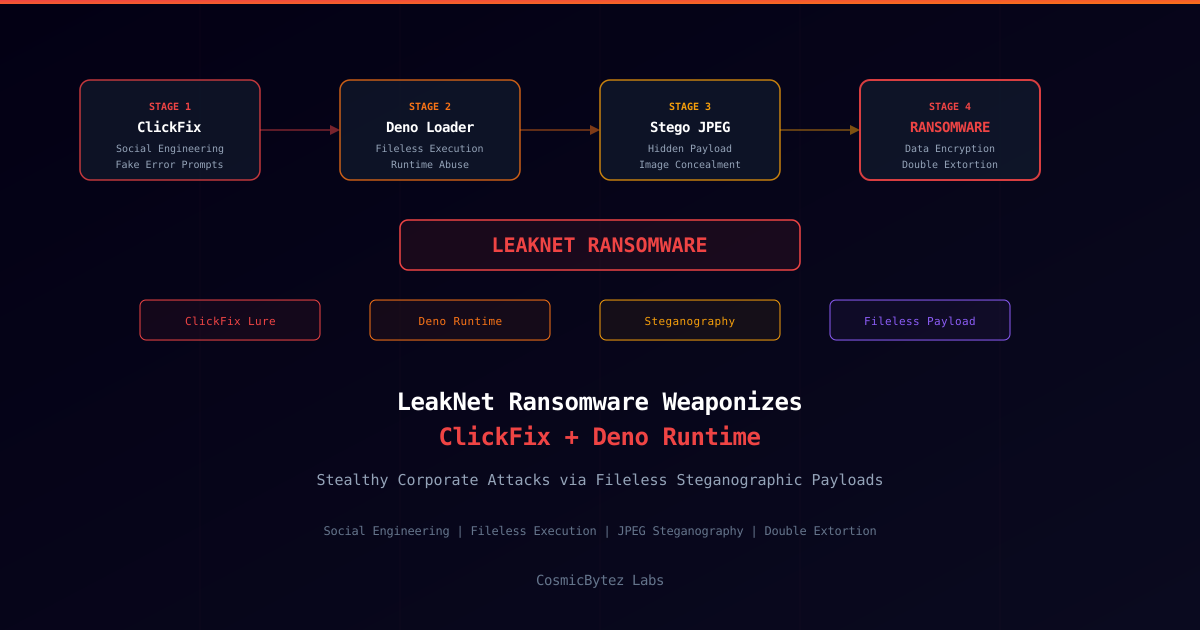
The LeakNet ransomware group has significantly upgraded its attack methodology, now combining the ClickFix social engineering technique for initial access with a novel Deno JavaScript runtime-based malware loader that executes payloads entirely in memory — bypassing traditional antivirus and EDR solutions. The campaign was documented by security researchers and reported by BleepingComputer on March 17, 2026.
LeakNet, active since November 2024, operates as a double-extortion ransomware group — exfiltrating data before encrypting and threatening to publish stolen files on their Tor-based leak site. The group has claimed approximately 3 victims per month across healthcare, finance, manufacturing, and education sectors, with documented victims across the United States, Canada, Taiwan, Pakistan, and Switzerland.
Incident Details
| Attribute | Value |
|---|---|
| Threat Actor | LeakNet |
| Active Since | November 2024 |
| Initial Access | ClickFix social engineering |
| Loader Technology | Deno JavaScript/TypeScript runtime |
| Evasion Technique | Fileless execution; steganographic JPEG payloads |
| Post-Exploitation | DLL sideloading, PsExec lateral movement, Kerberos ticket enumeration |
| C2 Infrastructure | Tor-based; unexpected S3 bucket exfiltration also observed |
| Operation Model | Double extortion (encrypt + exfiltrate + leak) |
| Targeted Sectors | Healthcare, Insurance, Manufacturing, Education, Finance, Energy, Logistics |
How the Attack Works
Phase 1: ClickFix Initial Access
ClickFix is a social engineering technique in which victims are directed to attacker-controlled websites displaying fake browser error messages, CAPTCHA challenges, or technical problem prompts. The page instructs the user to copy-paste a command into the Windows Run dialog or PowerShell terminal to "fix" the displayed issue.
In LeakNet's variant, the ClickFix lure triggers execution of a command that downloads and installs the legitimate Deno runtime onto the victim machine. Because the user voluntarily executes the command themselves, browser-based security filters are bypassed.
Observable detection signal: Browser processes spawning msiexec — monitor for any instance where a browser (chrome.exe, msedge.exe, firefox.exe) invokes msiexec directly.
Phase 2: Deno-Based Fileless Loader
Rather than deploying a custom binary (which would be flagged by AV/EDR), LeakNet installs the legitimate, digitally-signed Deno runtime and uses it as a living-off-the-land binary (LOLBin) to execute malicious JavaScript payloads.
Loader behavior:
- Deno decodes and executes a malicious JavaScript payload directly into system memory — creating no on-disk artifacts
- The encrypted malware payload is concealed inside a JPEG image file using steganography
- The payload is decoded from the image and reflectively loaded into memory, bypassing file-scanning security tools
- Deno scripts follow a naming convention: PowerShell files named
Romeo*.ps1, VBScript files namedJuliet*.vbs
Phase 3: Post-Exploitation Chain
Once the Deno loader delivers the second-stage payload, LeakNet executes the following post-exploitation sequence:
| Technique | Detail |
|---|---|
| Host Fingerprinting | Computer name, GUID, public IP collected; unique victim ID generated |
| C2 Beaconing | Encrypted C2 communication over Tor; persistent polling loop established |
| DLL Sideloading | jli.dll loaded via a Java process staged in C:\ProgramData\USOShared |
| Credential Discovery | klist executed to enumerate Kerberos tickets for lateral movement |
| Lateral Movement | PsExec used to spread across the corporate network |
| Data Exfiltration | Data uploaded to actor-controlled Tor infrastructure; unexpected S3 outbound traffic also observed |
Impact Assessment
| Impact Area | Description |
|---|---|
| Data Theft | Exfiltration of corporate data before encryption — published in batches (1% first as proof) |
| Encryption | File encryption follows exfiltration; double-extortion pressure applied |
| Detection Evasion | Fileless + steganographic loader significantly reduces AV/EDR detection rate |
| Lateral Spread | PsExec + Kerberos enumeration enables rapid domain-wide propagation |
| Sector Risk | Healthcare and financial sector victims face regulatory exposure from data leaks |
Indicators of Compromise
Tor Infrastructure:
| Purpose | Onion Address |
|---|---|
| Primary data leak site | nleakk6sejx45jxtk7x6iyt65hwvfrkifc5v7ertdlwm3gttbpvlvxqd.onion |
| File server 1 | ahic5qo3qbjgsyv7x2h5w7uh6nuh45km5srblj7i2amxt57xp4wud2qd.onion |
| File server 2 | bnlluetsuf6pv7mchgue46h43v66uxtccpg3n5vcdzbeqften5cedlid.onion |
Behavioral IOCs:
deno.exeexecuting outside known development environments- Browser processes spawning
msiexec jli.dllsideloaded via Java fromC:\ProgramData\USOSharedklistexecution in unusual process context- PsExec usage without matching change management records
- Unexpected outbound connections to S3 buckets
- PowerShell scripts matching
Romeo*.ps1/ VBScript matchingJuliet*.vbs
Detection and Response Recommendations
For Security Operations Teams
- Alert on Deno outside dev environments —
deno.exehas no legitimate business use on corporate endpoints; any execution should trigger immediate investigation - Monitor browser-to-msiexec process chains — this is a reliable ClickFix detection signal
- Hunt for jli.dll sideloading — specifically in
C:\ProgramData\USOSharedand other non-standard directories - Alert on klist execution — Kerberos ticket enumeration outside normal IT admin workflows is a lateral movement precursor
- Baseline and alert on PsExec usage — any PsExec invocation without a correlated change record warrants immediate review
- Monitor S3 outbound traffic — unexpected data transfers to S3 endpoints are an exfiltration signal
For IT Administrators
- User awareness training — ClickFix relies entirely on users executing commands they paste from websites; train users to never run copy-pasted commands from browser prompts
- Application whitelisting — block Deno from executing on endpoints where it is not an approved application
- Script block logging — enable PowerShell ScriptBlock logging to capture
Romeo*.ps1execution - Privileged access workstations — limit PsExec availability to dedicated admin workstations
- Network segmentation — limit east-west movement capabilities to contain post-compromise lateral spread
Key Takeaways
- LeakNet is a double-extortion ransomware group active since November 2024, now significantly increasing its technical sophistication with ClickFix + Deno-based fileless attacks
- ClickFix remains one of the most effective initial access techniques because it weaponizes user trust and bypasses browser-based security by having the victim execute the command themselves
- The use of the legitimate Deno runtime as a LOLBin combined with steganographic JPEG payloads represents a deliberate effort to evade both signature-based and behavioral detection
deno.exeexecuting on a corporate endpoint should be treated as a high-confidence indicator of compromise unless explicitly authorized- The group's Tor-based infrastructure and dual-exfiltration model (Tor + S3) makes C2 blocking difficult without comprehensive egress filtering
- Organizations in healthcare, finance, and insurance face the highest risk given LeakNet's documented victim selection pattern and the regulatory implications of data exfiltration in these sectors