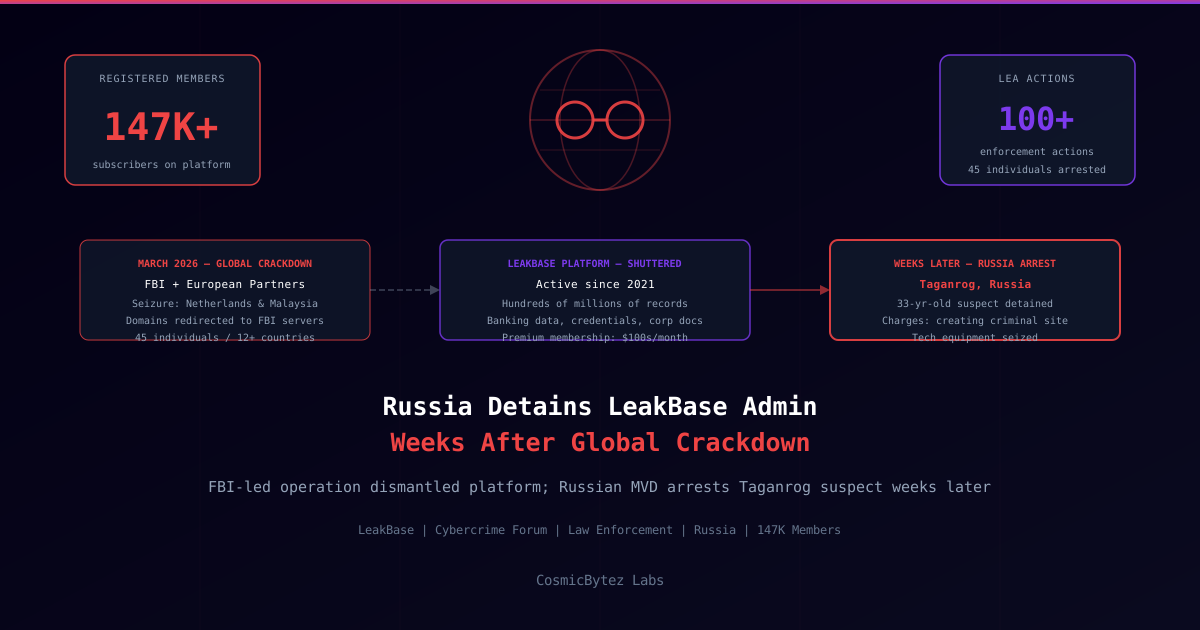
Russian law enforcement authorities have detained a 33-year-old suspect in Taganrog, Russia, alleged to be an administrator of LeakBase — one of the internet's most prolific marketplaces for stolen personal and corporate data. The arrest comes just weeks after FBI-led international law enforcement operations dismantled the platform's infrastructure, seized its domains, and arrested dozens of affiliated individuals across more than a dozen countries.
What Was LeakBase?
LeakBase operated as a subscription-based cybercrime marketplace that provided paying members access to hundreds of millions of records harvested from corporate data breaches, credential stuffing campaigns, and phishing operations. Active since at least 2021, the platform accumulated a reported subscriber base of over 147,000 members at its peak.
Platform capabilities included:
- Searchable databases of leaked credentials, including email/password combinations from major breach datasets
- Corporate document and employee data dumps sourced from ransomware group exfiltration operations
- Banking and financial account credentials sorted by institution and country
- Premium membership tiers priced in the hundreds of dollars per month, granting access to the highest-value and most recently acquired data sets
- API access for automated credential checking and account takeover tooling
The platform was considered a significant enabler of downstream cybercrime, providing the raw material for business email compromise (BEC) campaigns, account takeover fraud, identity theft operations, and ransomware pre-attack reconnaissance.
The March 2026 International Crackdown
The global law enforcement operation that preceded the Russian arrest was a coordinated multi-agency action involving the FBI, Europol, and national law enforcement agencies from more than 12 countries. Key actions included:
- Infrastructure seizure — LeakBase's primary domains were redirected to FBI-hosted seizure banners, as is standard practice in cybercrime platform takedowns
- Server seizure — Physical server infrastructure in the Netherlands and Malaysia was seized, with hosting providers compelled to hand over hardware and access logs
- Arrests — Approximately 45 individuals were arrested across 12+ countries in coordinated raids; additional individuals received summonses or are under ongoing investigation
- Financial disruption — Cryptocurrency wallets and payment infrastructure linked to the platform were frozen as part of broader asset seizure efforts
The operation represents one of the larger coordinated cybercrime enforcement actions of 2026, reflecting continued investment by Western law enforcement agencies in targeting the data-as-a-service infrastructure that underpins much of the modern cybercriminal economy.
The Russian Arrest: Significance and Context
The detention of a suspect in Russia is notable on several levels. Russian authorities have historically been reluctant to extradite cybercrime suspects to Western jurisdictions — a well-documented pattern that has allowed many cybercriminals operating from Russian soil to operate with de facto impunity from international law enforcement pressure.
The decision by Russia's Ministry of Internal Affairs (MVD) to detain the suspect domestically, rather than ignore the Western enforcement action, may reflect:
- Diplomatic signalling — A gesture of limited cooperation on cybercrime matters even amid broader geopolitical tensions
- Domestic legal action — Russian criminal law prohibits the creation of platforms facilitating data theft and cybercrime, and domestic prosecution remains possible even without extradition
- Unrelated operational pressure — Russian authorities may have independent intelligence or investigative interest in the suspect beyond the international case
The suspect faces charges related to creating a criminal site under Russian law. Whether the case will proceed to prosecution, and whether it is tied to the international investigation or represents a separate domestic action, remains unclear.
LeakBase's Operational History and Impact
During its operational period, LeakBase was linked to the distribution of data from numerous high-profile corporate breaches. The platform served as both a secondary market — reselling data originally extracted by ransomware groups and data brokers — and a primary repository that aggregated breaches from across the criminal ecosystem.
Security researchers estimate that the data traded through LeakBase contributed to:
- Thousands of BEC intrusions targeting organisations whose employee credentials appeared in leaked datasets
- Large-scale credential stuffing attacks against consumer platforms
- Identity fraud affecting millions of individuals whose data was repeatedly re-sold across the platform's multi-year operational lifetime
Broader Context: The Takedown Ecosystem
The LeakBase shutdown is part of a broader pattern of law enforcement disruption targeting the data leak marketplace segment of the cybercriminal underground. Previous operations have targeted BreachForums (multiple iterations), RaidForums, and similar platforms. The persistent challenge for law enforcement is that these platforms tend to respawn — often within weeks — under new branding and with new administrators emerging to fill the vacuum.
The simultaneous arrest of 45+ individuals across 12 countries suggests a more thorough disruption of the specific operator network than previous forum takedowns, though the broader market for stolen data will continue to operate through alternative channels.
Recommendations
Organisations that may have had data appear on LeakBase — which includes virtually any company whose employees use credentials that have been exposed in major breach datasets — should:
- Enforce password resets for any accounts whose credentials may have appeared in known breach datasets (use tools like HaveIBeenPwned for employee credential monitoring)
- Enable multi-factor authentication (MFA) on all corporate systems, particularly email, VPN, and remote access infrastructure where compromised credentials would enable the highest-impact access
- Monitor for credential stuffing patterns in authentication logs — a spike in failed login attempts from distributed IP ranges is a common indicator
- Conduct threat intelligence review to assess whether sensitive corporate data was available on the platform