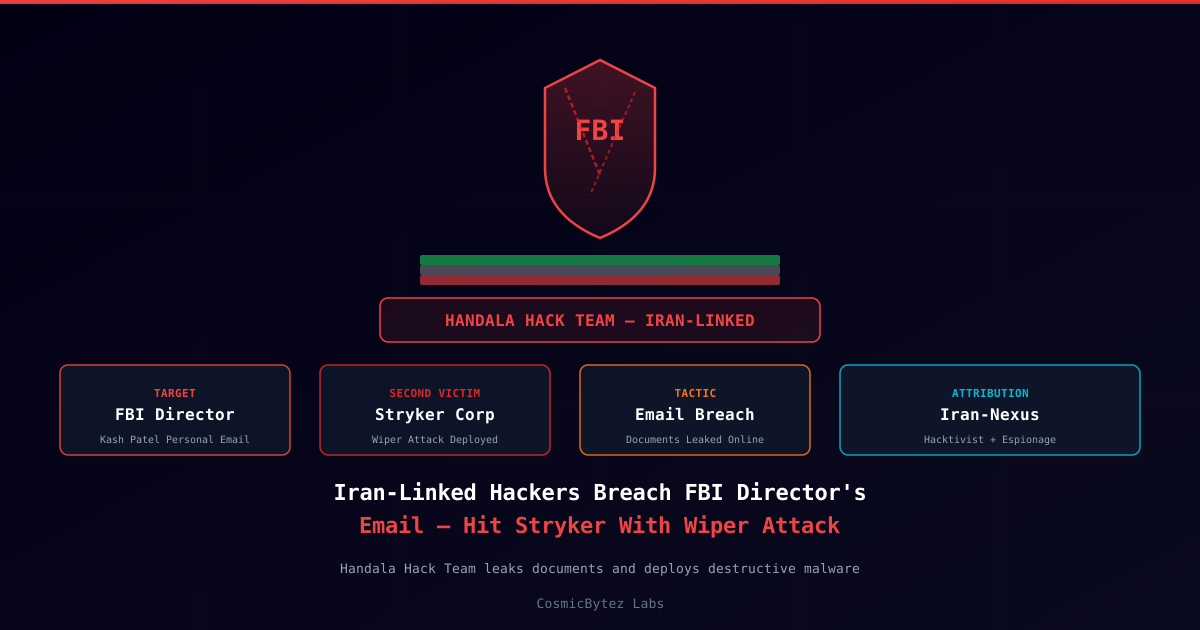
The Handala Hack Team, an Iran-linked threat actor group, has claimed responsibility for two significant operations disclosed on March 28, 2026: a breach of the personal email account of Kash Patel, the Director of the U.S. Federal Bureau of Investigation (FBI), and a destructive wiper attack against global medical device manufacturer Stryker Corporation.
FBI Director's Personal Email Compromised
Handala Hack Team announced via its own website that it successfully broke into the personal email account of FBI Director Kash Patel and exfiltrated a cache of photos and documents, which were subsequently leaked publicly. The group published the stolen content as part of an apparent influence and intimidation campaign.
Patel, who was confirmed as FBI Director in early 2026, became a high-value target for adversarial nation-state and hacktivist groups given his senior law enforcement role. The breach of a personal — rather than government — email account highlights the persistent risk posed by personal digital hygiene failures among senior officials, where personal accounts are often less hardened than official government systems.
Significance of Targeting Personal Accounts
Government officials at the cabinet and senior agency level typically operate with robust protections on official .gov email infrastructure, including multi-factor authentication requirements, monitoring, and advanced threat protection. Personal accounts, however, frequently lack equivalent controls and may be accessible from personal devices with varying security postures.
This pattern of targeting personal accounts has been observed previously in campaigns against senior U.S. officials and is consistent with Handala's established tradecraft.
Stryker Hit With Destructive Wiper Attack
In a separate but near-simultaneous operation, Handala Hack Team deployed a wiper malware attack against Stryker Corporation, a Fortune 500 medical device company headquartered in Kalamazoo, Michigan. Wiper attacks are designed not to steal data but to destroy it — overwriting files and storage to render systems inoperable.
The Stryker attack aligns with a broader pattern of Iranian threat actors employing destructive capabilities against Western corporate targets, particularly those with perceived ties to U.S. defense, healthcare, or government supply chains. Stryker produces medical equipment used extensively in U.S. military and veteran hospitals.
Wiper Attack Implications
Unlike ransomware, wiper attacks carry no financial motive — the objective is pure disruption and destruction. For a medical device manufacturer:
- Production disruption can delay critical equipment supply chains
- R&D data destruction can eliminate years of proprietary development
- Operational downtime in healthcare supply chains has patient safety implications
- Recovery timelines for wiper attacks are typically significantly longer than ransomware incidents, as data cannot be recovered by paying a ransom
About Handala Hack Team
Handala Hack Team is an Iran-linked hacktivist group that first gained prominence through a series of cyberattacks targeting Israeli and U.S.-affiliated organizations. The group operates with both espionage and influence objectives, combining data theft and public leaking (to maximize embarrassment and media impact) with destructive wiper deployments.
Security researchers have assessed Handala as operating with tacit or direct support from Iranian state interests, though the group presents publicly as an independent hacktivist collective. Their targeting consistently aligns with Iranian geopolitical priorities.
Pattern of Operations
Handala's dual-track approach — simultaneous high-profile leaks and destructive attacks — is designed to maximize psychological and operational impact:
- The FBI Director leak generates headline news and erodes public confidence in U.S. security leadership
- The Stryker wiper attack creates operational disruption with potential downstream healthcare implications
- Publishing stolen materials amplifies pressure and serves as propaganda
What This Means
The dual Handala operations on March 28 represent an escalation in Iran-linked offensive cyber activity against U.S. targets. The personal email breach of the sitting FBI Director is an especially brazen targeting choice designed for maximum symbolic impact.
Organizations affiliated with U.S. government agencies, defense, or healthcare should review their exposure to phishing and credential theft campaigns targeting personal accounts of senior personnel. Personal devices and accounts used by executives and officials represent a persistent attack surface that organizational security programs often cannot directly control.
For Stryker specifically, the immediate priority will be containment and forensic assessment of wiper damage, followed by business continuity activation. Medical device supply chain partners should assess whether any downstream impact on equipment availability or clinical data systems exists.
Source: The Hacker News