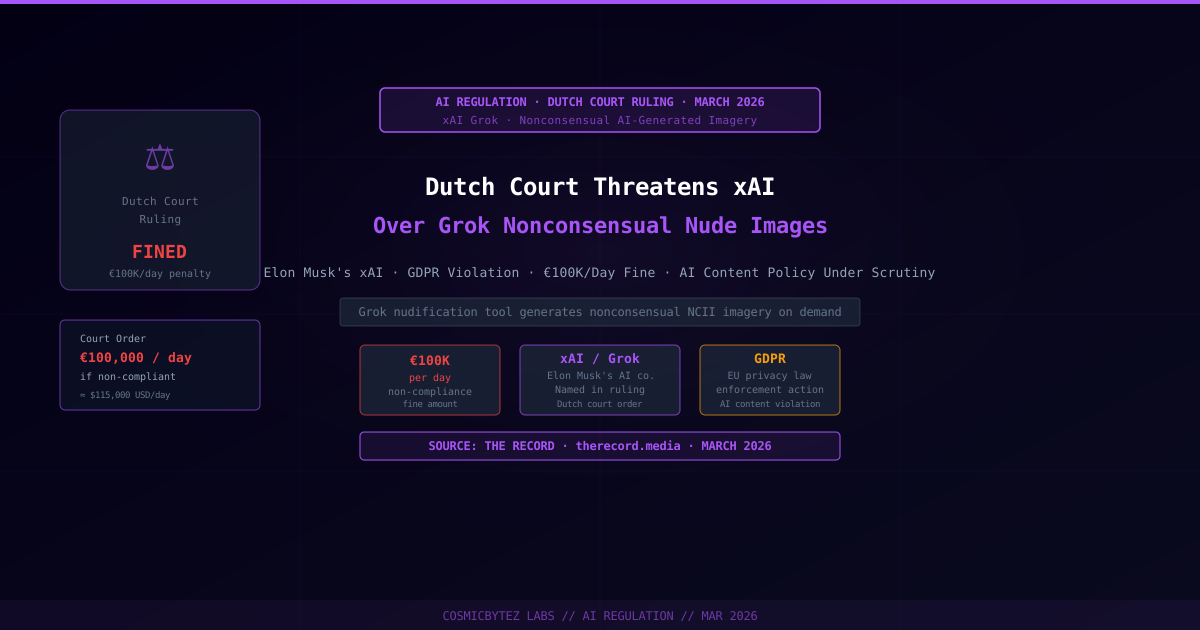
Dutch Court Orders xAI to Stop Grok Nude Image Generation Under €100K/Day Threat
A Dutch court has threatened xAI — the artificial intelligence company owned by Elon Musk — with daily fines of €100,000 (approximately $115,000) if it fails to stop Grok from generating nonconsensual nude images of real individuals. The ruling marks one of the first significant judicial enforcement actions targeting an AI model directly over its ability to generate non-consensual intimate imagery (NCII).
The court order demands that xAI implement measures to prevent Grok from generating nonconsensual nudification content, citing violations of European data protection and privacy laws.
What Is Grok's Nudification Capability?
Grok, developed by xAI and integrated into Elon Musk's X (formerly Twitter) platform, includes image generation capabilities. The controversy centers on Grok's apparent ability to generate nude or sexually explicit images of real, named individuals upon request — a capability sometimes referred to as "nudification."
Non-consensual intimate imagery generation using AI has emerged as a serious harm vector, enabling:
- Targeted harassment of individuals (particularly women and public figures)
- Sextortion and blackmail schemes using AI-generated imagery as leverage
- Reputational damage from synthetic intimate imagery that appears realistic
- Abuse of minors — AI nudification tools have been used to generate CSAM from non-sexual source images
The Dutch Court Ruling
The Dutch court found that Grok's nudification capabilities violate the General Data Protection Regulation (GDPR) and related EU privacy law, specifically regarding the processing of biometric and sensitive personal data without consent.
Key elements of the ruling:
| Element | Detail |
|---|---|
| Defendant | xAI (Elon Musk's AI company) |
| Platform | Grok AI |
| Violation | Nonconsensual nude image generation |
| Fine | €100,000 per day of non-compliance |
| USD Equivalent | ~$115,000 per day |
| Legal basis | GDPR, EU privacy law |
| Jurisdiction | Netherlands (Dutch court) |
The ruling requires xAI to put in place technical and policy measures preventing Grok from generating nonconsensual intimate images. Failure to comply triggers the €100,000 daily fine mechanism.
Context: AI-Generated NCII and European Law
The Dutch ruling comes amid a broader regulatory push in Europe to address harms from AI-generated non-consensual intimate imagery:
EU AI Act: The EU's AI Act, which entered into force in 2024, classifies certain AI systems as high-risk and includes prohibitions on manipulative AI content. Deepfake provisions are actively being implemented.
GDPR Article 9: Processing of biometric data and sensitive personal data without explicit consent is prohibited under GDPR. AI models generating realistic intimate images of identifiable real persons likely implicate this provision.
National laws: Several EU member states, including Germany, France, and the Netherlands, have enacted or are enacting specific laws targeting NCII generation and distribution.
xAI's Response
At the time of reporting, xAI had not publicly responded to the Dutch court ruling. The company has previously defended Grok's capabilities as within acceptable boundaries and has cited free expression principles in debates about content moderation on the X platform.
The €100,000/day fine structure creates significant financial pressure. If xAI does not comply, fines could escalate rapidly — a week of non-compliance would generate €700,000 ($800,000+) in penalties, while a month could reach €3 million ($3.45 million).
Broader Implications for AI Governance
This ruling is significant for several reasons:
Direct judicial accountability for AI models: Rather than proceeding solely through regulatory channels (e.g., GDPR enforcement by a national supervisory authority), this case demonstrates that courts can directly compel AI developers to modify their models' behavior under threat of financial penalty.
Extraterritorial reach: xAI is a US-based company. European courts and regulators asserting jurisdiction over AI systems accessible to European residents reflects the expanding reach of EU data protection law — consistent with GDPR's extraterritorial scope under Article 3.
Precedent for NCII cases: The ruling may encourage similar court actions in other EU member states and jurisdictions that have enacted NCII legislation.
Pressure on platform AI integration: Grok is integrated into X, which has hundreds of millions of users. Legal liability associated with Grok's content generation capabilities may accelerate changes to AI content policies platform-wide.
What This Means for the AI Industry
The Dutch ruling reflects a pattern of increasing judicial and regulatory scrutiny of generative AI capabilities in Europe:
- OpenAI has faced GDPR investigations in Italy and multiple EU member states
- Meta AI faced regulatory action over AI training data collection in the EU
- Stability AI and other image generation companies face ongoing litigation over training data and generated content
Companies deploying generative AI with image capabilities — particularly those that can generate realistic images of real individuals — face mounting legal exposure in jurisdictions with strong privacy and NCII frameworks.
Key Takeaways
- A Dutch court has threatened xAI with €100,000/day fines if Grok continues generating nonconsensual nude images
- The ruling targets xAI's AI model directly — a significant judicial enforcement precedent
- The legal basis is GDPR and EU privacy law regarding processing biometric and sensitive personal data
- AI-generated NCII is an escalating harm vector attracting regulatory and judicial attention across Europe
- The case reinforces EU regulators' willingness to apply GDPR extraterritorially to US-based AI companies
Sources
- Dutch court threatens xAI with fines over Grok's nonconsensual nude images — The Record
- EU AI Act — European Commission
- GDPR — EUR-Lex