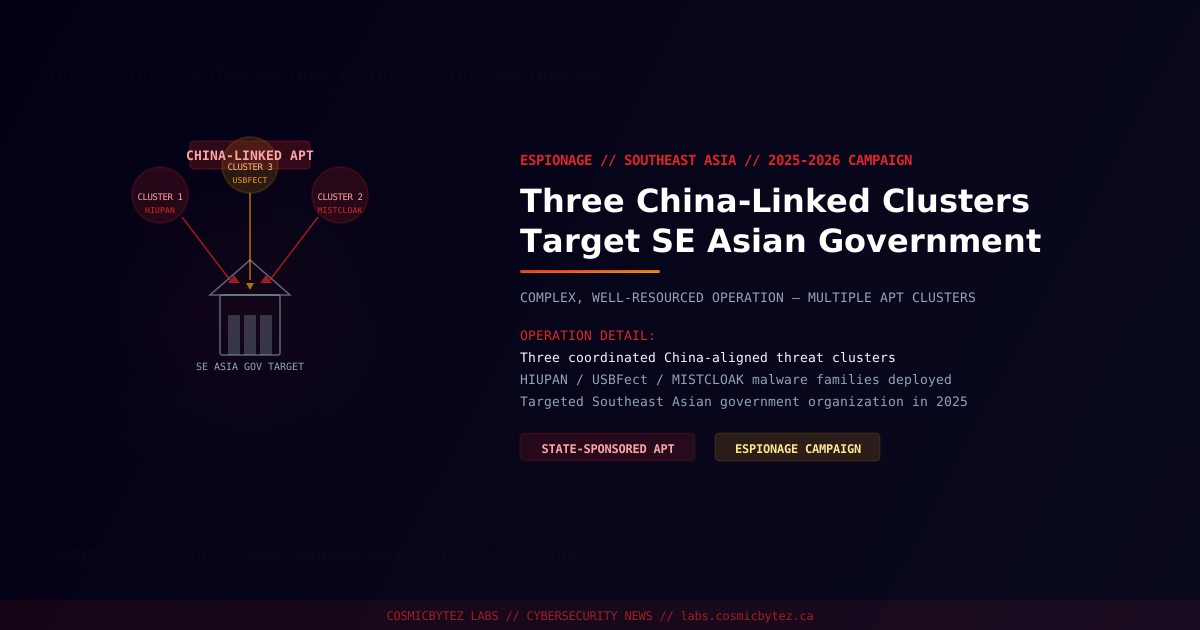
Three distinct threat activity clusters with ties to China jointly targeted a Southeast Asian government organization as part of what researchers describe as a "complex and well-resourced operation." The campaign, active throughout 2025, deployed multiple advanced malware families including HIUPAN (also known as USBFect and MISTCLOAK) and demonstrates the kind of coordinated, multi-actor offensive that has become a hallmark of Chinese state-sponsored cyber operations.
The Three Clusters
The attack involved three separate China-aligned threat activity clusters operating in coordination — an operational structure that provides redundancy, compartmentalization, and the ability to use specialized tools across different phases of the intrusion.
| Cluster | Malware Families | Role |
|---|---|---|
| Cluster 1 | HIUPAN / USBFect | Initial access, USB-based lateral movement |
| Cluster 2 | MISTCLOAK | Persistence, privilege escalation |
| Cluster 3 | Supporting tooling | Command and control, data exfiltration |
HIUPAN / USBFect
HIUPAN (tracked as USBFect in some intelligence reports) is a USB-propagating worm designed to spread through removable media — a capability that allows it to bridge air gaps and reach isolated network segments that are inaccessible via the internet. This type of malware is particularly effective against government targets that employ network segmentation as a primary defensive measure.
The malware can:
- Automatically copy itself to inserted USB drives
- Execute on new hosts when infected drives are inserted
- Establish persistence across systems with no direct internet connectivity
- Exfiltrate data back through the USB propagation chain
MISTCLOAK
MISTCLOAK is a post-exploitation tool used for maintaining stealth persistence and elevating privileges within compromised environments. In the context of this campaign, it likely served to consolidate access gained through HIUPAN's initial spread, enabling the threat actors to maintain long-term control over targeted systems.
Why Three Clusters?
The use of multiple coordinated clusters reflects a sophisticated operational model:
Redundancy: If one cluster's tools are detected and burned, the others retain access.
Specialization: Different clusters bring different capabilities — initial access, persistence, data collection, exfiltration.
Attribution complexity: Multi-cluster operations are harder to attribute definitively and complicate incident response, as defenders must track multiple distinct TTPs simultaneously.
Compartmentalization: Operational security is maintained by limiting what each cluster knows about the others' activities.
This model has been observed in other China-attributed campaigns, including operations attributed to APT41, APT40, and various sub-clusters within broader Chinese cyber organizations.
Target: Southeast Asian Government
The specific government organization targeted has not been publicly named. Southeast Asia has been a consistent focus of Chinese cyber espionage, given regional geopolitical tensions around:
- South China Sea territorial disputes involving multiple ASEAN member states
- Belt and Road Initiative intelligence collection on partner and adversary governments
- Economic intelligence targeting regional trade negotiations and policy positions
- Military intelligence on partner relationships with the United States and other Western allies
Government targets are particularly valuable because they hold policy deliberation records, diplomatic communications, military planning documents, and intelligence assessments.
Operational Timeline
The campaign was active throughout 2025 — a multi-month sustained operation indicating significant investment and patience by the threat actors. Extended dwell times are characteristic of nation-state espionage campaigns that prioritize intelligence collection over rapid monetization.
2025 (Early)   → Initial USB-based compromise via HIUPAN/USBFect
2025 (Mid)     → Lateral movement and privilege escalation via MISTCLOAK
2025 (Late)    → Sustained collection and exfiltration phase
2026 (Early)   → Campaign analysis and public disclosure
Implications for Government Security Teams
USB-Based Threats Are Not Obsolete
The use of USB-propagating malware like HIUPAN demonstrates that air-gapped network assumptions can be undermined by physical media. Organizations with classified or sensitive networks that rely on air gaps for protection should:
- Enforce USB device policies — allowlisting approved devices, blocking unauthorized removable media
- Deploy USB threat detection on endpoints that do allow removable media
- Physically audit USB ports on systems in sensitive areas
- Train staff on the risks of inserting unknown or unverified drives
Multi-Cluster Attribution Challenges
The three-cluster structure of this campaign has implications for incident response:
- Assume broader compromise when one cluster is detected — others may still be active
- Hunt for HIUPAN/USBFect/MISTCLOAK IOCs across the full network, not just the initially affected segment
- Engage threat intelligence services to correlate observed TTPs against known China-linked cluster profiles
Recommended Detections
| Malware | Detection Approach |
|---|---|
| HIUPAN / USBFect | Monitor for autorun-related registry modifications, USB event logs, unexpected file creation on removable media |
| MISTCLOAK | Monitor for unusual privileged process creation, credential dumping activity, scheduled task modifications |
| Campaign IOCs | Check threat intelligence feeds for HIUPAN/MISTCLOAK hashes, C2 infrastructure, and behavioral signatures |
Context: China's Southeast Asia Targeting Pattern
This campaign fits within a well-documented pattern of Chinese cyber espionage against Southeast Asian governments:
- UNC3886 — targeted Singapore telecom infrastructure
- APT40 (TEMP.Periscope) — sustained campaigns against Southeast Asian maritime and government targets
- Winnti Group — compromise of regional government supply chains
The three-cluster coordination seen here suggests this was not a one-off operation but part of a broader, sustained intelligence collection effort against the region.
Conclusion
The convergence of three China-linked clusters on a single Southeast Asian government target represents a level of operational investment that signals high-priority intelligence objectives. The use of USB-propagating malware to bridge network segmentation, combined with sophisticated post-exploitation tooling, demonstrates the technical depth these threat actors bring to high-value targets. Government organizations across Southeast Asia and their security partners should treat this disclosure as a prompt to audit for HIUPAN/MISTCLOAK indicators and reassess physical media security controls.
Source: The Hacker News — March 30, 2026