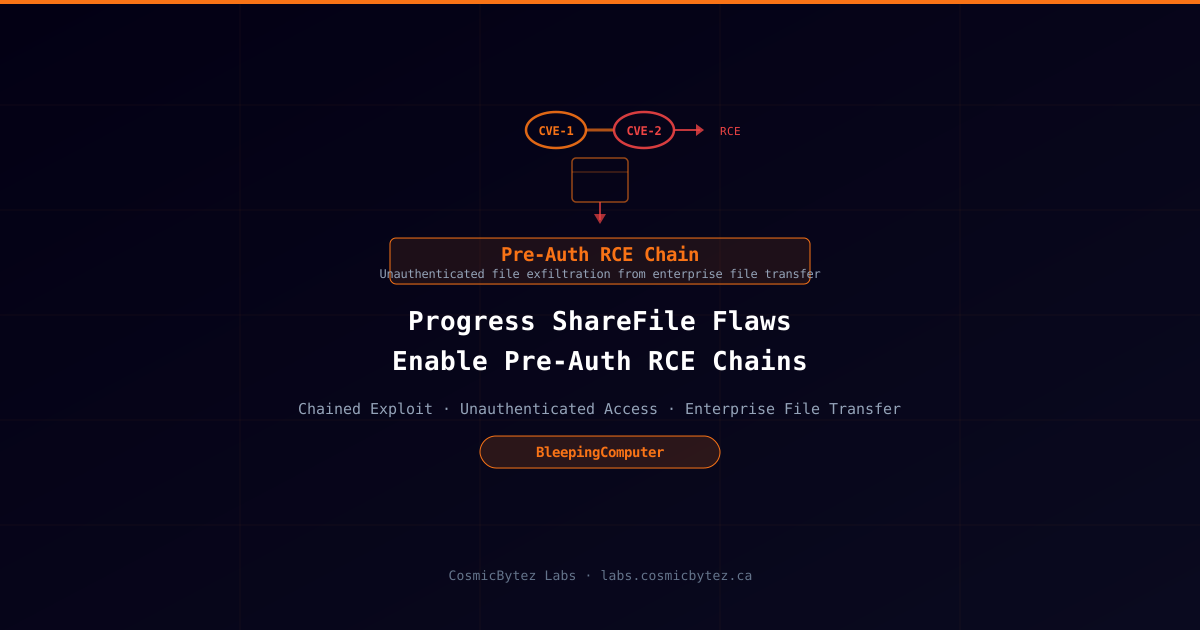
Security researchers have disclosed two vulnerabilities in Progress ShareFile, a widely deployed enterprise secure file transfer and collaboration platform, that can be chained together to achieve unauthenticated remote code execution (RCE) and enable file exfiltration from affected environments — all without requiring any authentication.
What Is Progress ShareFile?
Progress ShareFile is an enterprise-grade secure file transfer and content collaboration solution used by thousands of organizations worldwide, particularly in regulated industries such as finance, healthcare, and legal services. It enables businesses to share large files securely, manage client portals, and collaborate on sensitive documents — making it a high-value target for threat actors seeking access to sensitive data.
| Attribute | Details |
|---|---|
| Vendor | Progress Software |
| Product | ShareFile (on-premises and cloud deployments) |
| Vulnerability Type | Chained pre-authentication RCE + file exfiltration |
| Authentication Required | None |
| Source | BleepingComputer |
| Published | April 2, 2026 |
Vulnerability Details
The disclosure describes two distinct flaws that, when combined, escalate impact dramatically:
VULNERABILITY 1:
- Type: Authentication bypass / improper access control
- Impact: Allows unauthenticated access to restricted functionality
- Standalone impact: Unauthorized read access to files

VULNERABILITY 2:
- Type: Code injection / deserialization / server-side execution flaw
  (exact class pending full CVE publication)
- Impact: Arbitrary code execution on the ShareFile server
- Standalone impact: Requires authentication to exploit

CHAINED IMPACT:
- Vuln 1 bypasses authentication gate
- Vuln 2 then executes arbitrary code with server privileges
- Net result: Unauthenticated remote code execution
- File exfiltration possible from entire ShareFile storageThe chain is particularly dangerous because it requires no prior access, credentials, or user interaction — an attacker with network access to the ShareFile deployment can achieve full server compromise.
Attack Scenario
A realistic attack against an exposed ShareFile deployment would proceed as follows:
1. Attacker identifies a public-facing Progress ShareFile instance
   (via Shodan, Censys, or targeted reconnaissance)

2. Attacker sends a crafted unauthenticated request that exploits
   Vulnerability 1, bypassing the authentication layer

3. With unauthenticated access established, attacker triggers
   Vulnerability 2 to execute arbitrary code on the server

4. Attacker achieves code execution with ShareFile service privileges:
   - Exfiltrate all stored files and client data
   - Extract credentials and API keys from configuration
   - Deploy a web shell or backdoor for persistent access
   - Pivot to internal network infrastructure

5. Data harvested includes everything uploaded by all users:
contracts, financial documents, medical records, legal filesImpact and Risk Assessment
| Factor | Assessment |
|---|---|
| Exploitation Complexity | Low — chain is achievable with a single request sequence |
| Authentication Barrier | None — fully pre-authenticated |
| Data at Risk | All files stored in the ShareFile environment |
| Affected Deployments | On-premises and potentially cloud-managed instances |
| Industry Exposure | High in finance, legal, healthcare (regulated data) |
| Ransomware Potential | Significant — historical pattern with ShareFile attacks |
This vulnerability class is particularly sensitive for ShareFile given that the 2023 MOVEit Transfer and 2023 GoAnywhere MFT attacks — which also targeted enterprise file transfer solutions — resulted in mass data extortion affecting hundreds of organizations and millions of individuals. Threat actors, particularly the Cl0p ransomware group, have demonstrated a sustained interest in exploiting managed file transfer (MFT) solutions.
Affected Versions
Full version information was not published at time of disclosure. Progress Software is expected to release an advisory with specific version ranges and patch information. Organizations using any version of ShareFile on-premises should treat the risk as active until patched.
Recommended Actions
Immediate
PRIORITY ACTIONS:
1. Check Progress Software's security advisory portal for patches
   and apply updates as soon as they are available
2. If unable to patch immediately, assess whether the ShareFile
   management interface can be restricted to internal network only
3. Review access logs for unexpected unauthenticated requests
   to ShareFile endpoints
4. Inventory all sensitive files stored in the ShareFile environment
to understand potential breach scopeShort-Term
- Enable alerting on anomalous authentication events and file access patterns in ShareFile logs
- Place a WAF rule to detect and block suspicious request patterns against ShareFile endpoints until the patch is applied
- Rotate credentials stored in ShareFile configuration files (database connection strings, SMTP credentials, API keys)
- Audit all ShareFile user accounts for unauthorized additions or privilege escalations
For Incident Response Teams
If exploitation is suspected:
1. Preserve ShareFile access logs before any system changes
2. Check for unexpected files in the ShareFile directory tree
   (web shells, .aspx files in unexpected locations)
3. Review outbound network connections from the ShareFile server
   for data exfiltration to external IPs
4. Check for new scheduled tasks, services, or startup entries
   on the ShareFile host that may indicate persistence
5. Notify legal and privacy teams if user data may have been
accessed — regulatory notification obligations may applyHistorical Context: MFT Solutions as High-Value Targets
Enterprise file transfer solutions have become a prime ransomware and data extortion target:
| Year | Incident | Impact |
|---|---|---|
| 2023 | MOVEit Transfer (CVE-2023-34362) | 2,700+ organizations, 95M+ individuals |
| 2023 | GoAnywhere MFT (CVE-2023-0669) | 130+ organizations |
| 2024 | Cleo MFT (CVE-2024-50623) | Multiple Cl0p victims |
| 2026 | Progress ShareFile | TBD — patch urgently |
The pattern is consistent: threat actors invest in researching MFT solutions because a single exploit yields access to files belonging to all users and all clients of the platform — maximizing exfiltration value per compromised host.
Source: BleepingComputer — April 2, 2026