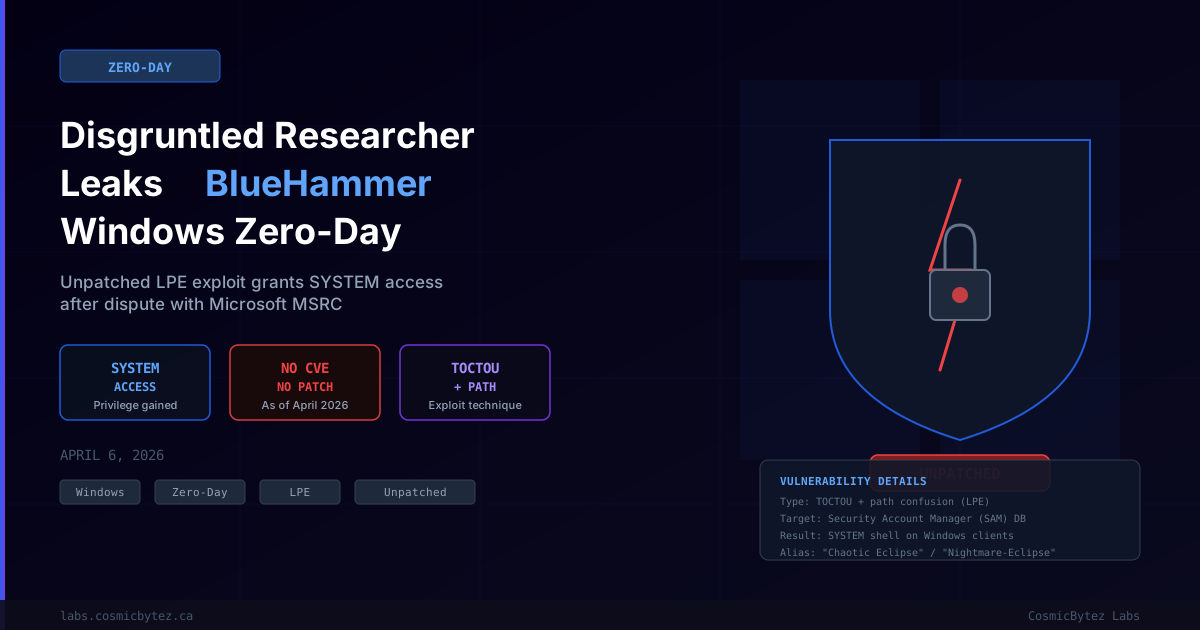
A frustrated security researcher has publicly released a working exploit for an unpatched Windows local privilege escalation (LPE) vulnerability, after a dispute with Microsoft's Security Response Center (MSRC) left the bug unacknowledged and unpatched. The vulnerability, dubbed BlueHammer, combines a time-of-check to time-of-use (TOCTOU) flaw with a path confusion weakness to grant attackers full SYSTEM-level privileges on Windows client systems.
The release escalates what began as a researcher-vendor disagreement into a live zero-day threat, with no CVE assigned and no Microsoft patch available as of April 2026.
The BlueHammer Vulnerability
BlueHammer targets the Security Account Manager (SAM) database — the Windows component responsible for storing local account password hashes. By exploiting a race condition (TOCTOU) combined with a path confusion flaw, an attacker with existing local access can manipulate the timing of a file system check to gain unauthorized read access to the SAM database.
Once the SAM database is accessible, an attacker can extract local account password hashes. These hashes can be cracked offline or used directly in pass-the-hash attacks to achieve full machine compromise.
As one security analyst summarized: "At that point, attackers basically own the system, and can do things like spawn a SYSTEM-privileged shell."
Vulnerability Technical Summary
| Attribute | Value |
|---|---|
| Vulnerability Name | BlueHammer |
| CVE | None assigned |
| Type | Local Privilege Escalation (LPE) |
| Technique | TOCTOU + path confusion |
| Target Component | Security Account Manager (SAM) database |
| Result | SYSTEM privileges on Windows clients |
| Windows Server Impact | Reduced — elevated administrator only |
| Patch Status | Unpatched as of April 2026 |
| Prerequisites | Local access to target system |
Researcher's Dispute with Microsoft MSRC
The researcher, operating under the aliases "Chaotic Eclipse" and "Nightmare-Eclipse", reported BlueHammer to Microsoft through responsible disclosure channels. According to the researcher's public statement accompanying the exploit release, Microsoft's Security Response Center failed to take the bug seriously or provide a satisfactory timeline for remediation.
The researcher expressed frustration directly: "I'm just really wondering what was the math behind their decision."
After exhausting what they considered reasonable patience with the disclosure process, the researcher chose to publish the exploit publicly — effectively converting a privately held vulnerability into a publicly accessible zero-day.
This type of "full disclosure" action — where researchers publish vulnerability details without an accompanying vendor patch — remains highly controversial in the security community. Proponents argue it forces vendors to act by making the business cost of inaction visible; critics point out that it exposes users and organizations to real-world attacks during the unpatched window.
Exploitation Prerequisites and Scope
A key constraint on BlueHammer is that it requires local access to the target system. This means remote attackers cannot directly weaponize it over a network; they first need a foothold on the machine through other means such as:
- Social engineering (phishing, malicious downloads)
- Credential theft (stolen passwords, pass-the-hash)
- Exploitation of another vulnerability that provides remote code execution
Once local access is established, BlueHammer enables a low-privileged user to escalate all the way to SYSTEM — the highest privilege level on a Windows system.
Windows Server systems are affected differently: the exploit escalates privileges to elevated administrator rather than SYSTEM, which is still significant but represents a narrower attack surface than on client versions.
Real-World Risk Assessment
While the local-access requirement limits BlueHammer's applicability for purely remote attack chains, it is highly valuable in the post-exploitation phase of an attack. Scenarios where BlueHammer becomes a practical threat include:
- Corporate environments where a single compromised workstation provides a stepping stone for SYSTEM-level persistence and lateral movement
- Malware payloads that gain low-privileged execution through phishing, and then use BlueHammer to escalate before deploying additional tools
- Insider threats where a non-administrative employee seeks to bypass access restrictions
- Shared computing environments (labs, kiosks, shared workstations) where multiple users share a physical machine
Mitigation Guidance
With no official patch available, defenders must rely on compensating controls:
Reduce Local Attack Surface
- Restrict local administrator accounts — minimize the number of accounts with local admin rights
- Implement application control (Windows Defender Application Control, AppLocker) to block unauthorized execution
- Enable Credential Guard — protects against credential harvesting from SAM and LSASS on supported hardware
Detect Exploitation Attempts
Monitor for indicators that BlueHammer or similar LPE techniques may be in use:
# Monitor for unexpected SAM database access attempts
# Check Security event log for privileged object access
Get-WinEvent -LogName Security -FilterXPath `
  "*[System[(EventID=4656)]]" | `
  Where-Object {$_.Message -match "SAM"}

# Monitor for new local account creation (persistence after LPE)
Get-WinEvent -LogName Security -FilterXPath `
"*[System[(EventID=4720)]]"Network-Level Containment
- Segment workstations from servers and sensitive systems — limits the blast radius if BlueHammer is used to achieve SYSTEM privileges on an endpoint
- Monitor for lateral movement indicators (pass-the-hash, new logon sessions with SYSTEM context)
Broader Context: The Full Disclosure Debate
BlueHammer's release reignites an ongoing debate about responsible disclosure timelines and vendor accountability. The security research community is divided:
Arguments for full disclosure:
- Vendors are incentivized to act only when exploitation becomes a real threat
- Users deserve to know about vulnerabilities affecting their systems
- Transparency enables defenders to implement mitigations even without a patch
Arguments against full disclosure:
- Publishing exploits before a patch is available directly enables attackers
- Legitimate researchers have alternative escalation paths (CERT/CC, public pressure) that don't require exploit publication
- The window between disclosure and patch deployment is the most dangerous period for users
Microsoft has not yet issued a public statement regarding BlueHammer or a timeline for a patch.
Sources: BleepingComputer