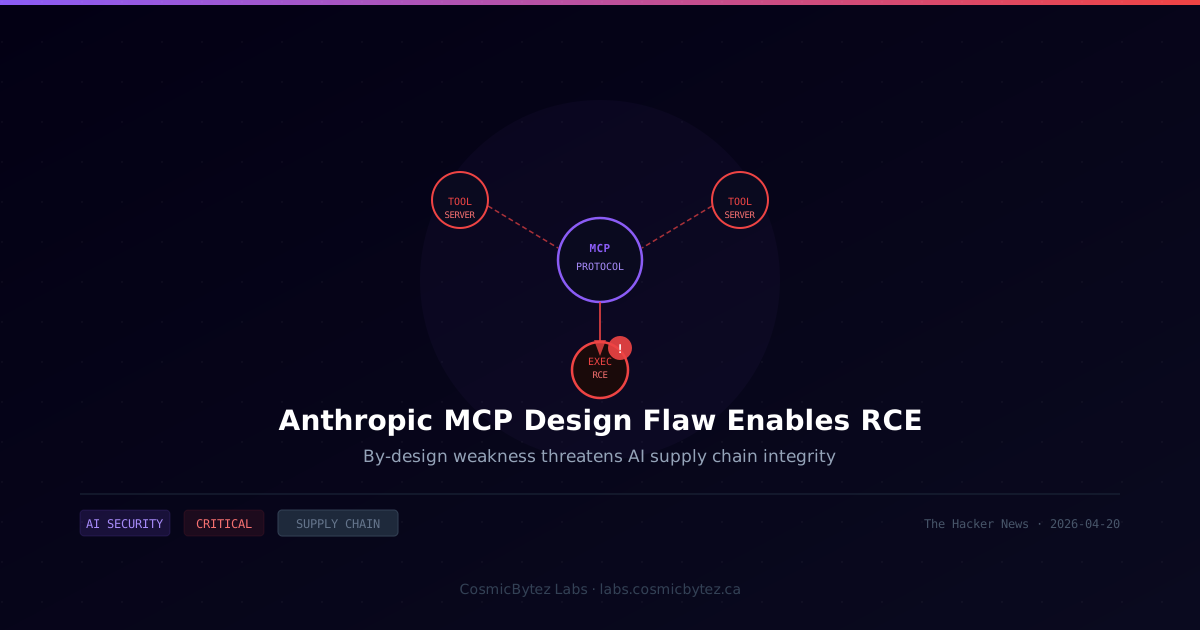
Cybersecurity researchers have disclosed a critical by-design weakness in the Model Context Protocol (MCP) architecture that enables arbitrary command execution and creates cascading risks for the rapidly growing AI supply chain.
MCP is an open standard developed by Anthropic that allows AI models — including Claude — to interact with external tools, APIs, databases, and local systems. The protocol is increasingly embedded in enterprise AI deployments, developer tooling, and agentic frameworks.
The Design Flaw
According to researchers, the core issue is not a traditional software vulnerability requiring a patch — rather, it is a fundamental architectural design choice within MCP that, under the right conditions, can be exploited to execute arbitrary commands on a host system.
The flaw operates through MCP's tool server invocation mechanism. When an AI agent calls out to an MCP-connected tool, the resulting command execution context inherits the permissions and environment of the MCP host process. Researchers demonstrated that:
- A malicious or compromised MCP tool server can send crafted responses that trigger remote code execution (RCE) on the client system
- The attack does not require user interaction beyond the AI model's normal tool-calling behavior
- Exploitation is feasible in any environment where MCP tool servers are trusted without strict validation
AI Supply Chain Implications
The disclosure carries particular concern for the AI supply chain — the growing ecosystem of MCP server packages, AI agent frameworks, and developer tools that rely on the protocol.
| Risk Factor | Description |
|---|---|
| MCP server marketplace | Third-party MCP servers shared publicly could be trojanized |
| Agentic workflows | Automated AI agents running unattended expand the attack surface |
| Inherited trust | AI models may invoke malicious tool servers without explicit user approval |
| Package ecosystem | MCP server packages distributed via npm, PyPI, or registries could be supply-chain-attacked |
In practice, this means a developer installing an MCP server package from a public registry could unknowingly introduce an RCE capability directly into their AI-enabled development environment.
How the Attack Works
The exploit chain follows a straightforward path:
1. Attacker publishes or compromises an MCP-compatible tool server package

2. Developer installs the package and registers it as an MCP server in their AI client

3. AI model calls the tool server during normal agentic operation

4. The malicious MCP server responds with a crafted payload

5. The MCP host process executes arbitrary commands with inherited system permissions

6. Attacker achieves code execution on the developer's machine or CI/CD environment
This mirrors supply chain attack patterns seen in npm and PyPI poisoning campaigns — except the attack surface is compounded by the AI model's autonomous decision-making about which tools to invoke.
Anthropic's Response
At time of publication, Anthropic has acknowledged the MCP architecture includes intentional design tradeoffs that enable powerful tool integration but also create trust boundaries that must be managed carefully. Anthropic has pointed to its MCP security guidelines, which recommend:
- Only connecting to trusted MCP server sources
- Reviewing MCP server code before installation
- Running MCP servers in sandboxed or isolated environments
- Applying least-privilege principles to MCP host processes
However, researchers argue these guidelines place the burden of security on end users rather than addressing the underlying architectural trust model.
Mitigation Guidance
Organizations using MCP-enabled AI tooling should take the following steps:
Immediate Actions
- Audit installed MCP servers — review all MCP server packages and their origins
- Apply process isolation — run MCP host processes in containers or VMs with restricted permissions
- Disable unused MCP servers — reduce the attack surface by removing any servers not actively needed
- Monitor MCP tool invocations — log all AI tool calls to detect anomalous behavior
Longer-Term Hardening
# Run MCP server processes with restricted permissions (Linux example)
systemd-run --user --property=AmbientCapabilities= \
  --property=NoNewPrivileges=true \
  npx @my-org/mcp-server

# Or use a dedicated unprivileged user for MCP processes
sudo -u mcp-runner npx @trusted-org/mcp-serverDeveloper Guidance
Before installing any MCP server:
- Verify the package publisher and audit the source code
- Check for unexpected network egress or file system access in the server implementation
- Prefer MCP servers that declare explicit permission scopes
Broader Context
The MCP vulnerability disclosure arrives amid an explosion in AI agent adoption. Claude, OpenAI's GPT models, and open-source LLMs are increasingly deployed in agentic configurations that can autonomously invoke tools, write files, execute code, and make API calls.
This trend dramatically expands the consequences of a compromised tool in the AI stack. Where a traditional software vulnerability might affect one application, a flaw in a widely-used MCP server could compromise every AI agent that invokes it — across thousands of organizations simultaneously.
Security researchers are urging the AI ecosystem to treat MCP server provenance with the same scrutiny applied to software dependencies — including integrity verification, vulnerability scanning, and runtime monitoring.
Source: The Hacker News