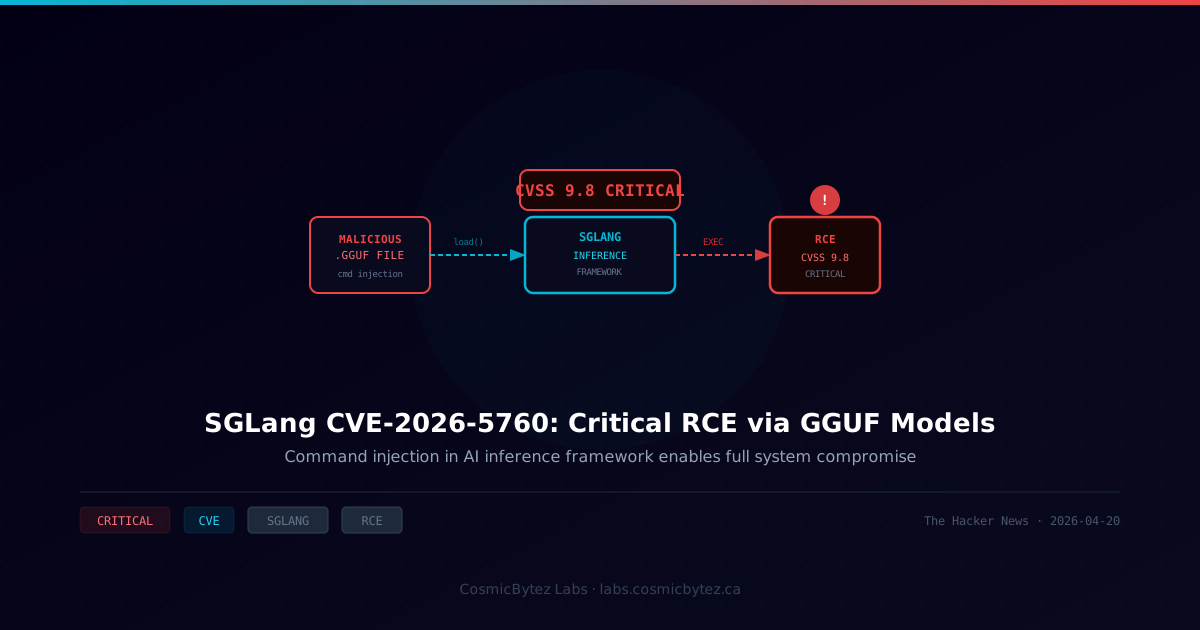
A critical remote code execution vulnerability tracked as CVE-2026-5760 has been disclosed in SGLang, a widely used open-source AI inference and serving framework. The flaw carries a CVSS score of 9.8 — the near-maximum severity rating — and can be exploited by supplying a malicious GGUF model file to trigger arbitrary command execution on the host system.
What is SGLang?
SGLang is a high-performance inference framework designed to accelerate large language model (LLM) serving. It is used across AI research environments, production ML deployments, and cloud-based inference pipelines. Its support for GGUF model formats — the standard for quantized LLM weights popularized by llama.cpp — makes it a popular target for anyone running local or self-hosted AI inference.
The Vulnerability
CVE-2026-5760 is classified as a command injection vulnerability in SGLang's model loading code path. When SGLang processes a GGUF model file, it parses metadata and configuration embedded within the file. Researchers discovered that attacker-controlled values within a specially crafted GGUF file can be passed unsafely to system command execution contexts — leading to arbitrary code execution with the privileges of the SGLang process.
| Attribute | Value |
|---|---|
| CVE ID | CVE-2026-5760 |
| CVSS Score | 9.8 (Critical) |
| CWE | Command Injection |
| Affected Component | SGLang GGUF model loader |
| Attack Vector | Supply a malicious model file |
| Authentication Required | None (zero-click when model is loaded) |
| User Interaction | Required only to load the file |
Exploit Chain
1. Attacker crafts a malicious GGUF file with injected command metadata

2. Victim downloads or receives the GGUF model file
   (e.g., from HuggingFace, Discord, shared cloud storage)

3. SGLang loads the model file for inference

4. Command injection payload executes during GGUF metadata parsing

5. Attacker achieves arbitrary code execution with SGLang process privileges

6. Potential outcomes: data exfiltration, backdoor installation,
   pivot to ML infrastructure, or supply chain compromise
Why This Matters for AI/ML Teams
The GGUF model format has become the de facto standard for sharing quantized LLMs across the open-source community. Millions of model files are distributed via:
- HuggingFace Hub — the primary community model registry
- GGUF-compatible hosting — community forums, Discord servers, direct file sharing
- Internal MLOps pipelines — where model files flow from research to production
A malicious GGUF file that appears to be a legitimate model (e.g., a fine-tuned variant of a popular base model) could be distributed through any of these channels. Any SGLang deployment that loads the file would be immediately compromised — without any additional user interaction beyond the normal model loading operation.
Affected Deployments
Organizations and individuals at elevated risk include:
- AI research teams running self-hosted SGLang inference servers
- MLOps pipelines that automatically pull and load models from registries
- Cloud AI deployments using SGLang as the inference backend
- Individual developers running local LLM inference with SGLang
Remediation
Immediate Actions
- Update SGLang to the patched version as soon as it is available — monitor the SGLang GitHub repository for the security release
- Audit GGUF model sources — only load model files from verified, trusted sources with known provenance
- Verify model file integrity — use SHA-256 checksums or cryptographic signatures where available to verify model files before loading
- Sandbox SGLang processes — run inference servers in containers with restricted permissions and network access
Process Isolation (Immediate Mitigation)
# Run SGLang in a restricted container environment
docker run --rm \
  --read-only \
  --no-new-privileges \
  --cap-drop ALL \
  --network none \
  -v /path/to/models:/models:ro \
  sglang-server python -m sglang.launch_server --model /models/model.gguf

# Or using systemd sandboxing
systemd-run --user \
  --property=NoNewPrivileges=yes \
  --property=PrivateTmp=yes \
  --property=ProtectSystem=strict \
python -m sglang.launch_server --model /path/to/model.ggufModel Provenance Verification
# Verify GGUF model file SHA-256 checksum before loading
sha256sum model.gguf
# Compare against the hash published by the original model author

# For HuggingFace downloads, use the CLI to verify:
huggingface-cli download org/model-name --verify-checksumsBroader Context
CVE-2026-5760 is part of a growing pattern of security vulnerabilities in AI/ML tooling. As inference frameworks become critical infrastructure for both research and production deployments, their attack surface grows accordingly.
The combination of the GGUF format's widespread adoption and SGLang's popularity in high-performance inference environments makes this a high-priority vulnerability for the AI security community. The 9.8 CVSS score reflects the near-zero bar for exploitation — an attacker needs only to get a model file in front of a SGLang instance.
Security teams operating AI infrastructure should treat model file provenance as a first-class security concern, applying the same scrutiny to model artifacts that they apply to software dependencies.
Source: The Hacker News