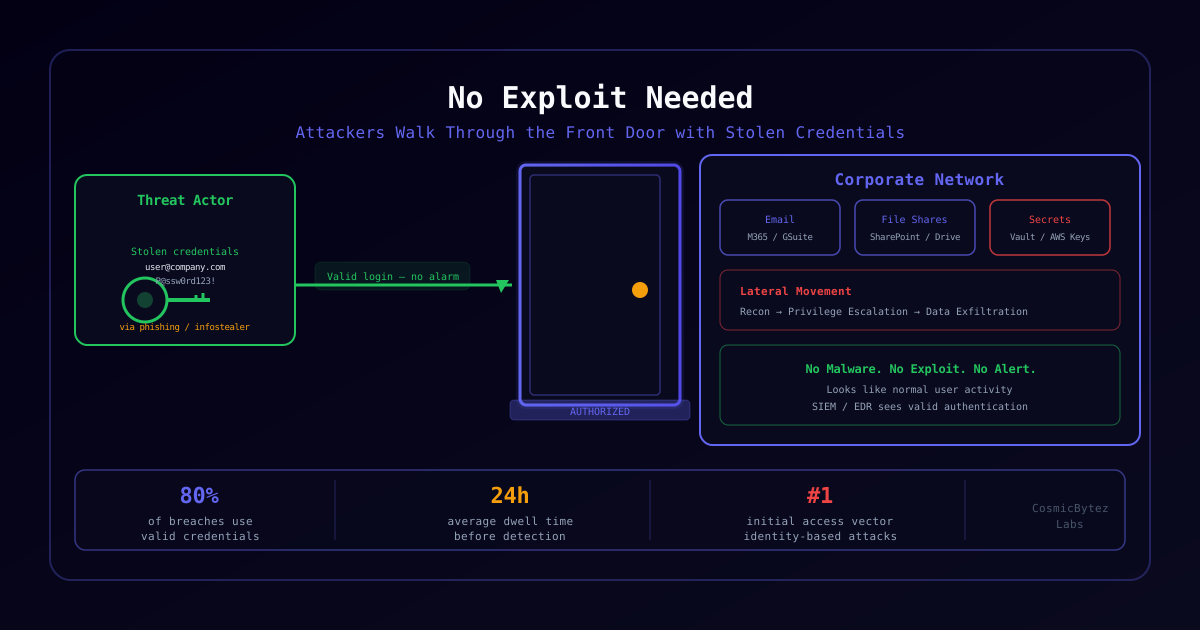
The cybersecurity industry has spent years chasing sophisticated threats — zero-days, supply chain compromises, and AI-generated exploits. However, the most reliable entry point for attackers still hasn't changed: stolen credentials. Identity-based attacks remain the dominant initial access vector in 2026, and they are becoming increasingly difficult to detect because they look like normal business activity.
Why Stolen Credentials Work Better Than Exploits
Zero-day vulnerabilities are expensive, burn quickly once disclosed, and require technical sophistication to weaponize. A valid username and password, on the other hand, is cheap, reusable across services, and produces activity that is nearly indistinguishable from legitimate user behavior.
| Attack Type | Cost | Detection Difficulty | Longevity |
|---|---|---|---|
| Zero-day exploit | High | Medium (anomalous behavior) | Short (patched quickly) |
| Supply chain attack | High | High | Medium |
| Stolen credentials | Very low | Very high | Long (until rotated) |
| Phished MFA code | Low | High | Session lifetime |
When an attacker logs into Microsoft 365 with a valid credential from an unfamiliar IP, most SIEM configurations will generate an alert — but a significant percentage of those alerts are false-positived into oblivion by overloaded security teams. The problem has become a detection fatigue problem as much as a technical one.
How Identity-Based Attacks Begin
Infostealers
Infostealer malware distributed via malvertising, cracked software, and fake game cheats silently harvests saved browser credentials, cookies, and session tokens. The stolen data is sold on underground markets or directly used. A single infected machine at a target organization can yield credentials for dozens of SaaS applications.
Phishing
Business email compromise (BEC) and credential phishing remain highly effective. Adversary-in-the-middle (AiTM) phishing kits like Tycoon 2FA and EvilGinx proxy legitimate login pages in real time, capturing both credentials and MFA tokens simultaneously — bypassing traditional two-factor authentication.
Password Spraying and Credential Stuffing
Billions of credentials leaked in prior breaches are continuously reused in automated attacks. Many users still reuse passwords across personal and corporate accounts, making credential stuffing a reliable low-effort technique.
What Happens After Initial Access
Once inside with valid credentials, attackers operate in "living off the land" mode — using legitimate tools and services to avoid detection:
1. Initial access via valid credential (email, VPN, SSO portal)
2. Reconnaissance using native cloud tools (Graph API, directory queries)
3. Identify high-value targets: finance accounts, IT admins, shared mailboxes
4. Lateral movement via delegated access, OAuth tokens, or password spraying internal systems
5. Data exfiltration via cloud storage sync, email forwarding rules, or API exports
6. Maintain persistence through OAuth app grants, backup email accounts, or MFA recovery codesThe entire chain may span days to weeks and generate no malware-related alerts. Traditional endpoint detection tools see nothing to flag.
The 2026 Identity Threat Landscape
Security teams in 2026 face an identity threat landscape shaped by several compounding factors:
MFA is no longer a silver bullet. AiTM phishing kits reliably bypass TOTP and push-notification MFA. Only phishing-resistant authentication (FIDO2/passkeys) provides meaningful protection against real-time credential capture attacks.
AI-assisted phishing is indistinguishable from legitimate communication. LLM-generated spear phishing emails contain no grammatical errors, reference real organizational context scraped from LinkedIn and corporate sites, and arrive from convincingly spoofed or compromised sender addresses.
Session token theft bypasses credential controls entirely. Infostealers increasingly target browser session cookies and OAuth tokens, allowing attackers to skip the login page entirely and authenticate as the victim's active session.
Cloud-native environments expand the attack surface. A single compromised Azure AD / Entra ID account with standard user permissions can enumerate all users, groups, applications, and conditional access policies — giving attackers an organizational map before they need to escalate.
Defensive Priorities
Phishing-Resistant MFA
Migrate to FIDO2/passkeys as fast as your organization can support it. Where hardware keys are not feasible, Certificate-Based Authentication (CBA) provides a middle ground. TOTP apps and SMS are insufficient against modern AiTM attacks.
Continuous Authentication Signals
Shift from perimeter-based to behavior-based authentication. Monitor for:
- Impossible travel (login from two geographically distant locations in short timeframe)
- Unusual access time patterns
- First-time access to sensitive applications
- Bulk data access or download events
Identity Threat Detection and Response (ITDR)
Purpose-built ITDR platforms monitor identity provider logs (Entra ID, Okta, Google Workspace) for attack patterns that generic SIEM rules miss. Key capabilities include detecting OAuth app consent phishing, stale session anomalies, and lateral movement via delegated permissions.
Credential Exposure Monitoring
Continuously monitor your organization's credentials in breach databases and infostealer marketplaces. Services like SpyCloud and Have I Been Pwned Enterprise allow proactive identification of compromised credentials before attackers use them.
Least Privilege and Just-In-Time Access
Minimize standing permissions. High-privileged accounts should use just-in-time (JIT) access with time-limited activation, reducing the blast radius of a compromised admin credential.
Key Takeaways
- Identity-based attacks dominate — stolen credentials are cheaper, more reliable, and harder to detect than exploits
- TOTP MFA is insufficient — AiTM phishing kits bypass it in real time; prioritize FIDO2/passkeys
- Living off the land means no malware alerts — detection requires behavioral analytics on identity signals, not endpoint telemetry alone
- Session token theft bypasses login — infostealers targeting browser cookies require endpoint security + session revocation controls
- Detection fatigue is a real risk — alert quality matters more than alert volume; tune SIEM rules for identity events