Overview
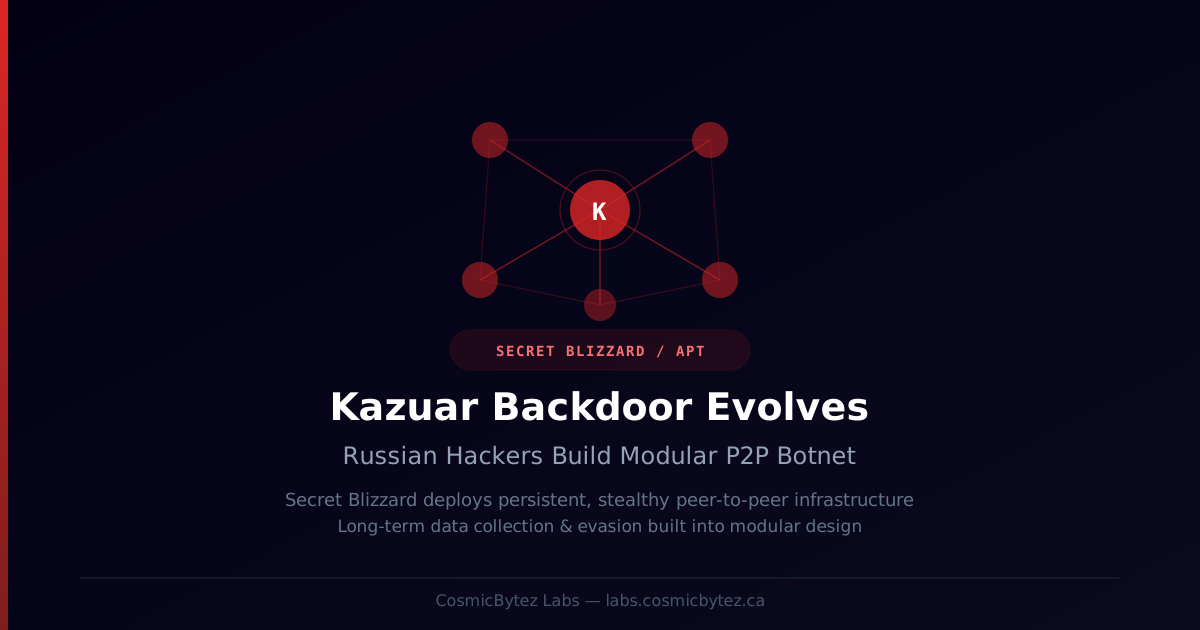
The Russian state-sponsored hacking group known as Secret Blizzard (also tracked as Turla, Venomous Bear, and Waterbug) has fundamentally redesigned its long-running Kazuar backdoor malware. Researchers report the threat actor has transformed the tool into a modular peer-to-peer (P2P) botnet architecture, making it significantly more resilient, stealthy, and difficult to disrupt through traditional sinkholing or takedown operations.
Background on Kazuar
Kazuar is a sophisticated .NET-based backdoor that has been attributed to Secret Blizzard since at least 2017. The malware has historically been used for espionage campaigns targeting government agencies, defense contractors, diplomatic organizations, and critical infrastructure across Europe, the Middle East, and Asia.
Previous iterations of Kazuar operated with traditional command-and-control (C2) infrastructure — centralized servers that researchers could identify and sinkhole to disrupt operations. The shift to a P2P architecture removes this single point of failure.
The New P2P Architecture
According to BleepingComputer's reporting, the redesigned Kazuar botnet now features:
Modular Design
The malware is broken into discrete functional modules, each responsible for specific tasks such as:
- Credential harvesting
- File exfiltration
- Network reconnaissance
- Persistence establishment
- Communication relay
Modules can be updated or swapped independently, allowing Secret Blizzard to retool specific capabilities without redeploying the entire implant — and without triggering detection signatures tied to the full toolset.
Peer-to-Peer Command and Control
Rather than relying on dedicated C2 servers, infected hosts communicate directly with each other in a distributed mesh. This design provides:
- Resilience against takedowns — No single server to sinkhole or seize
- Harder attribution — Traffic blends with legitimate host-to-host communication
- Scalable relay capability — Compromised machines act as proxies for deeper-network targets without direct internet exposure
Long-Term Persistence Focus
The updated architecture is explicitly engineered for long-duration access — months or years — rather than quick smash-and-grab operations. Dormancy features allow the malware to remain quiet during periods of heightened blue team activity.
Targeting and Campaign Context
Secret Blizzard is one of Russia's most sophisticated and patient threat actors, historically associated with the FSB (Federal Security Service). The group has a track record of:
- Long-term espionage against NATO governments and defense agencies
- Targeting of Ukrainian military and government infrastructure since 2022
- Piggybacking on other threat actors' infrastructure to complicate attribution
- Using legitimate cloud services and encrypted channels to mask C2 traffic
The Kazuar P2P botnet appears designed for sustained collection operations against high-value targets rather than opportunistic mass exploitation.
Defensive Recommendations
Organizations at elevated risk — government agencies, defense contractors, diplomatic missions, and critical infrastructure operators — should take the following steps:
- Hunt for Kazuar indicators — Review published IOCs from Microsoft, Mandiant, and ESET for network and host-based signatures
- Segment east-west traffic — P2P C2 relies on host-to-host communication; microsegmentation limits lateral propagation
- Monitor for anomalous outbound connections — Especially on non-standard ports from workstations and servers
- Deploy behavioral EDR — Signature-based detection is insufficient against modular, polymorphic malware; behavior-based rules are essential
- Audit privileged accounts — Credential theft is a primary Kazuar module capability; MFA enforcement and PAM are critical controls
Attribution
Secret Blizzard / Turla has been publicly attributed to Russia's FSB by the United States, United Kingdom, and EU member states on multiple occasions. The group is considered one of the most advanced persistent threat actors globally, with over two decades of confirmed espionage operations.
References
- BleepingComputer — Russian hackers turn Kazuar backdoor into modular P2P botnet
- MITRE ATT&CK — Turla
- CISA — Russian State-Sponsored Cyber Actors