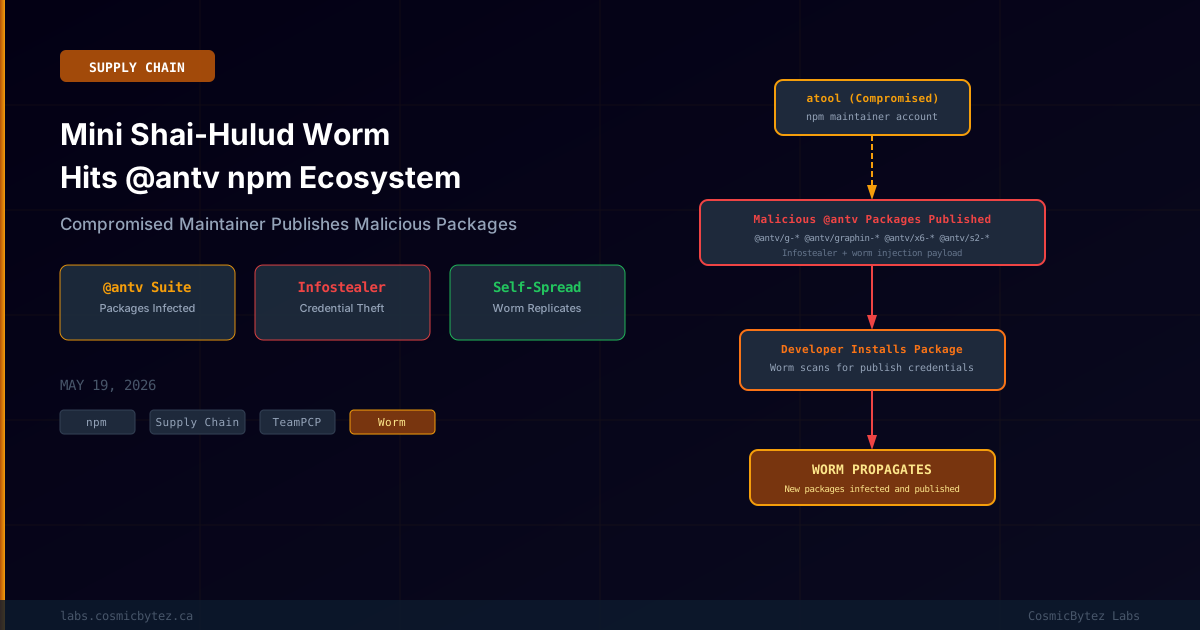
The Mini Shai-Hulud supply chain attack campaign has claimed another victim: researchers have discovered that threat actors compromised the atool npm maintainer account — responsible for publishing a significant portion of the @antv visualization library ecosystem — and used the access to push malicious package versions delivering infostealer payloads and worm injection code to developers' machines.
The @antv suite is a widely used collection of data visualization and graph analysis libraries developed by Ant Group (Alibaba's financial affiliate). Its components power dashboards, graph visualizations, and data analysis tools across thousands of production applications.
The @antv Ecosystem
The @antv (Ant Visualization) namespace on npm encompasses a large suite of interconnected JavaScript libraries for data visualization and graph computation:
@antv/g— a canvas/SVG rendering engine@antv/g6— graph visualization and network analysis@antv/graphin— React-based graph visualization built on G6@antv/x6— node-edge diagramming library@antv/s2— multi-dimensional data table visualization@antv/l7— geospatial data visualization
These packages are used by enterprise applications, analytics platforms, financial dashboards, and developer tools globally, with several packages exceeding hundreds of thousands of weekly downloads.
How the Attack Unfolded
According to The Hacker News, the attack follows the established Mini Shai-Hulud pattern:
- Account compromise: Threat actors gained access to the
atoolnpm maintainer account, which has publish rights across multiple@antvpackages - Malicious version publication: New versions of affected
@antvpackages were published containing the dual payload:- An infostealer component that scans the developer's machine for credentials, tokens, and sensitive configuration files
- A worm injection component that scans for
package.jsonfiles in nearby projects and, if npm publish credentials are found, republishes infected versions
- Propagation: Any developer who installs an infected
@antvpackage and has npm publish credentials stored locally becomes an unwitting participant in spreading the worm further through their own published packages
The attack specifically targets the atool account because it has maintainer access to a broad slice of the @antv ecosystem, meaning a single account compromise enables poisoning of many packages simultaneously.
Payload Analysis
The malicious packages reported by researchers deliver a two-stage payload consistent with the Mini Shai-Hulud campaign's established tooling:
Stage 1: Infostealer
The infostealer component activates at install time (via postinstall lifecycle hook) and targets:
- npm tokens —
.npmrcfiles in the home directory and project directories - Shell configuration —
.bashrc,.zshrc, and.profilefor exported environment variables containing API keys - Git credentials — stored credentials and SSH keys
- Cloud provider CLI configs — AWS
~/.aws/credentials, Azure~/.azure/, GCP~/.config/gcloud/ - IDE and tool configs — VS Code settings,
.envfiles in project directories
Harvested credentials are sent to an attacker-controlled command-and-control server.
Stage 2: Worm Injection
If the infostealer discovers valid npm publish credentials, the worm component:
- Scans parent directories for
package.jsonfiles - Injects itself as a dependency in found project manifests
- Attempts to publish new infected versions of any packages the victim maintains
- This creates new infection vectors that spread the attack to the victim's downstream package consumers
Affected Packages
The attack affects packages tied to the atool maintainer account within the @antv namespace. Developers should check whether any @antv packages in their dependency tree have versions published around the compromise window (mid-May 2026) and verify integrity via npm's provenance features or by inspecting the published tarball.
Use the following to audit your projects:
# Check for @antv packages in your dependency tree
npm ls | grep '@antv'

# Or in package.json
cat package.json | grep '@antv'

# Verify package integrity
npm auditImmediate Response Steps
For Developers Who Installed @antv Packages
1. Determine your exposure window
Check when you last ran npm install and whether any @antv packages were installed or updated during the compromise period.
2. Revoke npm tokens immediately
# List your npm tokens
npm token list

# Revoke all tokens (you will need to log in again)
npm token revoke <token-id>

# Or revoke all at once via the npm website: npmjs.com → Account Settings → Access Tokens3. Rotate cloud and API credentials
Assume any credentials stored in your shell config, .npmrc, or environment variables are compromised. Rotate:
- AWS/Azure/GCP credentials
- GitHub Personal Access Tokens
- Any service API keys referenced in
.envfiles or shell exports
4. Audit recently published packages
If you maintain npm packages, immediately check your published versions for unauthorized modifications:
# Compare latest published package with your local source
npm pack --dry-run
npm diff <package-name>@<version>5. Enable npm 2FA
Require two-factor authentication for all publish operations:
npm profile enable-2fa auth-and-writesFor Organizations
- Block or review
@antvinstalls in your npm private registry or Artifactory until affected versions are identified and removed - Require package provenance — npm now supports linking published packages to verified GitHub Actions workflows, making supply chain attacks easier to detect
- Implement CI/CD secret isolation — ensure CI/CD environments do not have access to production npm publish credentials
- Apply allowlisting in your private registry for
@antvpackages, requiring manual approval for new versions during the incident period
The Ongoing Mini Shai-Hulud Campaign
This attack is the latest in the Mini Shai-Hulud campaign wave that began with the TeamPCP group's compromise of TanStack packages in April 2026. Since TeamPCP publicly released the Shai-Hulud worm source code on May 15, 2026, the number of independent actors deploying variants has accelerated significantly.
Previous confirmed Mini Shai-Hulud targets include:
- TanStack query, router, and form packages
- Mistral AI npm packages (source code subsequently advertised for sale)
- Guardrails AI Python packages
- Checkmarx Jenkins AST plugin
- PyTorch Lightning and Intercom client packages
- Various SAP-related npm packages
The @antv compromise demonstrates that the campaign is broadening from individual high-profile packages to entire ecosystem namespaces — a shift that dramatically increases the potential blast radius of each attack.
npm Ecosystem Response
npm (GitHub) has been notified and is working to remove the malicious package versions. Package provenance enforcement and improved tag integrity features are being discussed as ecosystem-level mitigations.
However, the fundamental tension remains: npm's design prioritizes developer convenience over security, and the ability to publish new package versions through a compromised maintainer account with no additional verification creates a systemic vulnerability that individual package hardening cannot fully address.
References
- The Hacker News — Mini Shai-Hulud Pushes Malicious AntV npm Packages
- CosmicBytez Labs — Shai-Hulud Worm Clones Spread After Code Release
- CosmicBytez Labs — TeamPCP Releases Shai-Hulud Worm Source Code
- CosmicBytez Labs — Mini Shai-Hulud Worm Compromises TanStack, Mistral AI
- CosmicBytez Labs — OpenAI Confirms Security Breach in TanStack Supply Chain Attack