Overview
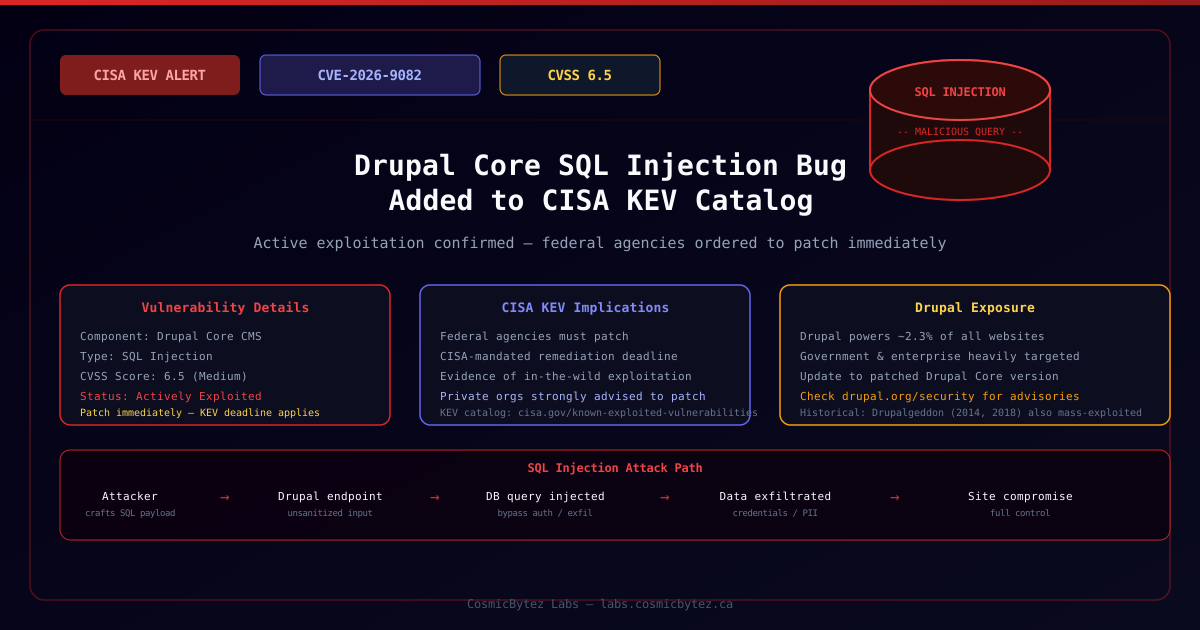
The U.S. Cybersecurity and Infrastructure Security Agency (CISA) has added a critical SQL injection vulnerability in Drupal Core to its Known Exploited Vulnerabilities (KEV) catalog after confirming evidence of active exploitation in the wild.
The flaw, tracked as CVE-2026-9082 (CVSS score: 6.5), affects Drupal's widely deployed content management system. Its addition to the KEV catalog triggers mandatory remediation timelines for U.S. federal agencies and serves as a strong signal to private organizations to prioritize patching.
Vulnerability Details
| Field | Value |
|---|---|
| CVE ID | CVE-2026-9082 |
| CVSS Score | 6.5 (Medium) |
| Vulnerability Type | SQL Injection |
| Affected Product | Drupal Core |
| Exploitation Status | Actively exploited in the wild |
| CISA KEV Added | May 23, 2026 |
SQL injection vulnerabilities allow attackers to manipulate database queries by injecting malicious SQL code through unsanitized user input. Depending on the implementation, successful exploitation can lead to:
- Authentication bypass — logging in without valid credentials
- Data exfiltration — reading sensitive database contents (user credentials, PII)
- Data manipulation — modifying or deleting database records
- In some cases, remote code execution — escalating to full server compromise
CISA KEV and What It Means
The CISA Known Exploited Vulnerabilities (KEV) catalog is a curated list of security flaws that have been confirmed as actively exploited by threat actors in real-world attacks. Addition to the KEV catalog carries significant weight:
For federal agencies: Under Binding Operational Directive (BOD) 22-01, all U.S. federal civilian executive branch (FCEB) agencies are required to remediate KEV vulnerabilities within CISA's specified timeframes — typically 2–4 weeks depending on severity.
For private sector: While not legally binding, CISA strongly recommends that all organizations treat KEV entries as high-priority. Vendors, critical infrastructure operators, and any organization running Drupal should patch immediately.
Drupal's Attack Surface
Drupal is one of the world's most widely used open-source content management systems, powering an estimated 2.3% of all websites globally. Its user base includes:
- Government agencies across North America, Europe, and Australia
- Universities and academic institutions
- Healthcare organizations
- Enterprise and Fortune 500 companies
This broad deployment, combined with Drupal's history of high-impact vulnerabilities (Drupalgeddon in 2014 and 2018 each triggered mass exploitation campaigns), makes CVE-2026-9082 a high-value target for opportunistic threat actors and sophisticated groups alike.
Historical Context: Drupalgeddon Pattern
Drupal has been targeted in mass exploitation campaigns before. When critical vulnerabilities were disclosed in 2014 (SA-CORE-2014-005) and 2018 (CVE-2018-7600), attackers began exploiting unpatched installations within hours of public disclosure — before most administrators could apply patches.
The current situation with CVE-2026-9082 follows a similar pattern:
- Drupal patches released alongside public advisory
- Technical details enabling exploitation quickly circulate
- Automated scanning and exploitation begins
- CISA confirms exploitation and adds to KEV
- Organizations that haven't patched are now actively targeted
Remediation Actions
Organizations running Drupal must act immediately:
Immediate steps:
- Update Drupal Core to the latest patched release per the official Drupal security advisory at drupal.org/security
- If immediate patching is impossible, consider taking the site offline or restricting access temporarily
- Enable web application firewall (WAF) rules targeting SQL injection payloads
Post-patch verification:
- Review web server and database access logs for anomalous SQL patterns
- Look for signs of data exfiltration — unusual outbound connections or database query spikes
- Audit user accounts for unauthorized additions or privilege escalations
- Check for web shells or backdoors in the Drupal filesystem
Ongoing:
- Subscribe to Drupal security advisories at drupal.org/security
- Monitor CISA KEV for additional Drupal entries
- Implement database activity monitoring to detect injection attempts
Sources
- The Hacker News — Drupal Core SQL Injection Bug Actively Exploited, Added to CISA KEV