Overview
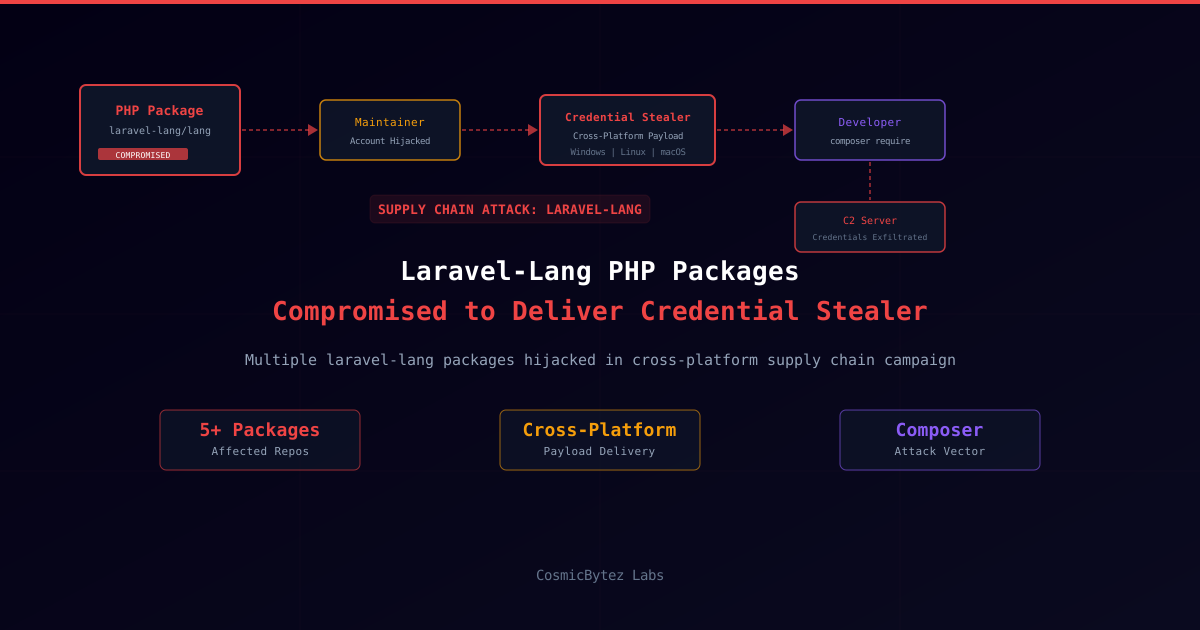
Cybersecurity researchers have uncovered a new software supply chain attack targeting the Laravel-Lang PHP package organization. Multiple widely used packages have been poisoned to deliver a comprehensive credential-stealing framework capable of running on Windows, Linux, and macOS environments.
The campaign targets developers who install Laravel internationalization packages via Composer — a common workflow for Laravel applications built for multilingual audiences.
Affected Packages
Researchers identified the following Laravel-Lang packages as compromised:
| Package | Purpose |
|---|---|
laravel-lang/lang | Core language files for Laravel |
laravel-lang/http-statuses | HTTP status message translations |
Additional packages in the laravel-lang namespace may also be affected. Developers should audit all laravel-lang/* dependencies in their projects.
Attack Mechanics
The attackers executed a classic maintainer account hijacking technique:
- Account compromise — The threat actors gained access to a package maintainer's credentials or session token
- Malicious version push — Poisoned package versions containing a credential-stealing payload were published to Packagist (the primary PHP package repository)
- Trojanized install — Developers running
composer require laravel-lang/*orcomposer updatewould silently pull in the malicious package - Credential harvesting — The payload collects stored browser credentials, SSH keys, API tokens, and environment variables
- Exfiltration — Stolen data is sent to attacker-controlled command-and-control infrastructure
The stealer framework is described as cross-platform, meaning a single payload delivery mechanism targets all major operating systems where PHP developers work.
Scope and Impact
Laravel is one of the most popular PHP frameworks in the world, with millions of active installations. The laravel-lang/lang package alone has been downloaded hundreds of millions of times via Packagist. Key impact areas include:
- Web application developers using Laravel for enterprise and SaaS applications
- DevOps and CI/CD pipelines that automatically pull updated dependencies during build processes
- Cloud-hosted environments where stolen credentials could enable lateral movement or privilege escalation
- Open-source contributors whose personal development machines may also be targeted
Organizations with automated Composer update processes are at particularly elevated risk — the poisoned packages could have been installed without any manual developer interaction.
Detection and Remediation
Immediate steps for affected organizations:
- Audit Composer lock files — Check
composer.lockfor recent updates tolaravel-langpackages and cross-reference against known-malicious version numbers - Rotate all credentials — Treat all credentials accessible from affected developer machines as compromised: API keys, database passwords, SSH keys, cloud credentials
- Review CI/CD secrets — If build pipelines pulled affected packages, assume pipeline secrets (GitHub Actions, GitLab CI tokens, etc.) are compromised
- Scan for malware persistence — Run endpoint detection tools to identify any remaining malware artifacts or persistence mechanisms
- Check environment files —
.envfiles containing database connection strings and API keys are prime targets for this type of stealer
Indicators to look for:
- Unexpected outbound connections from developer machines or CI systems
- New or modified files in PHP vendor directories with obfuscated code
- Unexpected processes spawning from
phpor Composer-related processes
Broader Supply Chain Context
This attack follows a pattern seen repeatedly in 2025–2026 against package ecosystems including npm, PyPI, RubyGems, and now Packagist. Key trends researchers have noted:
- Maintainer account takeovers are increasingly the preferred vector — attackers target individual developer credentials rather than exploiting the repository infrastructure itself
- Cross-platform payloads maximize the blast radius by ensuring the malware runs regardless of the victim's OS
- CI/CD pipeline targeting multiplies impact by potentially compromising entire organizations through a single developer's dependencies
Sources
- The Hacker News — Laravel-Lang PHP Packages Compromised to Deliver Cross-Platform Credential Stealer