Overview
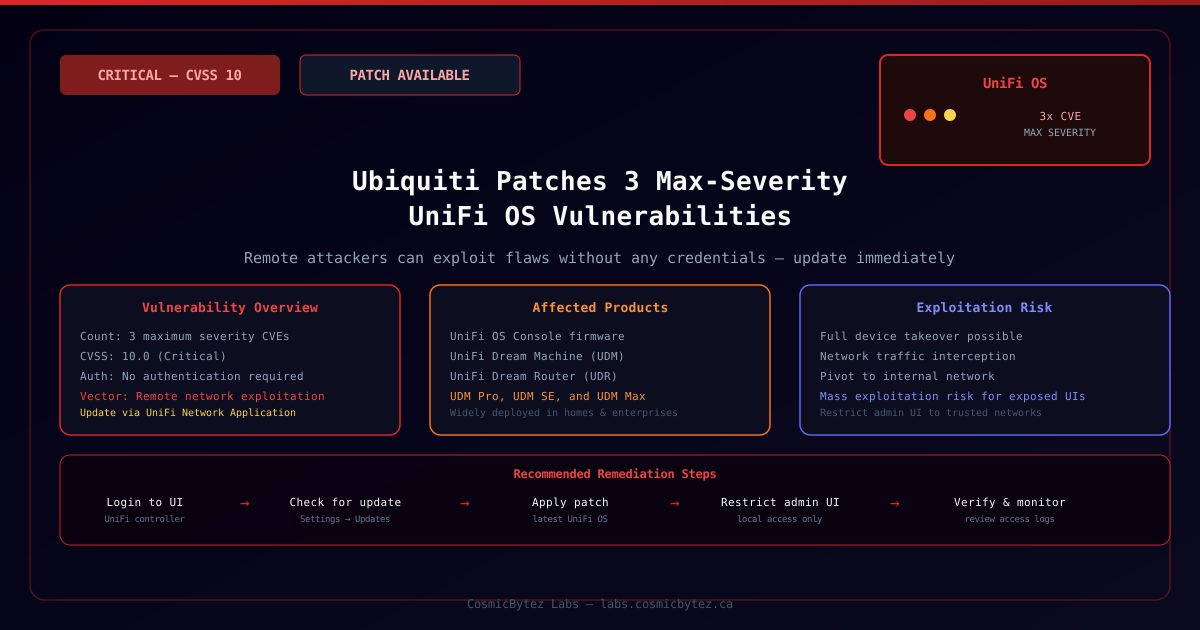
Ubiquiti has released critical firmware updates for UniFi OS to address three maximum severity (CVSS 10.0) vulnerabilities that can be exploited by remote, unauthenticated attackers. Successful exploitation could grant full control of affected UniFi network equipment — a serious risk for both home users and enterprise deployments.
Organizations and individuals using UniFi Dream Machines, Dream Routers, and other UniFi OS-based devices should apply the updates immediately.
Vulnerability Details
Ubiquiti disclosed three distinct vulnerabilities, all rated at the maximum CVSS score of 10.0 (Critical):
| Field | Value |
|---|---|
| Severity | Critical — CVSS 10.0 (all three) |
| Authentication | Not required |
| Attack Vector | Network (remote) |
| Affected Platform | UniFi OS |
| Patch Available | Yes — latest UniFi OS firmware |
While Ubiquiti has not published full technical details of the individual CVEs — standard practice to reduce immediate exploitation risk before widespread patching — the maximum severity scores indicate that:
- Exploitation requires no credentials and no user interaction
- Successful exploitation results in complete device compromise
- The vulnerabilities are exploitable over the network without physical access
Affected Devices
The vulnerabilities affect all devices running UniFi OS, which includes:
- UniFi Dream Machine (UDM) — home/SMB all-in-one gateway
- UniFi Dream Machine Pro (UDM-Pro) — rack-mount enterprise gateway
- UniFi Dream Machine SE (UDM-SE) — gateway with PoE switch integration
- UniFi Dream Machine Max (UDM-Max) — high-performance multi-WAN gateway
- UniFi Dream Router (UDR) — mesh router with UniFi OS
- Other UniFi OS Console devices — including Cloud Key Gen2 and Express variants
Why This Matters
Ubiquiti UniFi equipment is among the most widely deployed networking hardware in the world, popular across:
- Home networks for power users and prosumers
- Small and medium businesses seeking enterprise-grade features at lower cost
- Enterprise environments deploying UniFi at scale for switching, wireless, and routing
- Managed service providers (MSPs) managing customer networks remotely
A CVSS 10.0 unauthenticated remote vulnerability in a platform this widespread is a high-priority patching event. Threat actors routinely scan for exposed management interfaces and will attempt mass exploitation once technical details circulate.
Risk Scenarios
If exploited, attackers could:
- Take full control of the device — gaining administrator access to the UniFi OS console
- Intercept and manipulate network traffic — enabling man-in-the-middle attacks
- Pivot into the internal network — using the compromised gateway as a staging point
- Disable security controls — disabling firewall rules, IDS/IPS, or VPN configurations
- Persist across reboots — potentially implanting backdoors if root is achieved
Remediation
Immediate Action Required
Update to the latest UniFi OS firmware immediately:
- Log in to your UniFi Network Application or UniFi OS console
- Navigate to Settings → System → Updates (or the equivalent path for your firmware version)
- Apply all available firmware updates for your UniFi OS devices
- Reboot devices as prompted
Ubiquiti also pushes firmware updates through the Ubiquiti Community releases page and the official UniFi Network Application.
Defense in Depth
Even after patching, reduce future exposure:
- Restrict admin UI access to trusted LAN addresses only — do not expose the UniFi management interface directly to the internet
- Enable two-factor authentication (2FA) on your Ubiquiti account and UniFi OS login
- Use the UniFi Network Application hosted internally rather than the cloud portal where possible
- Monitor for anomalous connections to management interfaces
- Segment the management network — isolate UniFi OS consoles on a dedicated VLAN
Historical Context
This is not the first time Ubiquiti has faced serious security vulnerabilities. A 2021 breach at Ubiquiti exposed customer credentials and raised concerns about cloud-connected device management. The current advisory underscores the importance of:
- Applying firmware patches promptly for network infrastructure
- Limiting management interface exposure
- Maintaining a hardware inventory to know which devices require updates
Sources
- BleepingComputer — Ubiquiti Patches Three Max Severity UniFi OS Vulnerabilities