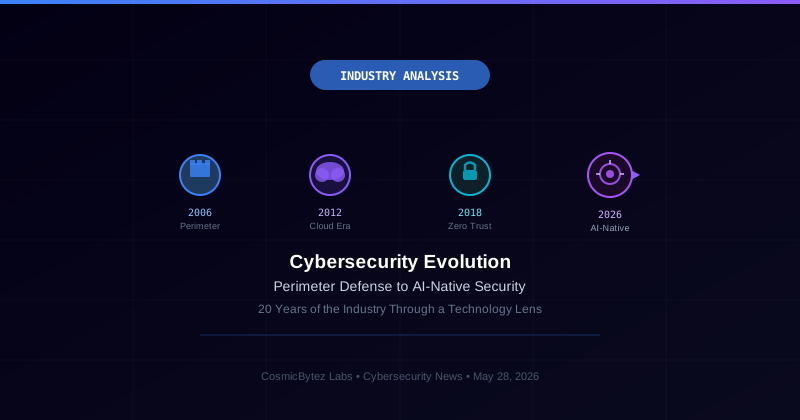
Dark Reading's 20th anniversary has prompted a compelling retrospective on how the cybersecurity industry evolved through technology eras — from the rigid perimeter defenses of the mid-2000s to the AI-native, identity-first architectures defining 2026.
The journey reflects not just technological change but a fundamental rethinking of where trust lives, what the "edge" of an organization means, and how defenders must reason about threats at scale.
Era 1: The Perimeter Era (2006–2011)
When Dark Reading launched in 2006, the dominant model was castle-and-moat: everything inside the corporate network was trusted, and everything outside was untrusted. Security teams invested in:
- Firewalls as the primary control point
- Antivirus on every endpoint
- Intrusion Detection Systems (IDS) watching network traffic
- DMZ architectures segmenting public-facing servers
The threat landscape was comparatively simpler: viruses spread via email attachments and USB drives, worms propagated across networks, and motivated attackers (often state-sponsored or organized crime) used targeted exploits against perimeter services.
The assumption was that if you could keep attackers outside the firewall, you were secure. This assumption began breaking down almost immediately as mobile devices, remote access VPNs, and early SaaS adoption created perforations in the perimeter.
Era 2: The Cloud and Mobility Disruption (2012–2016)
The rise of cloud computing and the BYOD (bring your own device) movement shattered the perimeter model. Corporate data no longer lived exclusively in on-premises data centers — it resided in Salesforce, Office 365, Google Workspace, Dropbox, and hundreds of other SaaS applications. Employees accessed sensitive systems from personal smartphones on home networks.
Security teams scrambled to adapt:
- Cloud Access Security Brokers (CASBs) emerged to provide visibility into SaaS usage
- Mobile Device Management (MDM) attempted to extend corporate policy to personal devices
- Security Information and Event Management (SIEM) platforms aggregated logs from a growing ecosystem of systems
- Encryption became a baseline expectation rather than a premium feature
The era also saw the rise of Advanced Persistent Threats (APTs) — nation-state and criminal groups capable of dwelling in networks for months or years undetected. The Sony Pictures breach (2014), Target's point-of-sale compromise (2013), and the OPM breach (2015) demonstrated that perimeter-focused organizations were catastrophically vulnerable to patient, sophisticated attackers.
Era 3: Zero Trust and the Death of Implicit Trust (2017–2021)
The zero trust framework — articulated by Forrester's John Kindervag as early as 2010 but broadly adopted in the late 2010s — represented the industry's acknowledgment that perimeter thinking was fundamentally broken. The core premise: never trust, always verify, regardless of whether a user, device, or workload is inside or outside the traditional network boundary.
Zero trust translated into concrete architectural shifts:
- Identity became the new perimeter — multi-factor authentication (MFA) and identity providers (IdPs) moved to the center of security architecture
- Microsegmentation replaced flat network architectures, limiting lateral movement
- Software-defined perimeter and ZTNA (Zero Trust Network Access) replaced legacy VPNs
- Privileged Access Management (PAM) gained prominence as credential theft became the dominant initial access technique
- EDR (Endpoint Detection and Response) supplanted traditional AV, enabling behavioral detection and active response
The SolarWinds supply chain attack (2020) and the Colonial Pipeline ransomware attack (2021) — each exploiting trust relationships and credential access rather than traditional perimeter breaches — validated zero trust's urgency.
Era 4: The Cloud-Native and DevSecOps Convergence (2022–2024)
As organizations completed cloud migrations accelerated by the COVID-19 pandemic, security had to integrate into development pipelines rather than existing as a bolt-on after deployment.
DevSecOps emerged as the dominant philosophy: security shifted left into code review, infrastructure-as-code scanning, container security, and software supply chain integrity. The Log4Shell vulnerability (2021) and subsequent supply chain attacks made Software Bill of Materials (SBOM) and dependency security mainstream concerns.
Key developments:
- CNAPP (Cloud-Native Application Protection Platforms) unified workload protection, CSPM, and CIEM
- Supply chain security frameworks (SLSA, Sigstore) addressed the growing threat of compromised open-source dependencies
- API security became a discipline as API-driven architectures created vast new attack surface
- Ransomware-as-a-Service commoditized sophisticated attacks, enabling criminal actors without technical depth to deploy enterprise-grade ransomware
Era 5: AI-Native Security (2025–Present)
The current era is defined by artificial intelligence on both sides of the equation. Attackers leverage AI to generate convincing phishing content, automate vulnerability discovery, accelerate exploit development, and scale social engineering at unprecedented volume. Defenders have responded by embedding AI throughout the security stack.
AI for defense:
- AI-powered anomaly detection identifies subtle behavioral indicators of compromise that rule-based systems miss
- Large language model-based security assistants (including Anthropic's Claude Mythos) autonomously discover vulnerabilities in production codebases at scale
- Automated threat hunting correlates signals across massive telemetry datasets without manual analyst bottlenecks
- AI-generated incident reports and runbooks reduce mean time to respond
AI creating new attack surface:
- LLM prompt injection enables attackers to manipulate AI agents into exfiltrating data or executing unauthorized actions
- AI-generated deepfakes power CEO fraud and identity verification bypasses
- Model poisoning and supply chain attacks target AI systems themselves
- AI-accelerated exploit development collapses the window between vulnerability disclosure and weaponization from days to hours
The Verizon DBIR 2026 confirmed a milestone: vulnerability exploitation has overtaken credential theft as the top initial access vector — driven in significant part by AI-assisted scanning and exploitation tools available to attackers at all skill levels.
What Hasn't Changed
Amid technological evolution, certain fundamentals have persisted:
- The human element remains the most exploited vector — phishing, social engineering, and credential theft underpin the majority of breaches regardless of era
- Patch management remains critically underperformed — known vulnerabilities with available patches continue to be responsible for a disproportionate share of successful attacks
- Visibility is still the prerequisite for security — you cannot defend what you cannot see
- Security culture at the organizational level determines outcomes more than any single technology
Looking Forward
The next decade will likely see security continue to dissolve into the fabric of infrastructure rather than existing as a separate layer. AI-native detection and response will become baseline capability. Post-quantum cryptography will transition from research to deployment urgency as quantum computing advances. And the fundamental tension between operational convenience and security will remain the practitioner's constant challenge.
Twenty years of cybersecurity coverage has traced a field that has grown from a niche technical discipline to a board-level strategic imperative. The evolution shows no sign of slowing.
Source
- Dark Reading: "Cybersecurity Evolution: How We Went From Perimeter Defense to AI-Native Security" (May 27, 2026)