Overview
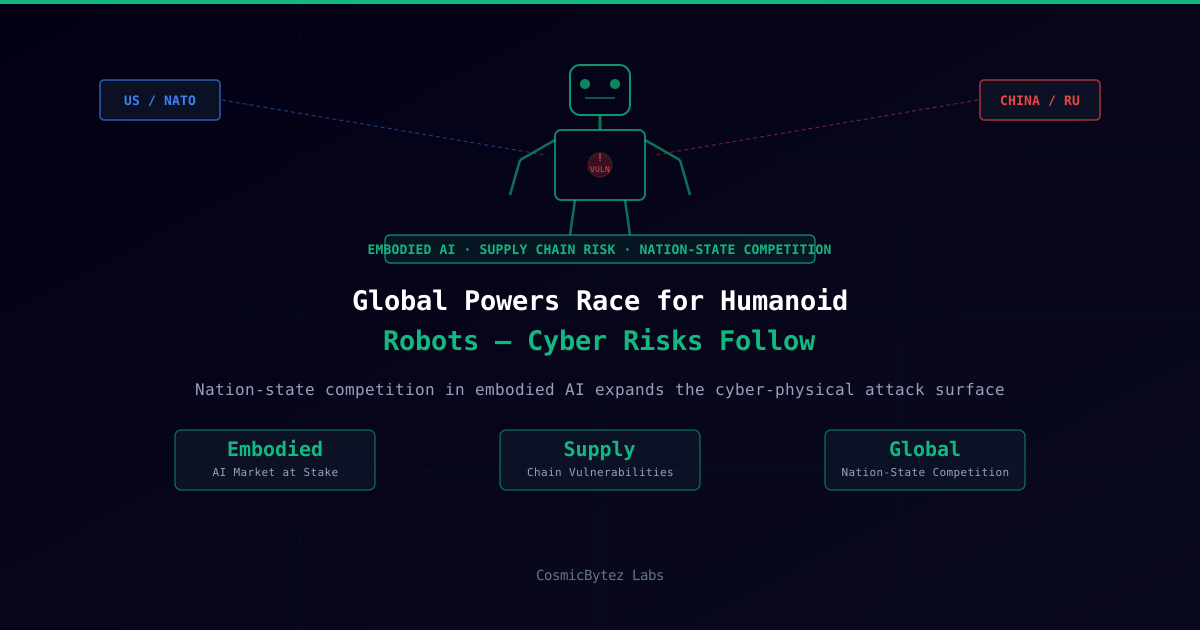
As the United States, China, and other global powers accelerate investment in humanoid robotics and embodied AI, cybersecurity experts are raising alarms about the nascent but expanding cyber-physical attack surface these systems introduce. Analysis from Dark Reading highlights how the geopolitical race for dominance in the embodied AI market is creating new supply chain vulnerabilities and security risks that the industry is not yet equipped to handle.
Humanoid robots — machines designed to operate in environments built for humans — are transitioning from science fiction to deployed reality. The implications for cybersecurity are profound: these devices can operate in physical spaces, manipulate objects, and interact with industrial and critical infrastructure systems.
The Embodied AI Race
The global competition in humanoid robotics is intensifying rapidly:
- United States: Companies like Boston Dynamics, Figure AI, and Tesla's Optimus program are developing general-purpose humanoid platforms with backing from major defense and commercial interests
- China: Chinese manufacturers are deploying humanoid robots at scale in factories, with strong state backing and aggressive commercialization timelines
- Europe and others: Multiple nations are investing in robotics as a strategic technology sector, with NATO evaluating military applications
This competition parallels the broader AI arms race but adds a critical physical dimension: humanoid robots can move through the physical world, carry out tasks autonomously, and — if compromised — become dangerous tools in an attacker's hands.
The Cyber-Risk Landscape
Supply Chain Vulnerabilities
Like any complex technology system, humanoid robots depend on extensive supply chains:
- Semiconductor components from multiple countries and manufacturers
- Software frameworks often built on open-source foundations
- AI models trained on data that may have integrity concerns
- Communication protocols for remote operation and fleet management
Each link in this chain represents a potential attack surface. A compromised hardware component, a backdoored software update, or a poisoned AI model could have physical consequences if the robot operates in a sensitive environment.
Attack Scenarios
| Threat Vector | Potential Impact |
|---|---|
| Remote code execution via robot management API | Unauthorized physical access or dangerous movement |
| AI model poisoning | Robot misidentifies objects or persons, causing harm or accidents |
| Supply chain compromise | Malicious firmware embedded at manufacturing stage |
| C2 hijacking | Fleet of robots controlled by adversary |
| Sensor spoofing | Manipulating robot perception to cause errors or accidents |
| Data exfiltration | Camera and microphone data stolen from sensitive environments |
Nation-State Exploitation
The nation-state dimension adds a persistent threat: adversaries with access to humanoid robot supply chains — particularly at the hardware and firmware level — could embed persistent access mechanisms that survive software updates. This mirrors concerns already seen with telecommunications equipment and other critical technology infrastructure.
Security Challenges Unique to Humanoid Robots
Humanoid robots introduce security challenges that differ from traditional IT systems:
- Physical consequences of compromise — unlike a hacked server, a compromised humanoid can cause physical harm, property damage, or safety incidents
- Long operational lifetimes — industrial robots are often deployed for 10-20 years, creating long patch lifecycle challenges
- Real-time operating constraints — security controls cannot introduce latency that impairs physical safety systems
- Sensor data sensitivity — robots collect rich environmental data (video, audio, lidar) that is highly sensitive if exfiltrated
- Air-gap expectations vs. connectivity reality — operators often assume physical systems are isolated, but modern robots require network connectivity for updates, fleet management, and AI model refreshes
Industry Recommendations
Security experts advising organizations deploying humanoid robotics suggest:
- Treat robots as critical infrastructure endpoints — apply the same security standards as industrial control systems (ICS/OT)
- Demand software bill of materials (SBOM) from robot manufacturers to understand all software components and their provenance
- Implement network segmentation — ensure robot fleets are isolated from corporate IT networks
- Require signed firmware updates and establish out-of-band verification mechanisms
- Monitor for anomalous behavior — establish behavioral baselines and alert on deviations in movement, network communications, or sensor outputs
- Evaluate supply chain provenance — assess the manufacturing origins of critical components before deployment in sensitive environments
The Broader Cyber-Physical Frontier
The humanoid robotics discussion is part of a larger trend: cyber-physical security is becoming one of the most consequential security domains as AI and automation extend into the physical world. From autonomous vehicles and industrial robotics to smart infrastructure and drones, the convergence of software-defined systems with physical actuators is creating attack surfaces with real-world consequences that the industry must address proactively.
The global powers exploring humanoid robots are, in effect, also building new frontiers for cyber conflict — and the security community needs to be ready.
Sources
- Dark Reading — As Global Powers Explore Humanoid Robots, Cyber-Risk Looms