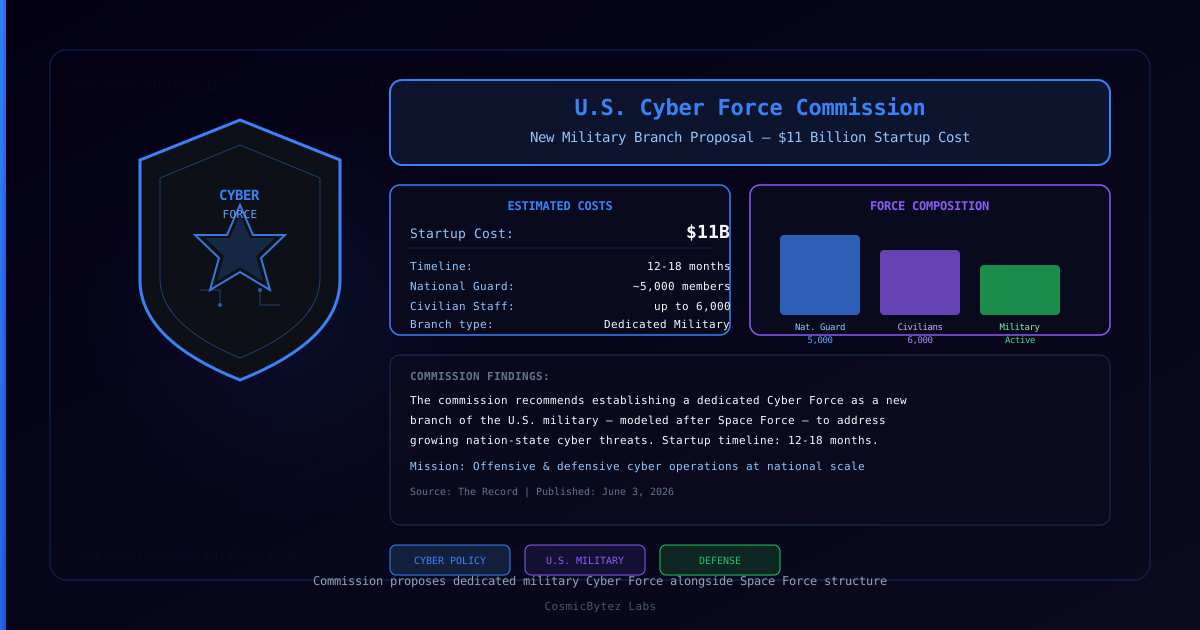
A U.S. government commission examining the creation of a dedicated military Cyber Force has put a price tag on the endeavor: up to $11 billion to get the new branch up and running, with an estimated timeline of 12 to 18 months to achieve initial operational capability.
The commission's findings, reported by The Record, outline a substantial force structure that would include roughly 5,000 members of the National Guard and up to 6,000 civilians, alongside active-duty military personnel drawn from the existing Cyber Command workforce.
What Is Being Proposed
The proposed Cyber Force would be established as a dedicated military branch focused exclusively on offensive and defensive cyber operations at national scale — conceptually similar to how the U.S. Space Force was carved out of the Air Force in 2019. Unlike existing cyber units distributed across Army Cyber Command, Navy Cyber Defense Operations Command, and similar service components, a standalone Cyber Force would consolidate resources and command authority under a single organizational structure.
The commission envisions the force handling:
- Offensive cyber operations — at the direction of national command authority and Cyber Command
- Defensive cyber operations — protecting critical infrastructure and DoD networks
- Cyber intelligence — integrating signals intelligence with cyber effects
- Interagency coordination — working with CISA, NSA, and intelligence community partners
Cost and Timeline Breakdown
The $9B–$11B startup estimate covers:
- Headquarters establishment and command structure buildout
- Training pipelines for a new career field pathway separate from existing service branches
- Infrastructure and tool acquisition — offensive and defensive cyber platforms, ranges, and simulation environments
- Personnel recruitment — drawing from existing Cyber Command billets and bringing in civilian talent
- Integration costs — standing up interoperability with NSA, CISA, and allied partners
The 12-to-18-month timeline reflects the minimum needed to reach initial operating capability — full operational capability would take longer.
Why Now
The proposal comes amid growing concern that the current distributed cyber force model is creating coordination friction at a time when adversaries — particularly China, Russia, North Korea, and Iran — are executing increasingly sophisticated and coordinated cyber campaigns.
High-profile incidents in recent years, including sustained intrusions into U.S. telecommunications infrastructure, attacks on critical infrastructure, and supply chain compromises affecting government networks, have intensified calls for a more streamlined and better-resourced national cyber posture.
Proponents argue that a dedicated Cyber Force would:
- Elevate cyber as a warfighting domain on par with air, land, sea, and space
- Consolidate fragmented expertise currently spread across multiple service branches
- Improve recruiting and retention by creating dedicated career paths for cyber specialists
- Accelerate decision-making by reducing inter-service coordination overhead during crisis operations
The Counterarguments
Critics of the Cyber Force concept have long argued that consolidation creates its own problems:
- Breaking integration: Cyber effects are most powerful when tightly integrated with the warfighting domains they support — separating cyber into its own branch could sever those relationships
- Startup risk: Standing up a new branch is enormously disruptive; the Space Force transition took years and consumed significant political capital
- Duplicate overhead: A new four-star command, Joint Chiefs seat, and service secretary adds bureaucratic layers without necessarily adding capability
- Talent drain: Pulling experienced cyber operators out of existing service branches to staff the new force may hollow out cyber capacity in the near term
Congressional and Administration Response
The commission's report is likely to land in a contested political environment. Defense budget pressures and competing priorities mean that an $11 billion startup commitment — on top of existing Cyber Command funding — will face scrutiny on Capitol Hill. The administration has not yet indicated whether it will formally embrace or reject the commission's recommendation.
What Happens Next
The commission's findings are advisory. Moving from recommendation to reality would require:
- Congressional authorization in the National Defense Authorization Act (NDAA)
- Appropriations to fund the $9B–$11B startup cost
- DoD implementation planning — potentially a multi-year transition period
- Legislation formally establishing the Cyber Force as a branch of the armed services
Given historical precedent with the Space Force (authorized 2019, still maturing organizationally), a realistic estimate for a fully operational Cyber Force — if approved — would be mid-to-late 2020s at the earliest.
Source: The Record — Published June 3, 2026