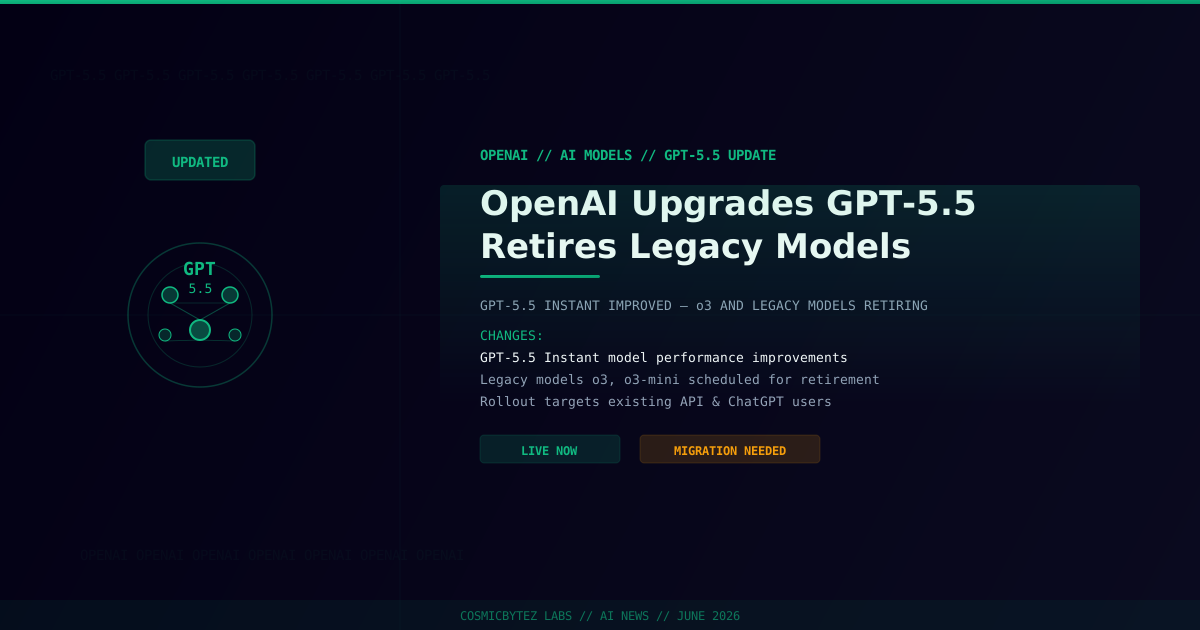
OpenAI has announced an update to its GPT-5.5 Instant model, delivering improved reasoning and response quality, alongside a broader plan to retire several legacy ChatGPT models in the coming weeks. The move signals OpenAI's accelerating push to consolidate its AI lineup around the GPT-5 family.
What's Changing
GPT-5.5 Instant Improvements
The latest update to GPT-5.5 Instant focuses on:
- Enhanced reasoning speed for multi-step problem solving
- Improved instruction following in complex, long-context conversations
- Reduced hallucination rates across factual and coding domains
- Better code generation with tighter adherence to requested patterns
OpenAI describes the update as an incremental improvement to the existing model rather than a new model release, meaning developers using the gpt-5.5-instant API endpoint will automatically receive the improved version with no configuration changes required.
Legacy Model Retirement Schedule
As part of the transition toward the GPT-5 family, OpenAI has announced the retirement of several older models:
| Model | Retirement Date |
|---|---|
| o3 | TBD — imminent |
| o3-mini | TBD — imminent |
| GPT-4.1 mini (original) | Deprecated |
| Earlier GPT-4o variants | Phased out |
Developers still relying on these models will need to migrate to supported alternatives before the cutoff dates to avoid service interruptions.
Recommended Migration Paths
OpenAI recommends the following migration targets for affected users:
- o3 / o3-mini users → Migrate to GPT-5.5 Instant for speed-optimized workloads, or GPT-5 for maximum capability
- GPT-4.1 mini users → GPT-5.5 Instant offers comparable cost efficiency with significantly improved performance
- Older GPT-4o users → GPT-5 or GPT-5.5 depending on latency requirements
# Before: legacy model reference
response = client.chat.completions.create(
    model="o3-mini",
    messages=[{"role": "user", "content": "Explain quantum entanglement"}]
)

# After: migrate to GPT-5.5 Instant
response = client.chat.completions.create(
    model="gpt-5.5-instant",
    messages=[{"role": "user", "content": "Explain quantum entanglement"}]
)Context: AI Model Landscape in 2026
OpenAI's rapid model iteration reflects the intensifying competition in the large language model space. Following Google's Gemini 2.5 releases, Anthropic's Claude 4 family, and Meta's Llama 4 models, OpenAI has been under pressure to ship improvements faster than its traditional annual release cadence.
The GPT-5.5 update comes just weeks after OpenAI launched GPT-5 Turbo and announced Codex-2, its specialized coding model. The simultaneous retirement of older reasoning models like o3 suggests OpenAI believes the GPT-5 family's native reasoning capabilities have made separate reasoning-focused model variants less necessary.
Security Considerations
The model transition also has security implications. Legacy models have known jailbreak vectors and prompt injection patterns that researchers have catalogued extensively. Migrating to newer models can improve a platform's baseline resistance to adversarial prompting — though it simultaneously introduces new attack surfaces that have yet to be fully characterized by the security community.
Organizations deploying OpenAI models in production should:
- Test migrated workloads against their existing red team prompt libraries before cutover
- Review API rate limits — new model tiers may have different throughput caps
- Audit cost implications — GPT-5.5 pricing differs from o3-mini for high-volume workloads
- Update content filtering configurations if relying on model-specific moderation behavior
What This Means for Developers
For most API users, the GPT-5.5 Instant update is transparent — improved outputs with no code changes. However, teams using deprecated models should prioritize migration planning now to avoid scrambling when retirement dates are confirmed.
OpenAI's model lifecycle page is the authoritative source for deprecation timelines, and developers are encouraged to monitor it weekly as the company continues its rapid release cadence.
OpenAI's model retirement schedule and updated pricing are available in the OpenAI platform documentation.