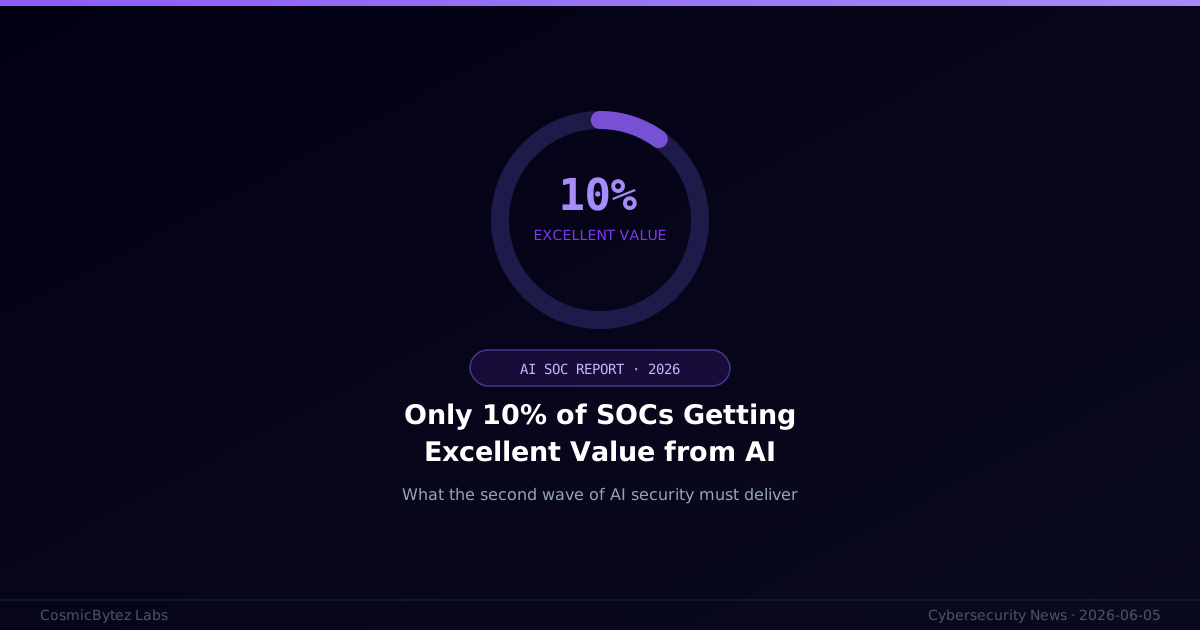
Eighteen months ago, the AI-powered Security Operations Center (SOC) was a marketing talking point. Today it's a budget line item. Billions of dollars are flowing into AI-powered security platforms, agentic SOC tools, and AI co-pilots embedded at every layer of enterprise security — yet a new analysis reveals a stark disconnect: only 10% of SOCs report getting excellent value from their AI investments.
This figure, drawn from research surveying security operations teams globally, signals that the first wave of AI deployment in cybersecurity has not delivered on its promises — and raises an important question: what must the second wave of AI in security actually do to justify the investment?
The State of AI in Security Operations
The past 18 months have seen rapid adoption of AI capabilities across security tooling:
- SIEM and SOAR platforms with embedded AI triage and alert correlation
- AI co-pilots built into EDR, NDR, and cloud security tools
- Dedicated agentic SOC platforms promising autonomous investigation and response
- Threat intelligence enrichment via large language models
Despite this wave of AI integration, the operational reality inside most SOCs tells a different story. Teams report:
- Alert noise reduction that is modest at best
- False positive rates remaining high despite AI filtering
- AI-generated summaries that add steps rather than reduce analyst workload
- Integration friction between AI capabilities and existing analyst workflows
- Trust deficits — analysts are reluctant to act on AI recommendations without manual verification
The result is that most SOC teams are using AI as a supplementary feature rather than a force multiplier.
Why the First Wave Fell Short
The Triage Trap
The majority of first-generation AI SOC deployments focused on alert triage — using AI to score, correlate, and prioritize the flood of alerts generated by existing security tools. While this addressed a real pain point, the approach had fundamental limitations:
- AI trained on historical patterns struggles with novel attack techniques
- Alert correlation is only as good as the underlying detection logic
- Triage automation does not address the investigation and response bottlenecks that follow
The Co-Pilot Problem
AI co-pilots embedded in security tools were designed to assist analysts with contextual enrichment, suggested queries, and summarized findings. In practice, many teams found:
- Co-pilots generated plausible-sounding but incomplete or inaccurate analysis
- Analysts spent time verifying AI outputs rather than investigating threats
- Integration with proprietary data lakes and internal threat intelligence was limited
- Co-pilots were optimized for demos, not for the messy reality of production SOC environments
The Agentic AI Gap
The newest category — agentic SOC platforms claiming autonomous investigation and response — promises the most transformative capability but carries the highest risk of failure if deployed without appropriate guardrails, training data, and workflow integration.
Early agentic deployments have highlighted challenges around:
- Autonomy boundaries — when should the agent act vs. escalate to a human?
- Explainability — can analysts understand and audit what the agent did?
- False action risk — incorrect autonomous responses can create new incidents
- Context limitations — agents with narrow context windows miss cross-environment signals
What the Second Wave Must Deliver
Researchers and practitioners agree on several requirements for AI in security operations to move from 10% excellent-value adoption to broad operational effectiveness:
1. Outcome-Oriented Design
AI tools must be designed around measurable SOC outcomes — mean time to detect (MTTD), mean time to respond (MTTR), analyst hours per incident, false positive rate — rather than feature demonstrations. Security leaders should demand vendors provide quantitative outcome data from production deployments, not lab benchmarks.
2. End-to-End Workflow Integration
The second wave cannot treat AI as a bolt-on feature. Effective AI in SOC operations must integrate across the full investigation workflow:
- Alert intake and deduplication
- Contextual enrichment from SIEM, EDR, threat intel, and identity systems
- Hypothesis generation and investigation automation
- Evidence gathering and timeline construction
- Response recommendation with appropriate confidence scoring
- Human-in-the-loop escalation paths
3. Trust Calibration
Analyst trust is the most underrated factor in AI SOC adoption. Tools must be transparent about confidence levels, clearly flag when they are operating at the edges of their training, and make it easy for analysts to override or correct AI decisions. Trust is built incrementally — autonomous agents should start with low-stakes tasks and expand scope as reliability is demonstrated.
4. Adversarial Robustness
As AI becomes more prevalent in SOC operations, adversaries will adapt to evade AI-based detection. The second wave of security AI must be designed with adversarial robustness in mind — including:
- Resistance to adversarial alert crafting designed to lower AI confidence scores
- Detection of AI evasion techniques (fragmented C2, timing manipulation, living-off-the-land)
- Continuous model retraining on emerging threat data
5. Agentic AI with Appropriate Guardrails
True autonomous capability in the SOC is not a question of if, but when and how. The key is deploying agentic AI with:
- Well-defined authority boundaries
- Immutable audit trails
- Graceful degradation when confidence is low
- Human oversight mechanisms that do not bottleneck the value of automation
The Competitive Landscape
The $10B+ AI security market is now crowded with vendors making overlapping claims. Key players across the agentic SOC space include Exaforce, Secureworks Taegis AI, Microsoft Sentinel Copilot, CrowdStrike Charlotte AI, SentinelOne Purple AI, and Palo Alto Cortex XSIAM. The differentiation between these platforms will increasingly come down to measurable outcomes in production environments rather than capability demos.
Security leaders evaluating AI SOC platforms in 2026 should insist on:
- Reference customers with published outcome metrics
- Proof-of-concept engagements measured against their own environment data
- Clear SLAs around AI accuracy, latency, and escalation rates
- Transparent model update cadences and retraining processes
Key Takeaways
- 10% excellent-value adoption signals that the first wave of AI SOC investment has not delivered at scale
- Alert triage and co-pilots were insufficient — the second wave must tackle end-to-end workflow automation
- Analyst trust is the critical adoption bottleneck that technical capability alone cannot solve
- Agentic AI is the next frontier, but only with appropriate autonomy boundaries and auditability
- Measurable outcomes — not feature lists — must become the standard for evaluating AI security investments