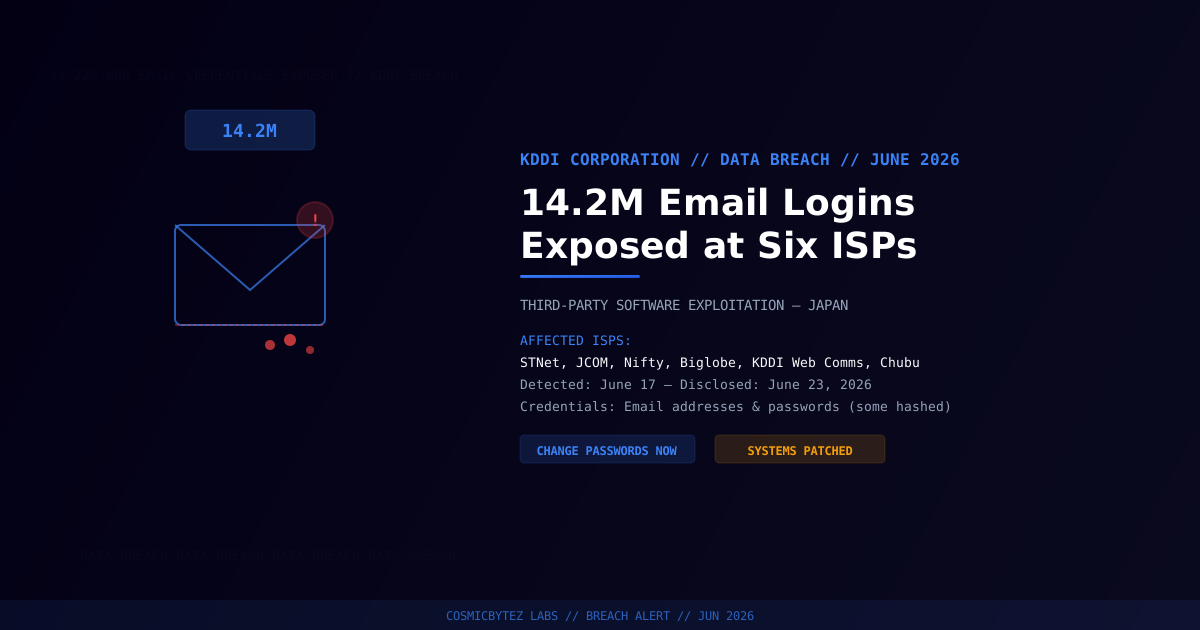
KDDI Email Platform Breach Affects Six Japanese ISPs
Japanese telecommunications operator KDDI Corporation has disclosed a significant data breach that exposed the email credentials of up to 14.22 million accounts across six internet service providers. The incident underscores the cascading risk of centralized infrastructure shared among multiple ISPs.
What Happened
Attackers exploited a vulnerability in third-party software embedded in KDDI's shared email infrastructure platform. Because KDDI operates a centralized email hosting system on behalf of multiple ISPs under management agreements, a single breach point cascaded across all six providers simultaneously.
Timeline
| Date | Event |
|---|---|
| June 17, 2026 | Breach detected by KDDI |
| June 23, 2026 | Public disclosure made |
| June 25, 2026 | Nifty disables passwords for unchanged accounts |
| June 28, 2026 | Ongoing investigation and customer notifications |
Affected ISPs
The breach affected email accounts managed across six providers:
| ISP | Affected Services |
|---|---|
| STNet | Pikara Hikari, Pikara Mobile, Oshigoto Pikara |
| KDDI Web Communications | CPI rental server email |
| JCOM | J:COM NET and associated cable TV operator services |
| Chubu Telecommunications | Commufa Hikari, Business Commufa |
| Nifty Corporation | @nifty Mail |
| Biglobe | BIGLOBE Mail |
What Data Was Exposed
The breach potentially exposed:
- Email addresses — up to 14.22 million accounts (including inactive and cancelled accounts in the worst-case estimate)
- Passwords — some stored in hashed or encrypted form, others potentially in weaker formats depending on the legacy system
- Account metadata — account status, service associations
KDDI has not publicly confirmed whether plaintext credentials were exposed, but the broad scope of the disclosure and the mandatory password reset guidance suggest the risk is significant.
Why This Is Significant
The KDDI breach illustrates several compounding risks common in enterprise telecommunications environments:
Shared Infrastructure Risk
When a single platform manages email for multiple ISPs, a single vulnerability becomes a force multiplier. An attacker who compromises one component gains access to all tenants on that platform simultaneously — in this case, six distinct ISP customer bases.
Credential Reuse Threat
Even if passwords were stored in hashed form, cracking technologies have advanced significantly. MD5 and SHA-1 hashes remain trivially crackable with modern GPU-based tooling. If any customers reuse these passwords across banking, government portals, or corporate systems, the exposure extends far beyond email.
Scale of Impact in Japan
KDDI is one of Japan's three major telecom operators. The six affected ISPs collectively serve a significant portion of the Japanese residential and business internet market. The 14.22 million figure includes inactive accounts, but the active subset is still large enough to fuel large-scale credential stuffing campaigns.
KDDI's Response
Following discovery, KDDI took the following actions:
- Modified affected systems to close the exploited vulnerability
- Notified Japan's Personal Information Protection Commission and the Ministry of Internal Affairs and Communications as required under Japanese data protection law
- Urged all affected customers to change email passwords immediately
- Coordinated with ISPs to issue customer notifications
Nifty Corporation took an additional proactive step: on June 25, 2026, it disabled passwords for all @nifty Mail accounts that had not been changed since the breach deadline, forcing users to reset credentials before regaining access.
What Affected Users Should Do
If you hold an email account with any of the six affected ISPs, take these steps immediately:
- Change your email password — use a strong, unique password not used on any other service
- Enable two-factor authentication if your ISP offers it
- Change passwords on any other accounts where you used the same password as your ISP email
- Watch for phishing — attackers who have your email address may send targeted phishing messages impersonating your ISP, bank, or government services
- Monitor account activity — check for unexpected login attempts or sent emails you don't recognize
- Consider a password manager to prevent future credential reuse
Broader Implications
This breach adds to a growing pattern of attacks targeting ISP and telecommunications infrastructure globally. Earlier in 2026, US telecom operators faced congressional scrutiny over similar shared infrastructure vulnerabilities exploited by the Salt Typhoon threat group. The KDDI incident demonstrates that this is not an isolated regional problem — centralized email platforms operated on behalf of multiple ISPs represent a systemic architectural risk that attackers are actively targeting.
ISPs and telecoms operating shared infrastructure should conduct urgent third-party software audits, apply network segmentation between tenant environments, and consider zero-trust architectures that limit the blast radius of any single compromised component.
This story is developing. CosmicBytez Labs will update this article as additional details emerge from KDDI's investigation.