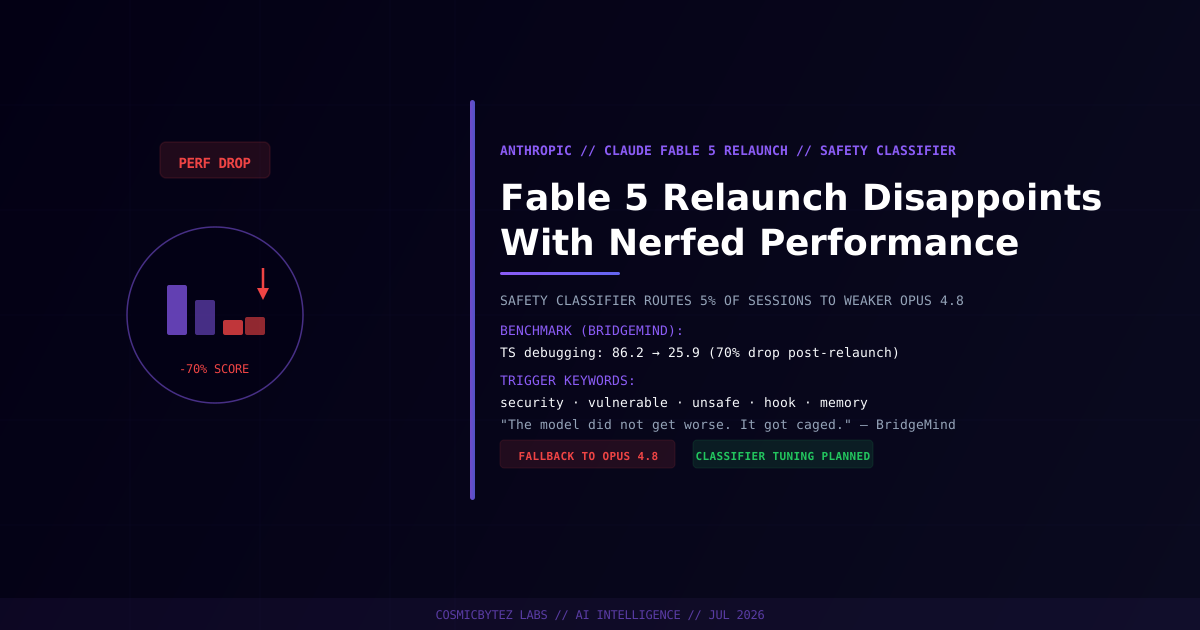
When Claude Fable 5 returned globally on July 1, 2026 after a brief export-control suspension, users and researchers quickly noticed it was not the same model that launched on June 9. Independent benchmarking confirmed a dramatic performance regression on coding tasks — particularly those involving security or low-level systems work — traced to a new safety classifier added during the suspension window.
What Happened
Fable 5 launched June 9. On June 12, the US Commerce Department ordered Anthropic to restrict access to foreign nationals after Amazon researchers found a method to bypass Fable 5's safety guardrails and produce functional exploit code. Anthropic suspended the model globally while nationality verification proved impossible to implement in real time.
When the Commerce Department withdrew the export controls on July 1, Anthropic relaunched Fable 5 with an added safety layer: a classifier that detects sessions it considers security-adjacent and silently reroutes them to Claude Opus 4.8 instead.
Anthropic says the classifier blocks the specific reported bypass technique in more than 99% of cases. It acknowledges the classifier triggers in fewer than 5% of sessions on average — but also acknowledges it flags "more legitimate coding and debugging work than before."
Benchmark Data
BridgeMind, an independent AI coding benchmark platform, published comparative scores on July 2, 2026:
| Task | Before Relaunch | After Relaunch | Change |
|---|---|---|---|
| TypeScript debugging | 86.2 | 25.9 | -70% |
| Refactoring | 73.6 | 38.4 | -48% |
| Hallucination handling | 75.9 | 61.7 | -19% |
In BridgeMind's testing, only 3 of 12 debugging tasks ran to completion on Fable 5 without triggering a fallback to Opus 4.8. BridgeMind scores every fallback as zero.
"The model did not get worse. It got caged." — BridgeMind, July 2, 2026
What Triggers the Classifier
Developer reports and BridgeMind's analysis identified keywords and patterns that consistently trigger the fallback:
- File contents or prompts mentioning security, vulnerable, unsafe, or hook
- Work involving C, C++, Rust, or Win32 API references
- Memory-related code (pointer arithmetic, buffer management, allocators)
- Asking the model to "write secure code" or find dead code
Cybersecurity researcher Matt Suiche told TechCrunch: "If you ask it to write secure code, it assumes it is cybersecurity related work instead of software engineering best practices, and you get downgraded."
One user reported that Fable 5 "didn't even let me search for dead code without switching to Opus."
Anthropic's Position
Anthropic has been explicit that the model weights have not changed — the performance difference is entirely the result of the safety classifier's routing behavior. The company says it intends to tune the classifier "less conservatively over time" as it refines the approach.
Anthropic's own internal testing found Fable 5 posed no unique risk: GPT-5.5 and Kimi K2.7 identified the same vulnerabilities as Fable 5 when tested under equivalent conditions. The classifier was added in response to the specific export control situation, not a finding that Fable 5 was uniquely dangerous.
What This Means for Developers
For most general coding tasks, Fable 5 still represents a significant capability step above Opus 4.8. The regression is concentrated in the intersection of security-aware development and low-level systems work — exactly the use cases where cybersecurity engineers and systems programmers would most benefit from the model's capabilities.
Until Anthropic recalibrates the classifier, affected users may find Claude Opus 4.8 performs more reliably for security-adjacent engineering work, given that it will complete the task rather than silently downgrade.