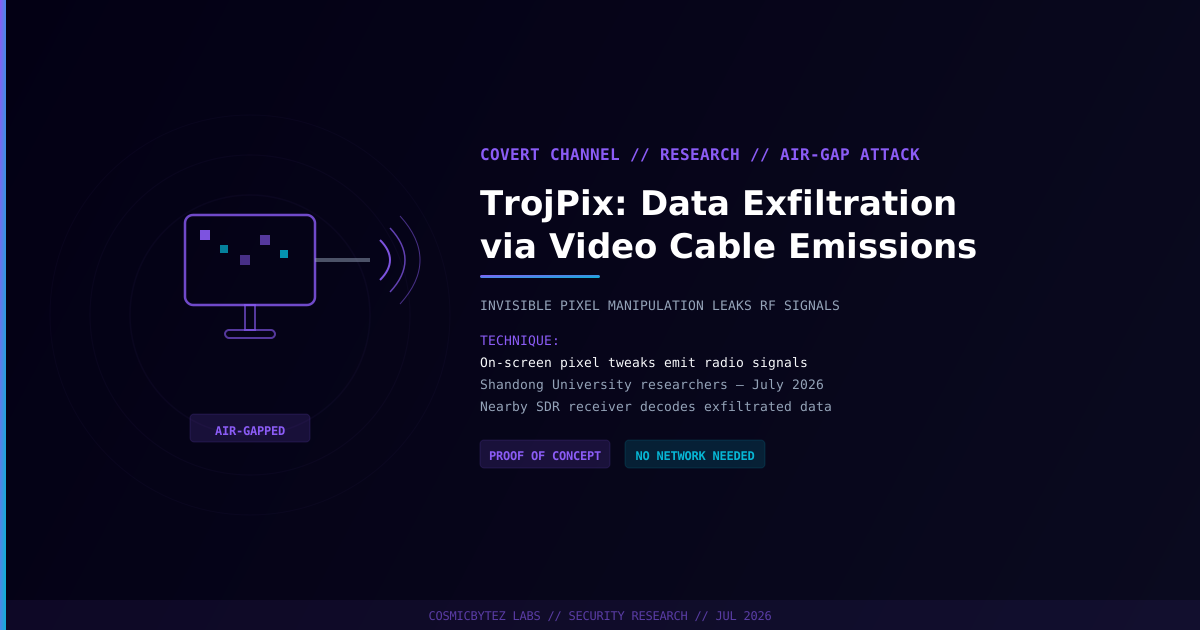
Researchers at Shandong University have published details of TrojPix, a novel covert channel attack capable of exfiltrating data from air-gapped systems — computers deliberately isolated from all networks — by exploiting electromagnetic emissions from video cables.
How TrojPix Works
Air-gapped systems are often considered among the most secure computing environments because they have no network interfaces active. TrojPix sidesteps this protection entirely by operating at the physical layer.
The technique works as follows:
- Pixel manipulation — Malware on the target machine tweaks specific on-screen pixels in patterns invisible to the human eye
- RF emission — The video cable carrying the display signal radiates faint radio frequency (RF) signals as a byproduct of those pixel changes
- Interception — A nearby software-defined radio (SDR) receiver — potentially concealed in the same room — captures the RF emissions
- Decoding — The received signal is processed to reconstruct the exfiltrated data
The pixel changes are designed to be imperceptible to users, meaning the attack can operate continuously on an active workstation without triggering visual suspicion.
Why This Matters
Air-gapped networks are used in high-security environments: government classified networks, industrial control systems (ICS/SCADA), nuclear facility management, and financial clearing systems. The fundamental security assumption is that physical isolation prevents remote data theft.
TrojPix is the latest in a line of electromagnetic covert channel research that has progressively lowered the bar for air-gap attacks. Previous techniques have exploited:
- Fan speed modulation (acoustic)
- Hard drive LED activity (optical)
- Power supply noise (electrical)
- CPU thermal signatures (thermal)
- USB bus emissions (RF)
TrojPix is notable because video cables are nearly universal — present even on systems that have had all wireless interfaces physically removed or disabled.
Technical Parameters
| Parameter | Value |
|---|---|
| Channel | Electromagnetic emissions from video cable (HDMI/DisplayPort/VGA) |
| Trigger | Controlled pixel pattern changes on-screen |
| Receiver | Software-defined radio (SDR) |
| Detection | Invisible to the unaided eye |
| Prerequisite | Malware execution on the target system |
The research team demonstrated data rates sufficient to exfiltrate meaningful payloads — such as encryption keys, passwords, or classified documents — within a practical timeframe, depending on proximity of the receiver.
Threat Model
TrojPix requires that malware already be installed on the air-gapped system. This is not trivial: initial compromise of an air-gapped machine typically requires physical access (USB drop, supply chain attack) or exploitation of an update mechanism.
However, once installed, the attack provides a persistent, hard-to-detect exfiltration channel that survives any network-based security controls.
Who is at risk?
- Organizations running classified or sensitive workloads on physically isolated systems
- Industrial facilities with SCADA systems in security zones
- Any environment where an insider threat or supply chain attack is plausible
Defensive Measures
| Measure | Effectiveness |
|---|---|
| Physical RF shielding (Faraday cage/TEMPEST) | High — blocks emissions at the source |
| Random screen noise / constant pixel activity | Moderate — degrades SNR of the covert channel |
| Video cable RF shielding (ferrite cores, shielded cables) | Moderate — reduces cable emission amplitude |
| Endpoint monitoring for unusual GPU/display activity | Low-Moderate — may detect anomalous rendering patterns |
| Physical security (no unauthorized RF receivers in room) | High — removes the receiver from the attack chain |
TEMPEST-certified equipment (electromagnetic emission shielding per NSA/NATO standards) remains the most reliable countermeasure for high-security environments.
Context: Growing Air-Gap Attack Surface
The TrojPix disclosure follows a sustained body of academic research demonstrating that air-gapped systems can be attacked through a variety of physical side channels. Security teams responsible for high-assurance environments should treat the air gap as one layer of a defence-in-depth strategy, not as a complete security boundary.
For most enterprise environments, TrojPix represents a theoretical rather than practical threat — the attack requires pre-existing malware installation, proximity for the receiver, and a high-value target worth the effort. But for the security posture of classified and critical infrastructure environments, this research reinforces the importance of TEMPEST controls and physical security.
References
- The Hacker News — New TrojPix Attack Leaks Data From Air-Gapped Systems
- TEMPEST/EMSEC standards — NSA CSS EPL, NATO SDIP-27