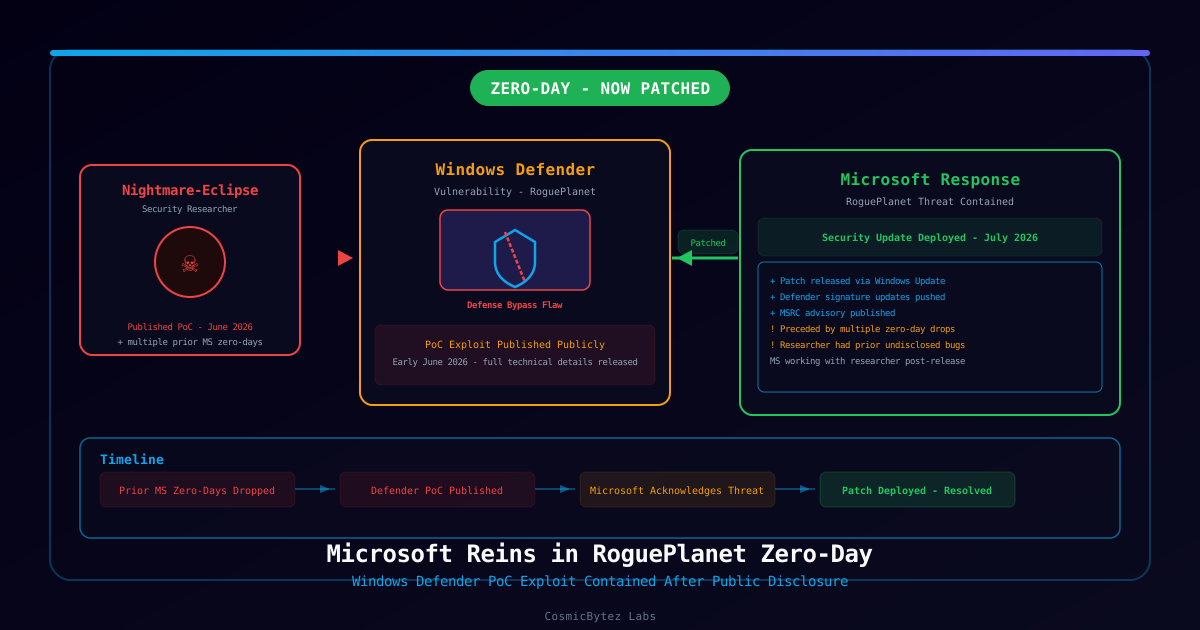
Microsoft has moved to contain the RoguePlanet zero-day, a Windows Defender vulnerability that became public when security researcher "Nightmare-Eclipse" released a proof-of-concept (PoC) exploit after Microsoft's 90-day coordinated disclosure window lapsed without a patch.
What Is RoguePlanet?
RoguePlanet is a vulnerability in Windows Defender — Microsoft's built-in endpoint protection solution — that allows an attacker to abuse the security product itself to achieve privilege escalation or code execution. The specific attack surface relates to how Defender processes certain inputs, turning the protector into a vector for exploitation.
The researcher initially reported the flaw through responsible disclosure channels. When Microsoft failed to deliver a fix within the standard 90-day window, Nightmare-Eclipse published the PoC in early June 2026, consistent with industry-standard full disclosure practices.
The Disclosure Timeline
| Date | Event |
|---|---|
| ~March 2026 | Nightmare-Eclipse reports RoguePlanet to Microsoft |
| ~June 2026 | 90-day disclosure window expires without patch |
| Early June 2026 | PoC exploit published publicly |
| July 2026 | Microsoft releases fix |
The publication of a working PoC significantly raises the threat level of any vulnerability — shifting it from theoretical to immediately exploitable by any motivated actor, including ransomware groups and nation-state operators.
Why Windows Defender Vulnerabilities Are Serious
Windows Defender runs with elevated privileges by design — it needs kernel-level access to inspect processes, memory, and file system activity. Vulnerabilities in security software are especially dangerous because:
- High privilege context: Exploiting Defender can grant SYSTEM-level access
- Always running: Unlike optional software, Defender is active on virtually every Windows endpoint
- Trusted by other defenses: EDR solutions and security policies may exempt Defender processes from scrutiny
- Wide attack surface: Defender processes files, network traffic, emails, and script execution
A flaw in Defender effectively turns the security layer into an attack layer.
Microsoft's Response
After the PoC went public, Microsoft accelerated its remediation timeline and has now issued a patch addressing the RoguePlanet vulnerability. The fix is expected to be distributed through Windows Update. Microsoft has not publicly acknowledged whether RoguePlanet was exploited in the wild between the PoC release and the patch.
Recommendations
Apply the patch immediately. Given that a working PoC is publicly available, any unpatched Windows system running Defender is at meaningful risk.
Additional steps organizations should take:
- Prioritize Windows Update across all endpoints — enable automatic updates where policy permits
- Monitor for exploitation indicators — look for unusual Defender process activity or unexpected privilege escalation events
- Segment sensitive systems — limit lateral movement opportunities if an endpoint is compromised
- Review EDR telemetry — even if Defender itself is compromised, secondary EDR solutions may surface anomalous behavior
The Responsible Disclosure Debate
The RoguePlanet case renews debate around disclosure timelines. Researchers argue that publishing after 90 days — even without a patch — creates pressure that protects users by forcing vendor action. Microsoft and other vendors often argue that complex vulnerabilities require more time, particularly in widely-deployed security products where a flawed patch could cause widespread disruption.
The security community generally supports the 90-day standard (pioneered by Google Project Zero) but recognizes that high-complexity flaws in critical infrastructure sometimes warrant negotiated extensions. In this case, no extension was requested or granted before the PoC dropped.