Overview
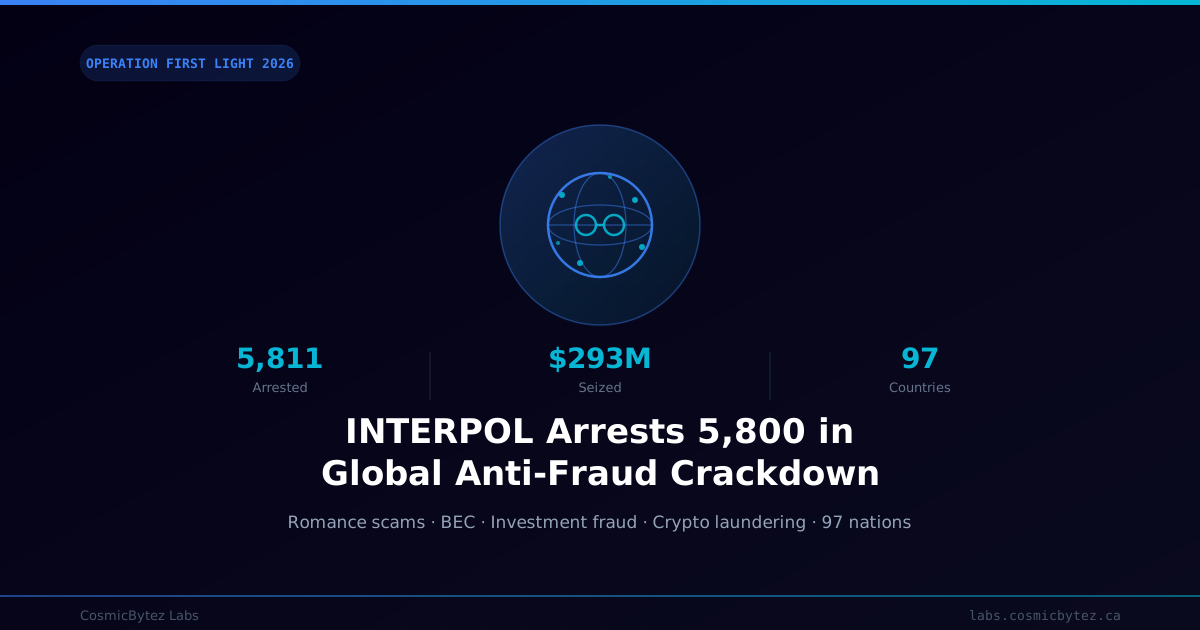
INTERPOL's Operation First Light 2026 concluded with the largest coordinated anti-fraud sweep in the operation's history: 5,811 suspects arrested, $293 million in illicit assets seized, and 142,000 victims identified across 97 countries. The operation ran from January 15 to April 30, 2026, targeting the full spectrum of social engineering fraud — romance scams, business email compromise (BEC), investment fraud, impersonation schemes, and cryptocurrency laundering.
The results represent a sharp escalation from First Light 2024, which involved 61 countries, 3,950 arrests, and $257 million seized. The 2026 edition delivered a 47% increase in arrests across a 59% larger country coalition.
Key Statistics
| Metric | Result |
|---|---|
| Countries participating | 97 |
| Suspects arrested | 5,811 |
| Suspects identified (ongoing) | 15,606 |
| Victims identified globally | 142,000+ |
| Illicit assets seized | $293 million (fiat + crypto) |
| Bank accounts blocked/frozen | 31,014 |
| Cases analyzed | 152,808 |
| Cases resolved | 23,715 |
| INTERPOL Notices issued | 99 |
How the Operation Worked
INTERPOL's Financial Crime and Anti-Corruption Centre (IFCACC) coordinated the effort, funded by China's Ministry of Public Security and supported by ASEANAPOL, GCCPOL, and Europol.
A structured two-phase approach was used:
-
Intelligence collection: Participating nations shared intelligence on fraud networks, high-value targets, and criminal infrastructure over several months before enforcement began.
-
Simultaneous enforcement: Three-plus months of coordinated raids, account freezes, and arrests — leveraging INTERPOL's Global Rapid Intervention of Payments (I-GRIP) mechanism to freeze suspicious transfers of both traditional currency and virtual assets before they could settle.
Fraud Types Targeted
All fraud types fell under the social engineering umbrella — techniques that exploit human psychology rather than technical vulnerabilities:
- Business Email Compromise (BEC) — impersonating suppliers and executives to redirect payments
- Romance scams — long-term relationship fraud designed to build trust before extracting funds
- Investment scams — fake trading platforms promising outsized returns
- Government impersonation — posing as tax authorities, police, or courts to extract payments
- Sextortion — threatening to release intimate images unless payment is made
- Crypto laundering — layering illicit proceeds through cross-chain swaps and mixing services
Notable Country-Level Outcomes
Thailand — $122.5M Crypto Wallet Uncovered
Two arrests revealed a cryptocurrency money-laundering operation routing romance-scam proceeds through cross-chain token swaps. One 20-year-old suspect's single wallet had processed $122.5 million over 10 months.
Eswatini — Fake Police Station
Investigators uncovered a fully operational replica of a Brazilian police station, complete with fake uniforms, signage, and equipment. Criminals used it to conduct video-call impersonation scams, convincing foreign victims they were under investigation and compelling payments to "settle charges."
Singapore and Oman — $6.6M BEC Blocked
INTERPOL's I-GRIP mechanism was used to block a $6.6 million BEC transfer targeting a Singapore commodity trading firm whose supplier was being impersonated by criminals.
Macao, China — $372K Impersonation Stopped
Police intervened before a victim transferred $372,000 to criminals impersonating government officials.
Palau — Hotel-Based Scam Centres
22 individuals were deported after operating scam centres out of hotels, targeting foreign victims through cryptocurrency schemes and illegal gambling sites.
Year-Over-Year Growth
| Edition | Countries | Arrested | Seized |
|---|---|---|---|
| First Light 2024 | 61 | 3,950 | $257M |
| First Light 2026 | 97 | 5,811 | $293M |
| Change | +59% | +47% | +14% |
What This Means
Operation First Light demonstrates that coordinated international law enforcement can make meaningful inroads against sophisticated fraud networks — but the scale of the problem remains vast. With over 150,000 cases analyzed and only 23,715 resolved, and with criminal networks continuing to innovate (fake police stations, AI-assisted romance personas, multi-chain crypto laundering), the cat-and-mouse dynamic is far from resolved.
The I-GRIP payment interception mechanism is an increasingly critical tool: its ability to freeze funds across both traditional banking and virtual asset networks before they reach criminal wallets represents one of the most operationally effective interventions law enforcement has developed for financial cybercrime.
Key Takeaway
Social engineering fraud is a global industry generating hundreds of millions in criminal revenue annually. No single nation can tackle it alone. Operation First Light's model — sustained intelligence sharing followed by simultaneous coordinated enforcement — is the template that works.
"Social engineering scams continue to pose a significant threat to our society. Criminal syndicates exploit human psychology to manipulate their targets, and no nation can stay safe unless all countries are equipped and committed to jointly fighting back." — Tomonobu Kaya, INTERPOL Financial Crime Director