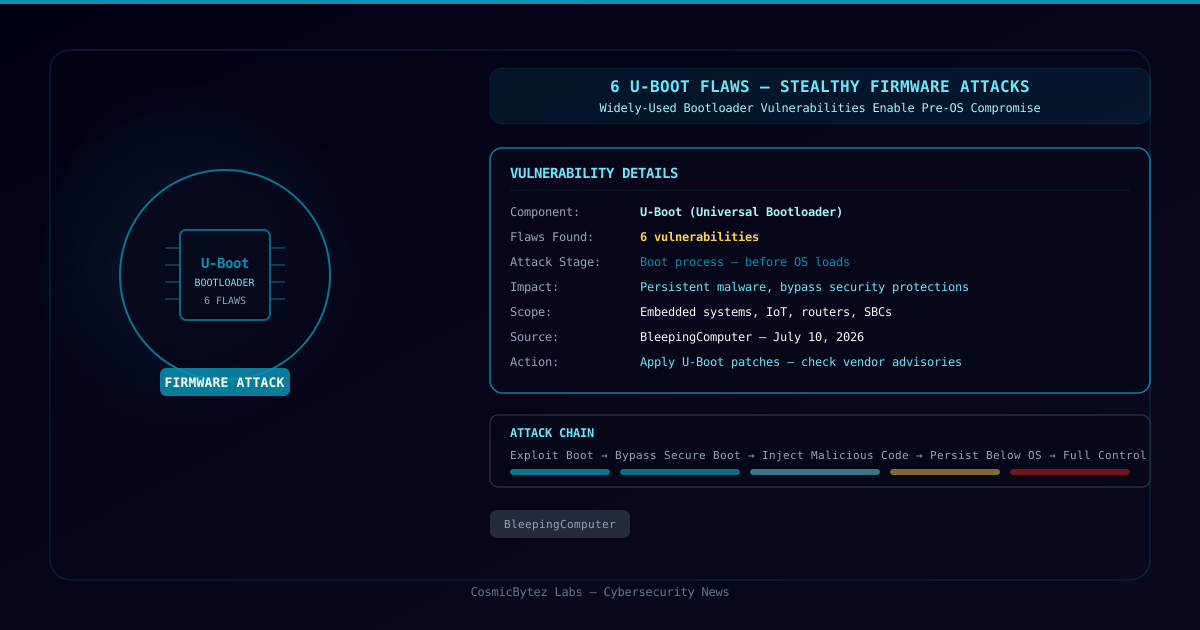
Security researchers have disclosed six vulnerabilities in U-Boot, one of the most widely used open-source bootloaders in the world, that could allow attackers to execute malicious code during the device boot process. First reported by BleepingComputer on July 10, 2026, the flaws could enable stealthy firmware attacks that persist below the operating system — surviving reboots, OS reinstalls, and standard malware removal.
What Is U-Boot?
Das U-Boot (Universal Bootloader) is an open-source bootloader used across hundreds of millions of embedded devices, including:
- Single-board computers (Raspberry Pi variants, BeagleBone, RISC-V boards)
- Network equipment (routers, switches, access points)
- IoT devices (smart home hubs, industrial controllers)
- ARM-based development boards
- Custom embedded Linux systems
The bootloader runs before the operating system — it initializes hardware, loads the kernel, and hands off control. Compromising U-Boot means compromising a layer that the OS cannot inspect or defend against.
The Six Vulnerabilities
Researchers discovered six distinct flaws in U-Boot's codebase. While full technical details are being coordinated with maintainers, the vulnerabilities share a common threat model:
- They can be exploited to execute arbitrary code during the boot sequence
- Exploitation can occur before the operating system has loaded
- Successful exploitation enables bypassing Secure Boot and other OS-level security protections
- Attackers can use these flaws to install persistent malware in firmware that survives standard remediation
The specific vulnerability classes include memory corruption, input validation failures, and improper verification of boot artifacts — all at a stage where defensive controls are minimal.
Why Bootloader Vulnerabilities Are Especially Dangerous
Below-OS Persistence
Standard security tools — antivirus, EDR, OS integrity checks — operate within the OS environment. A threat actor who compromises the bootloader operates at a layer these tools cannot see:
Hardware
  └── UEFI/BIOS
        └── U-Boot (VULNERABLE LAYER)
              └── Linux Kernel
                    └── OS Services
└── Security Tools ← cannot see below thisSurviving Remediation
Because the malicious code resides in firmware or the boot partition:
- OS reinstallation does not remove it
- Factory reset on some devices does not remove it
- The implant can re-infect the OS on every boot
Secure Boot Bypass
U-Boot is often the component responsible for verifying Secure Boot chain-of-trust. A vulnerability here can nullify that protection entirely — even on devices where Secure Boot is properly configured at higher layers.
Affected Devices and Scope
U-Boot is used across an enormous range of hardware. The vulnerability exposure is broad:
| Device Category | Examples |
|---|---|
| Single-Board Computers | Raspberry Pi (some models), BeagleBone |
| Network Devices | Routers, APs using OpenWRT |
| IoT Devices | Smart hubs, industrial PLCs |
| ARM Development Boards | Various vendor boards |
| Custom Embedded Linux | Appliances, NVRs, media devices |
The scope depends on the specific U-Boot version, build configuration, and device implementation. Organizations running large IoT or embedded device fleets should audit their exposure.
Mitigation
For Device Manufacturers and Operators
- Identify U-Boot versions across your device fleet — check vendor documentation or
u-boot -voutput where accessible - Apply U-Boot patches — the U-Boot project and device vendors will be issuing updates; monitor the U-Boot mailing list and vendor security advisories
- Enable Secure Boot where supported and properly configured — while not a complete fix, it raises the bar for exploitation
- Restrict physical access — many bootloader attacks require either physical access or an OS-level compromise to deliver the payload
- Network segmentation for IoT devices — limit what compromised devices can reach
For Individuals
- Update device firmware when manufacturers release patches — this applies to routers, smart home devices, and SBCs
- Replace unsupported devices — hardware that no longer receives firmware updates is permanently vulnerable
- Monitor for unusual behavior from embedded devices (unexpected network connections, performance changes)
Verification
Confirming U-Boot version on accessible systems:
# On systems with U-Boot access (e.g., serial console during boot)
U-Boot> version

# From Linux on embedded systems (if available)
strings /dev/mtd0 | grep "U-Boot"

# Check vendor-specific update utilitiesThe Challenge of Patching Embedded Devices
Unlike PCs or servers, embedded devices present unique patching challenges:
- No automatic updates — many devices require manual firmware flashing
- Vendor dependency — U-Boot must be integrated and released by the device manufacturer, not applied directly
- Long device lifespans — industrial and IoT devices often run for years without updates
- Physical access requirements — some devices require JTAG or serial console to reflash bootloader
This means the window of exposure is likely to be extended — organizations should assume many devices will remain vulnerable for months or years even after patches become available.
Key Takeaways
- Six U-Boot vulnerabilities discovered — enable code execution at boot time before the OS loads
- Bootloader compromise allows persistent firmware implants that survive OS reinstalls and reboots
- Scope is extremely broad — U-Boot is used in hundreds of millions of devices globally
- Patch when available — monitor your device vendors for firmware updates addressing these flaws
- IoT and embedded device fleets should conduct inventory and exposure assessments now
- Expect a long tail of vulnerable devices — patching embedded systems is slow by industry norms