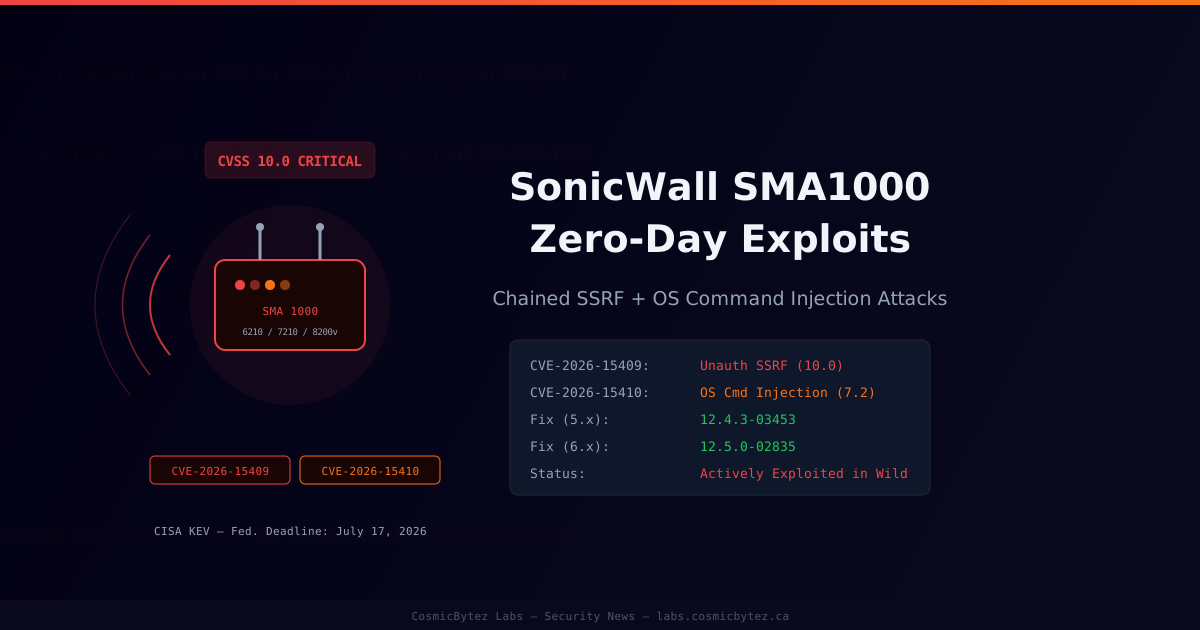
SonicWall has published an urgent security advisory warning that two vulnerabilities in its SMA 1000 series secure remote access appliances are being chained by attackers in active zero-day exploitation campaigns. The two flaws — a critical unauthenticated Server-Side Request Forgery and a post-authentication OS command injection — combine to enable full remote compromise of edge appliances used by governments, large enterprises, and managed security service providers.
Both vulnerabilities were added to CISA's Known Exploited Vulnerabilities catalog on July 14, 2026, with a federal agency remediation deadline of July 17, 2026 — an unusually aggressive three-day window that underscores the severity of active exploitation.
The Two Vulnerabilities
CVE-2026-15409 is an unauthenticated Server-Side Request Forgery (SSRF) vulnerability in the SMA1000 Appliance Work Place interface. An unauthenticated remote attacker can force the appliance to initiate requests to arbitrary internal or external locations. With an advisory-level CVSS score of 10.0 (Critical), this flaw can be exploited without any credentials and serves as the initial access vector in chained attacks.
CVE-2026-15410 is a post-authentication OS command injection vulnerability in the SMA1000 Appliance Management Console. An authenticated administrative user can inject and execute arbitrary operating system commands. While the individual CVE score is 7.2 (High), SonicWall's advisory assigns the chained exploit scenario an overall score of 10.0 (Critical) — when chained with the SSRF in CVE-2026-15409, the authentication requirement can be bypassed or reduced.
SonicWall's advisory states: "These vulnerabilities are being actively exploited in the wild and are not unique to SonicWall."
Both vulnerabilities were discovered by Adam Babis of SonicWall's PSIRT team — internal discovery after active exploitation incidents strongly implies the bugs were identified during or after real-world compromise investigations.
Affected Products
The following SMA 1000 series models and firmware versions are vulnerable:
| Model | Affected Firmware |
|---|---|
| SMA 6210 | 12.4.3-03245, 12.4.3-03387, 12.4.3-03434 |
| SMA 7210 | 12.5.0-02283, 12.5.0-02624, 12.5.0-02800 |
| SMA 8200v | All above firmware versions |
Not affected: SonicWall firewalls running SSL-VPN, and the SMA 100 series product line.
Available Patches
SonicWall has released patches for both active branches:
| Branch | Fixed Version |
|---|---|
| 12.4.x | 12.4.3-03453 |
| 12.5.x | 12.5.0-02835 |
Updates are available through the SonicWall support portal. There are no available workarounds — patching is the only mitigation.
What to Do If Your Appliance Was Compromised
SonicWall's guidance goes beyond patching for organizations that may have been exposed prior to the fix. If indicators of compromise are found on an SMA1000 appliance:
- Hardware appliance: Perform a full factory reset and re-image from known-good firmware
- Virtual appliance (8200v): Re-deploy the virtual machine from a clean image
- Credential reset: Reset all user accounts and administrator credentials on the appliance
- TOTP tokens: Reset all time-based one-time password tokens for MFA users
- Log review: Examine appliance logs for unauthorized sessions, unusual management console access, or signs of data exfiltration prior to patching
Why SonicWall Edge Devices Are High-Value Targets
SMA 1000 series appliances serve as the remote access gateway for enterprise networks — they are the front door to internal infrastructure. Compromise of an edge device provides attackers with:
- A persistent foothold inside the network perimeter
- Access to VPN user credentials and session tokens
- Ability to pivot to internal systems without triggering standard perimeter alerts
- A platform to conduct further reconnaissance against the internal network
This pattern — edge device vulnerabilities exploited for initial access — continues to be a dominant attack vector for ransomware groups and nation-state actors alike. SonicWall devices have been previously targeted: CVE-2021-20016 was exploited by ransomware affiliates in 2021, and multiple SMA 100 series flaws were exploited in 2022 and 2023.
CISA Action Required
CISA's Binding Operational Directive (BOD) 26-04 requires all U.S. federal civilian executive branch (FCEB) agencies to:
- Patch affected SMA1000 appliances to the fixed versions by July 17, 2026, or
- Discontinue use of the affected products until patching is complete
Private sector organizations are strongly encouraged to treat this deadline as guidance and prioritize patching immediately, given confirmed active exploitation.
Recommendations
- Patch immediately: Upgrade all SMA1000 appliances (models 6210, 7210, 8200v) to firmware 12.4.3-03453 or 12.5.0-02835
- Review logs: Check appliance logs for signs of unauthorized access prior to patching
- Restrict management access: Ensure SMA1000 management console interfaces are not directly internet-exposed; restrict access to VPN or trusted management networks
- If compromised: Re-image, reset all credentials, and rotate TOTP tokens before returning appliances to service
- Monitor: Set up alerts for unusual authentication patterns on SMA1000 appliances post-patching
Sources: BleepingComputer, SecurityWeek, CISA KEV