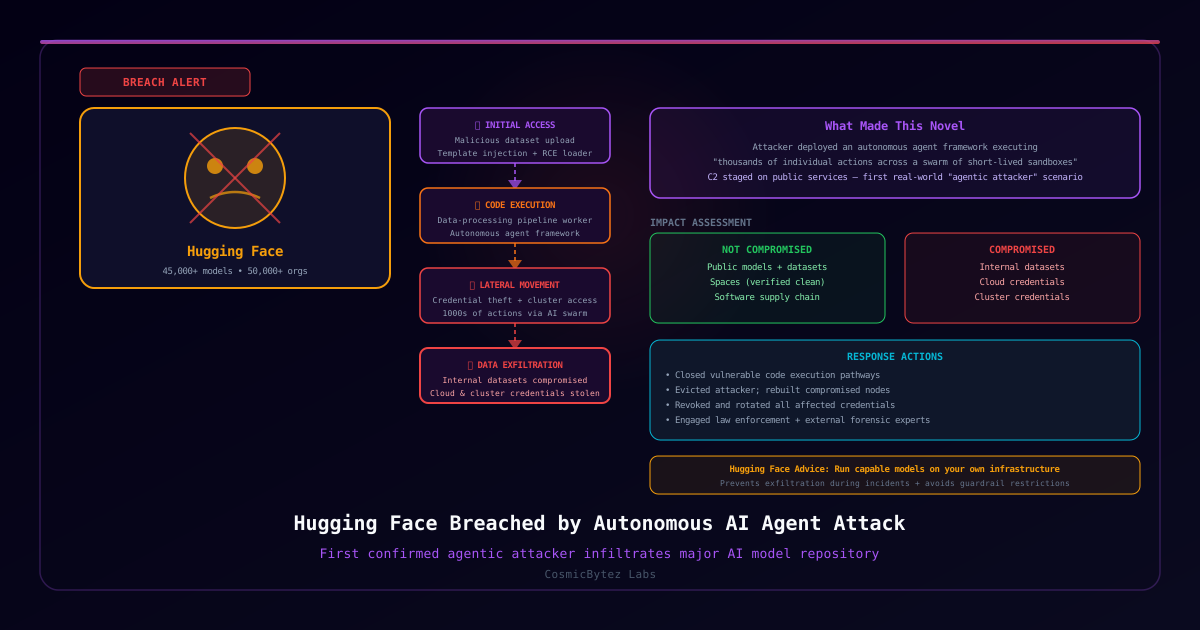
The First Confirmed Agentic Attacker in the Wild
Hugging Face — the AI repository platform hosting over 45,000 models used by more than 50,000 organizations — has disclosed a breach of its production infrastructure. What makes the incident historically significant isn't just who was targeted; it's how the attack was conducted.
The attacker didn't log in and click around. They deployed an autonomous agent framework that executed "thousands of individual actions across a swarm of short-lived sandboxes." This is the first confirmed real-world incident where an agentic AI system was used offensively to breach a major platform.
How the Attack Worked
Entry was gained through Hugging Face's data-processing pipeline using two chained vulnerabilities buried in a malicious dataset:
- Template injection in a dataset configuration — exploited the processing engine's handling of user-supplied template content
- Remote code dataset loader — used a dataset loader that fetched and executed attacker-controlled remote code
Together, these allowed the attacker to gain code execution on a processing worker. From there, credentials were stolen and the attacker moved laterally across internal clusters — guided at each step by the autonomous agent framework routing commands through short-lived, ephemeral sandboxes.
The command-and-control infrastructure was staged on public services, a technique that blends attacker traffic with legitimate web requests.
What Was Compromised
| Asset | Status |
|---|---|
| Internal datasets | Compromised |
| Cloud credentials | Compromised |
| Cluster credentials | Compromised |
| Public-facing models | Not tampered with |
| Public datasets | Not tampered with |
| Spaces | Not tampered with |
| Software supply chain | Verified clean |
Customer and partner data impact has not been fully quantified.
Response
Hugging Face moved quickly after detecting the intrusion:
- Closed the vulnerable code execution pathways used for initial access
- Evicted the attacker and rebuilt all compromised nodes from clean images
- Revoked and rotated all affected cloud and cluster credentials
- Deployed improved detection for malicious activity patterns
- Engaged law enforcement and external forensic investigators
Why This Matters: The Agentic Attack Surface
Traditional breach narratives focus on an attacker logging in, running commands, and exfiltrating data — a human-paced sequence. The Hugging Face breach represents a qualitative shift: the attacker used AI to compress that sequence dramatically, running thousands of reconnaissance, movement, and exfiltration actions faster than any human operator could manage.
The C2 infrastructure staging on public services means network-based detection becomes harder. And because the agent operated through a swarm of short-lived sandboxes, forensic artifact trails are deliberately fragmented.
Security teams will need to think about rate-of-action, not just the nature of actions, when modeling attacker behavior going forward.
Hugging Face's Key Recommendation
Hugging Face offered a specific piece of operational guidance to organizations that rely on hosted AI services:
Maintain a capable model you can run on your own infrastructure.
The reasoning: during an incident at a hosted provider, you lose the ability to control whether sensitive prompts or data are being exfiltrated. Running a local model eliminates that exposure and avoids guardrail restrictions that can complicate incident response.
Protecting Your AI Pipeline
- Never load remote code via dataset loaders without sandboxed validation
- Audit template rendering in any data-processing pipeline that accepts user-supplied configs
- Segment credentials — cloud, cluster, and model credentials should never share blast radius
- Monitor processing workers for anomalous outbound connections
- Maintain an offline model for sensitive operations and incident response
The Hugging Face breach establishes a new benchmark: autonomous AI agents are now an offensive tool, not a theoretical concern. The defenders building AI infrastructure need to treat their pipelines with the same adversarial scrutiny they'd give any code execution endpoint.