Google's First DMA Fine
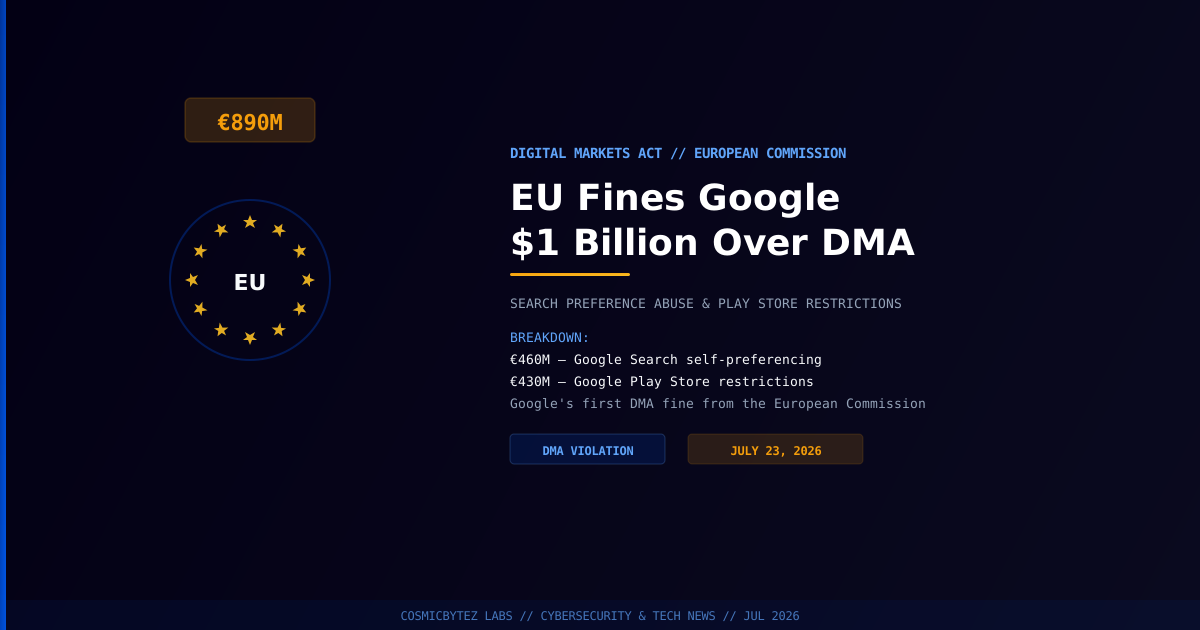
The European Commission has levied a €890 million (~$1 billion USD) fine against Google — the company's first penalty under the Digital Markets Act (DMA), the EU's landmark framework for regulating dominant technology platforms. The fine was announced on July 23, 2026, and covers two separate violations.
| Component | Fine |
|---|---|
| Google Search self-preferencing | €460 million |
| Google Play Store developer restrictions | €430 million |
| Total | €890 million (~$1 billion USD) |
What Google Did Wrong
Search: Self-Preferencing
The Commission found that Google systematically gave preferential placement to its own services — including Google Shopping, Google Hotels, Google Flights, and Google Sports results — over equivalent third-party offerings in Google Search results. This conduct disadvantaged competing services that had no equivalent means of reaching users through the dominant search engine.
Under the DMA, Google is designated as a gatekeeper for Google Search, meaning it must ensure that third-party services are treated fairly and not disadvantaged relative to Google's own products.
Play Store: Developer Restrictions
The second violation concerns the Google Play Store, where Google prevented app developers from directing users to cheaper pricing options available outside the Play Store — such as purchasing apps or in-app items directly through a developer's own website.
The DMA requires gatekeepers to allow developers to "steer" users to alternative purchasing channels. The Commission found Google's implementation insufficient.
Context and Significance
Google's Cumulative EU Exposure
The €890 million fine is the latest in a long line of EU regulatory actions against Google:
- This fine (~0.22% of Google's global annual revenue)
- €4.1 billion Android antitrust fine — Google lost its final EU court appeal in early July 2026
- Multiple previous DMA and traditional antitrust actions
Google's total EU liabilities now exceed €10 billion.
Google's Response
Kent Walker, Google's President of Global Affairs, pushed back on the decision:
"To comply, we are having to strip away real-time Search features Europeans love."
Google argued that compliance with the DMA's requirements would harm both consumers and businesses in Europe by degrading the quality of Search features.
The Commission indicated that daily penalty fines are unlikely as long as Google continues cooperating on compliance efforts.
What This Means for the Industry
The DMA is proving to be one of the most consequential pieces of technology regulation in a generation. Unlike traditional antitrust enforcement — which can take years of litigation before remedies are imposed — the DMA empowers the Commission to levy fines directly against platforms for non-compliance with specific obligations.
Key DMA Gatekeeper Obligations Google Must Meet
| Obligation | Status |
|---|---|
| No self-preferencing in Search | Violated — fine issued |
| Allow developer steering in Play Store | Violated — fine issued |
| Allow sideloading on Android | Partially implemented |
| Interoperability for messaging | Ongoing |
| Data portability | Ongoing |
What to Watch
- Whether Google will appeal the fines in EU courts
- Whether the Commission escalates to daily fines if compliance improvements are deemed insufficient
- How Apple's similar DMA proceedings around the App Store progress
- Whether the US FTC or DOJ use EU findings to inform domestic proceedings
Sources
- EU fines Google $1 billion for Digital Markets Act breaches — BleepingComputer
- Google Fined €890 Million in EU Over Search, App Store Breaches — Bloomberg
- EU hits Google with $1 billion fine over its Play app store and search — AP