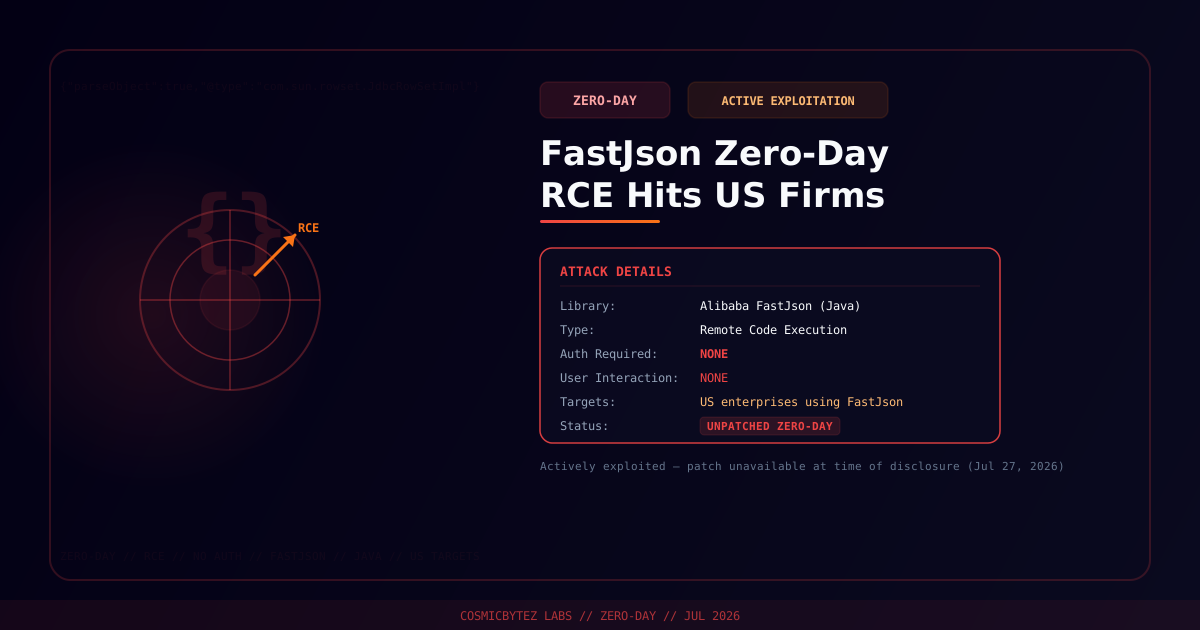
Active Exploitation of Unpatched FastJson Vulnerability
Threat actors are actively exploiting a remote code execution (RCE) zero-day vulnerability in Alibaba's FastJson, one of the most widely used open-source Java JSON parsing libraries. The attacks are targeting US enterprises and require no authentication and no user interaction, giving the vulnerability maximum exploitability characteristics.
FastJson is embedded in countless enterprise Java applications for high-performance JSON serialization and deserialization. Its widespread adoption across financial services, logistics, healthcare, and government applications makes this zero-day particularly high-impact.
Vulnerability Details
| Attribute | Value |
|---|---|
| Library | Alibaba FastJson (open-source Java) |
| Type | Remote Code Execution (RCE) |
| Authentication Required | None |
| User Interaction | None |
| Patch Status | Unpatched (zero-day) |
| Active Exploitation | Confirmed |
| Primary Targets | US enterprises |
The flaw resides in FastJson's deserialization logic — the same attack surface responsible for previous high-severity FastJson vulnerabilities (CVE-2022-25845 and earlier). Attackers craft malicious JSON payloads that, when parsed by the vulnerable library, trigger arbitrary class instantiation and ultimately achieve full remote code execution on the target server.
How the Attack Works
1. Attacker identifies an internet-facing endpoint that parses JSON via FastJson
2. Attacker sends a crafted payload referencing a dangerous class
   (e.g., JNDI-connected gadget chains via JdbcRowSetImpl or similar)
3. FastJson deserializes the payload without validation
4. Malicious class is instantiated — OS command or callback executes
5. Attacker gains code execution in the context of the web server processFastJson's @type mechanism — which allows callers to specify a Java class during deserialization — has historically been abused this way. Despite multiple rounds of denylist hardening, researchers have repeatedly found bypasses.
Scope and Impact
The attack campaign is currently focused on US firms, though the library's global deployment means any organization using FastJson in an internet-exposed application may be at risk. Successful exploitation allows attackers to:
- Execute arbitrary OS commands on the server
- Exfiltrate sensitive data (credentials, PII, intellectual property)
- Establish persistent backdoor access
- Pivot to internal network resources
- Deploy ransomware or destructive payloads
Immediate Mitigations
While no official patch is available for the exploited zero-day, organizations can take defensive steps now:
1. Audit FastJson Usage
# Scan your project dependencies
grep -r "fastjson" pom.xml build.gradle requirements.txt

# Check for the library in deployed JARs
find /opt/app -name "fastjson*.jar"2. Apply Existing Hardening Flags
// Enable SafeMode (blocks all autotype by default — FastJson 1.2.68+)
ParserConfig.getGlobalInstance().setSafeMode(true);

// Or restrict autoType to specific trusted classes
ParserConfig.getGlobalInstance().addAccept("com.yourcompany.");3. Upgrade to Latest FastJson 2.x
FastJson 2.x introduced a redesigned type resolution system that is not affected by legacy FastJson 1.x gadget chains:
<dependency>
    <groupId>com.alibaba.fastjson2</groupId>
    <artifactId>fastjson2</artifactId>
    <version>2.0.57</version>
</dependency>Note: FastJson 2.x is not a drop-in replacement — an API compatibility audit is required.
4. Network-Level Defenses
- Block outbound JNDI/LDAP connections from application servers at the firewall
- Deploy a WAF with rules targeting FastJson-style
@typepayloads - Enable outbound network monitoring on application tier hosts
- Restrict application server egress to only required destinations
Detection
| Indicator | Where to Look |
|---|---|
@type keys in inbound JSON POST requests | Web/application logs |
| Outbound LDAP/RMI connections from app servers | Firewall/NDR |
| Unexpected process spawning from JVM processes | EDR/SIEM |
New child processes of java (e.g., curl, sh, cmd) | Process telemetry |
| DNS lookups to attacker-controlled domains from app servers | DNS logs |
Context: FastJson's Security History
FastJson has a long history of critical deserialization vulnerabilities, including:
- CVE-2017-18349 — Original autotype RCE (CVSS 9.8)
- CVE-2022-25845 — Autotype bypass enabling RCE (CVSS 8.1)
Each patch has been followed by community-discovered bypasses, making migration to FastJson 2.x or an alternative library (Jackson, Gson) the recommended long-term solution.
Recommended Actions
- Immediately enable SafeMode if on FastJson 1.x
- Upgrade to FastJson 2.x or migrate to Jackson/Gson
- Block outbound JNDI connections at the firewall/NDR layer
- Deploy WAF rules targeting
@typepayload patterns - Monitor application logs for anomalous JSON POST patterns
- Patch as soon as Alibaba releases a fix — subscribe to the FastJson GitHub security advisories