Overview
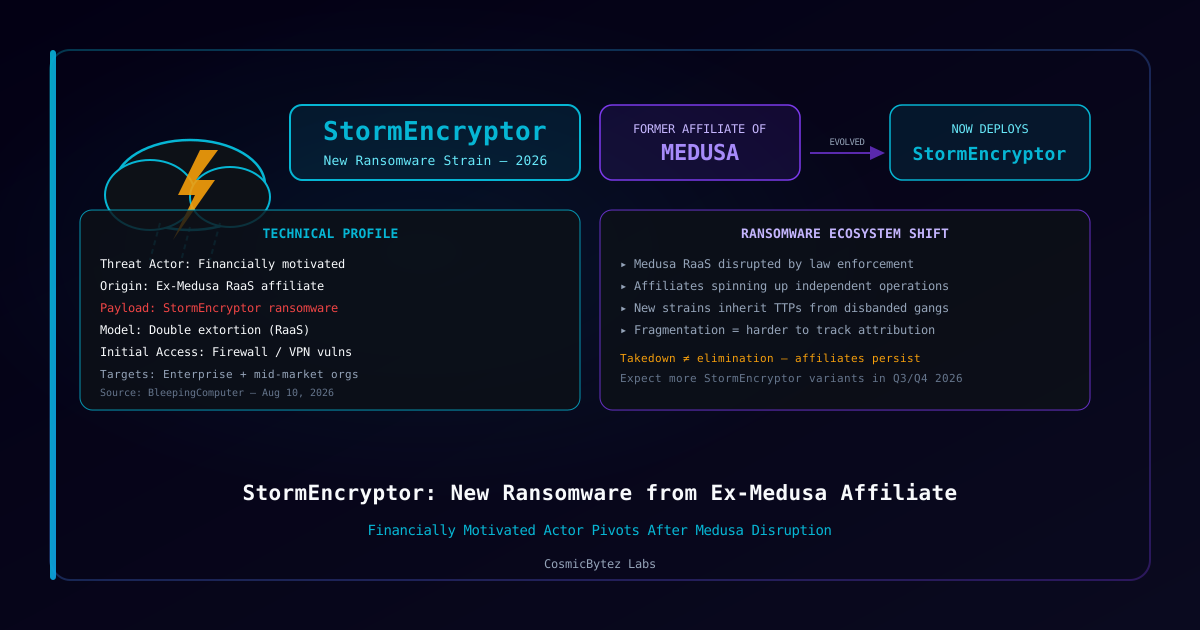
A financially motivated threat actor that previously operated as an affiliate of the Medusa ransomware operation has pivoted to deploying a new ransomware strain called StormEncryptor, according to reporting from BleepingComputer.
The development is the latest example of ransomware ecosystem fragmentation following law enforcement disruption — where affiliates who survive takedown operations spin up their own campaigns rather than exit the criminal market.
From Medusa to StormEncryptor
Medusa's Disruption
The Medusa ransomware operation (not to be confused with MedusaLocker) was a prolific Ransomware-as-a-Service (RaaS) group that recruited affiliates to conduct intrusions in exchange for a cut of ransom payments. Law enforcement and industry action against the Medusa infrastructure in 2025-2026 disrupted the group's core operations.
However, disrupting a RaaS operation does not eliminate its affiliates — individuals with existing access to targets, tools, and criminal infrastructure who simply need a new payload to deploy.
The New Strain
StormEncryptor is the ransomware payload now being attributed to this ex-Medusa affiliate. Analysis indicates the strain:
- Inherits tactics, techniques, and procedures (TTPs) from the affiliate's prior Medusa campaigns
- Operates under a double-extortion model — data theft before encryption
- Uses its own dedicated leak site for victim shaming if ransom demands are not met
- Targets enterprise and mid-market organizations across multiple sectors
Technical Profile
| Attribute | Detail |
|---|---|
| Strain name | StormEncryptor |
| Threat actor type | Financially motivated, independent operator |
| Prior affiliation | Medusa RaaS |
| Model | Double extortion |
| Initial access | Firewall / VPN vulnerabilities, phishing |
| Encryption | Asymmetric key scheme (analysis ongoing) |
| Ransom demand | Negotiated via dark web portal |
| Leak site | Active |
Attack Flow
Based on available reporting, StormEncryptor campaigns follow a multi-stage pattern consistent with the affiliate's prior Medusa-era operations:
- Initial access — Exploitation of unpatched firewall/VPN appliances or targeted phishing
- Reconnaissance — Internal network mapping, credential harvesting (Mimikatz and equivalents observed)
- Lateral movement — Propagation to additional systems using stolen credentials and legitimate admin tools
- Data staging and exfiltration — High-value data copied to actor-controlled infrastructure
- Ransomware deployment — StormEncryptor payload pushed via group policy, PsExec, or similar mechanisms
- Extortion — Victims contacted with ransom demand; non-payers threatened with data publication
What This Tells Us About the Ransomware Ecosystem
Takedowns Don't Eliminate Threat Actors
The StormEncryptor emergence illustrates a well-documented pattern in ransomware disruptions:
- LockBit affiliates moved to LockBit successors, BlackSuit, and RansomHub after 2024's Operation Cronos
- ALPHV/BlackCat core team exit scammed affiliates who then dispersed across competing operations
- Hive affiliates joined competing groups within weeks of the 2023 takedown
Each takedown displaces human operators who retain their skills, access, and criminal contacts. The barrier to deploying a new payload is lower than the barrier to building enterprise intrusion capability.
Fragmentation Complicates Attribution
The proliferation of independent operators using custom strains makes attribution increasingly difficult:
- Traditional tracking by RaaS brand becomes less reliable
- TTPs provide better attribution signals than strain names alone
- The same actor may appear under multiple new brand names across campaigns
Defensive Implications
Patch Perimeter Devices
Like Gunra and other active ransomware operations this week, StormEncryptor's initial access vector centers on unpatched network perimeter devices. Organizations should:
- Audit firewall and VPN firmware — Identify and patch all known vulnerabilities
- Enable logging on perimeter devices and forward logs to a SIEM
- Restrict management interfaces to trusted IPs and require MFA
Detect Early-Stage Activity
The multi-week dwell time between initial access and encryption provides a detection window. Key signals:
Unusual authentication from perimeter device IPs
Admin tools (psexec, wmic, net.exe) running from unexpected sources
Large outbound data transfers (staging for exfiltration)
Shadow copy deletion commands (vssadmin, wmic shadowcopy)
Prepare for Double Extortion
Even organizations with reliable backup and recovery processes should prepare for data extortion scenarios:
- Classify sensitive data — Know what's at stake if exfiltrated
- Engage legal counsel — Pre-establish guidance on ransom payment decisions
- Prepare a public communications plan — Data leak events have reputational dimensions
- Notify IR and legal teams early if anomalous activity is detected
Outlook
Expect StormEncryptor activity to expand in Q3 and Q4 2026 as the operator establishes a track record and potentially recruits sub-affiliates of their own. The ransomware ecosystem's fragmentation means the threat surface is growing even as individual brands are disrupted.
For defenders, the consistent lesson is that the ransomware brand matters less than the TTPs — and those TTPs are converging around a small set of high-value attack patterns: perimeter exploitation, credential theft, and data staging before encryption.