Online privacy often feels like a losing battle. A single email address, phone number, and payment method used across dozens of services is all data brokers need to assemble a detailed profile of your life — your purchasing habits, social connections, health concerns, and political leanings. But according to Anonyome Labs, the company behind the MySudo privacy app, the answer to "Is online privacy possible?" is yes — if you're willing to be deliberate about it.
The strategy hinges on separate digital identities, sometimes called digital personas or Sudos.
The Problem: One Identity, Total Exposure
Most people operate with a single digital identity. One email. One phone number. One set of payment details. Every time you sign up for a service, that identity gets added to a growing dataset that data brokers aggregate, correlate, and sell.
The result: a comprehensive profile built without your knowledge or consent. Data brokers pull from hundreds of sources — loyalty programs, public records, browser tracking, app permissions, and more. That profile can then be used for targeted advertising, insurance risk scoring, pricing discrimination, and in some cases, targeted attacks.
Using the same identifiers across platforms also means that when any one of those platforms is breached — and eventually, most will be — your real credentials are the ones exposed.
The Solution: Compartmentalization
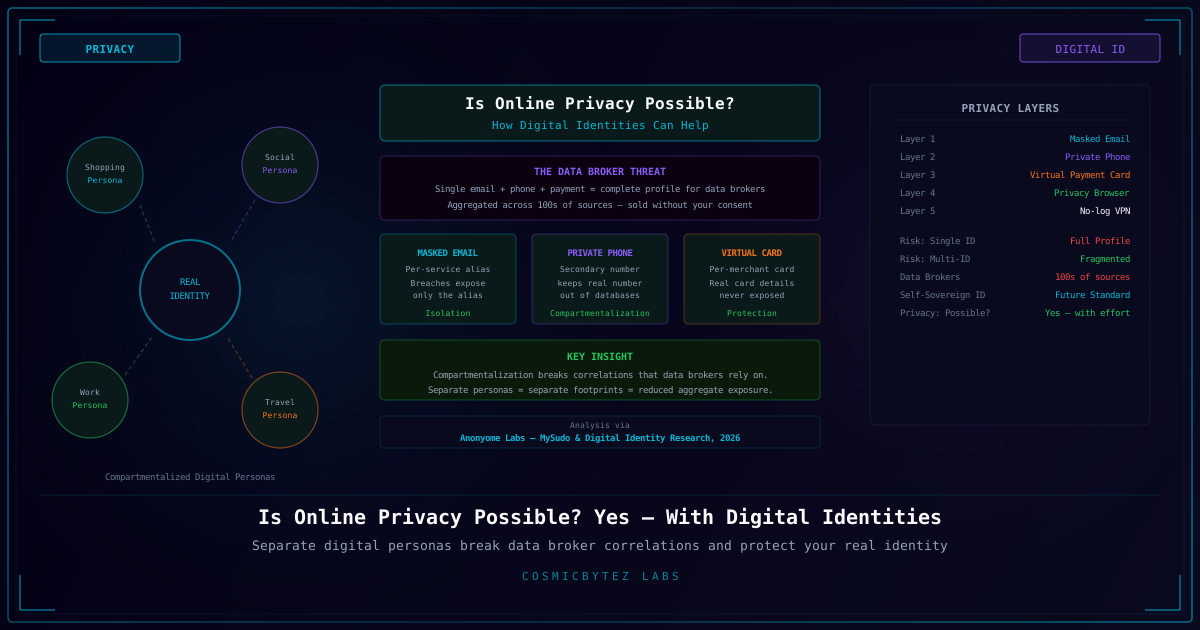
Compartmentalization is the practice of separating your digital footprint across distinct personas, each used for a different context:
- Shopping Persona — a unique email and payment card for online retail
- Social Persona — a separate number and email for social platforms
- Work Persona — distinct from both personal and social
- Sign-up Persona — a throwaway identity for one-time registrations
By fragmenting your footprint, you break the correlations data brokers need to build a complete profile. A breach at one service exposes only the alias — not your real email. A compromised phone number is just a secondary number — not your primary contact. The damage is contained.
Anonyome Labs notes that even a few changes make a meaningful difference: "Even a few changes will noticeably reduce how much companies can track you."
Practical Layers of Protection
Masked Email
Use a unique aliased email address for each service. When you're breached, only the alias leaks. You can deactivate that alias without affecting your real inbox or any other service.
Private Phone Numbers
A secondary phone number keeps your primary number out of commercial databases. Services that require mobile verification get the secondary — your real number stays private.
Virtual Payment Cards
Generate per-merchant virtual cards with a spending limit. Cancel them anytime without affecting your real account. Real card details never enter a merchant's database.
Privacy Browser
A built-in privacy browser with ad and tracker blocking prevents the kind of passive behavioral profiling that feeds data broker databases. Browsers are described by Anonyome Labs as "an excellent mechanism for data brokers to collect personal information."
No-Log VPN
A VPN that retains no logs adds another layer between your traffic and the platforms and ISPs that would otherwise record it.
The Data Broker Scale
The scope of data broker activity is difficult to overstate. A 2026 analysis found Google, Meta, and Apple collectively provided data from over 3.5 million user accounts to US authorities over the past decade — a 770% increase — with over 282,000 American accounts shared in just the first half of 2025 alone. And that's only what gets disclosed to law enforcement. Commercial data broker sales operate with far less visibility.
AI systems are increasingly trained on or interfaced with broker databases, enabling behavior prediction at scale — from purchase decisions to voting behavior — without users ever being aware.
The Self-Sovereign Identity Horizon
Anonyome Labs also points to self-sovereign identity (SSI) as an emerging solution. SSI puts credential control back in users' hands, allowing selective disclosure — you prove you're over 18 without revealing your birthdate, you prove employment without revealing your employer. SSI is designed to make the user the intermediary in any data exchange rather than an invisible data subject.
Takeaway
Online privacy isn't about achieving perfect invisibility — it's about raising the cost of profiling to the point where the aggregate picture breaks down. Separate personas, masked emails, virtual cards, and a privacy browser stack these costs. No single tool is sufficient, but each additional layer compounds the protection.
The tools exist. The strategy is accessible. The question is whether users will adopt it before the next breach makes the decision for them.
Analysis based on research and guidance from Anonyome Labs, makers of the MySudo privacy app.