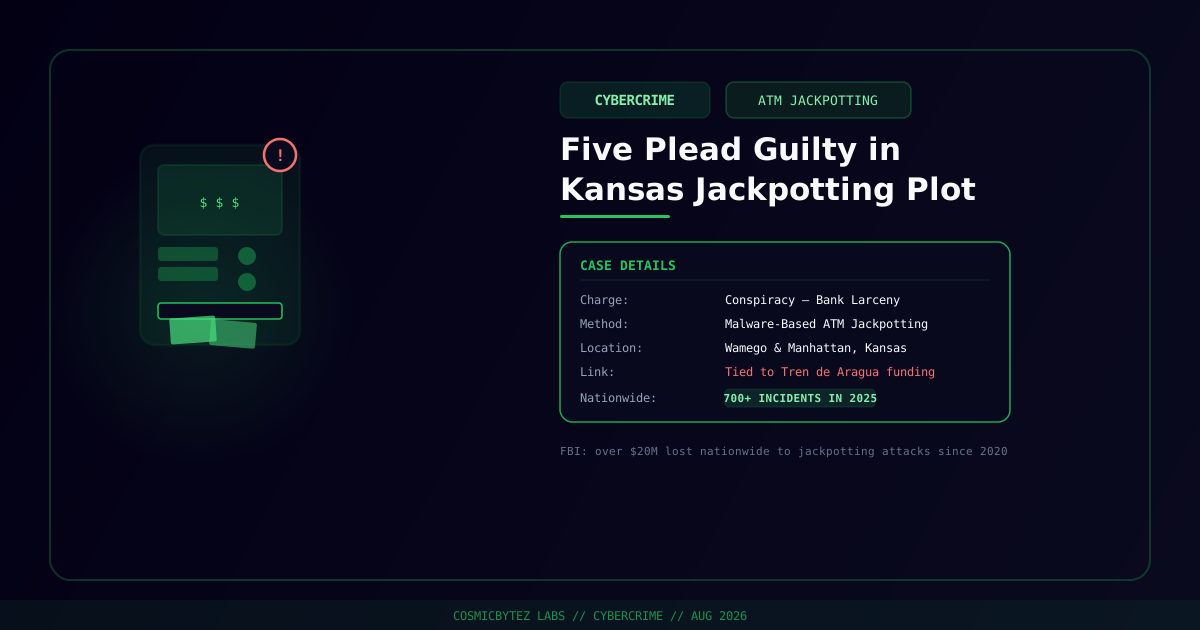
Five Plead Guilty to Conspiracy to Commit Bank Larceny
Five Venezuelan nationals have pleaded guilty to conspiracy to commit bank larceny after prosecutors accused them of running a malware-based ATM jackpotting operation in Kansas. A federal court sentenced Luis Alberto Velasquez-Artigas, 27, to nine months in prison; the remaining four defendants — Royder Adrian Figuera-Perez, 29, Javier Mejia Jr., 27, Gabriel Alexjandro Corales-Garcia, 33, and Italo Lizandro Corrales-Carrillo, 26 — are awaiting sentencing.
How the Scheme Worked
According to court documents, the group drove from Indiana to Kansas in December 2025 to target ATMs in Wamego and Manhattan, Kansas. Jackpotting involves physically installing malware inside an ATM, then remotely triggering a command that forces the machine to dispense all of its cash on demand.
| Field | Details |
|---|---|
| Charge | Conspiracy to commit bank larceny |
| Method | Malware-based ATM jackpotting |
| Targets | ATMs in Wamego and Manhattan, Kansas |
| Outcome | Both installation attempts failed and triggered alarms |
| Arrest | Group identified via surveillance footage, arrested days later |
Both attempted installations failed and tripped police alarms; the group was caught on surveillance cameras and arrested within days.
Tied to a Larger Nationwide Investigation
Federal prosecutors have linked this and related jackpotting schemes to the Venezuelan gang Tren de Aragua (TdA). Assistant Attorney General A. Tysen Duva said the jackpotting operations were meant to help fund transnational criminal organizations, including TdA. The Kansas case sits inside a broader federal effort — a December 9, 2025 indictment charged 22 people in a nationwide scheme spanning bank fraud, bank burglary, computer crimes, money laundering, and material support for terrorism, and a related 56-count indictment from October 21, 2025 charged 32 people with bank fraud, burglary, computer damage, and conspiracy. The effort is part of the Justice Department's Operation Take Back America.
In a related case, two Venezuelan nationals were separately sentenced to 78 months in federal prison for their roles in a transnational conspiracy that used similar malware to steal millions from ATMs across the US.
Scale of the Jackpotting Threat
U.S. Attorney Ryan A. Kriegshauser said the group specifically targeted ATMs it believed were "more vulnerable to malware by design," and urged financial institutions to invest in preventive technology. The FBI reported 1,900 jackpotting incidents since 2020, including more than 700 in 2025 alone, totaling over $20 million in losses nationwide — a trend the bureau flagged as accelerating in a February 2026 report.
Why It Matters
Jackpotting requires physical access to the machine, which makes it a harder crime to scale than pure cyber intrusion — but the funding link to organized crime, and the frequency with which these plots keep surfacing across states, points to a persistent, coordinated effort rather than isolated opportunistic attacks. Financial institutions running older or unpatched ATM firmware remain the primary target.