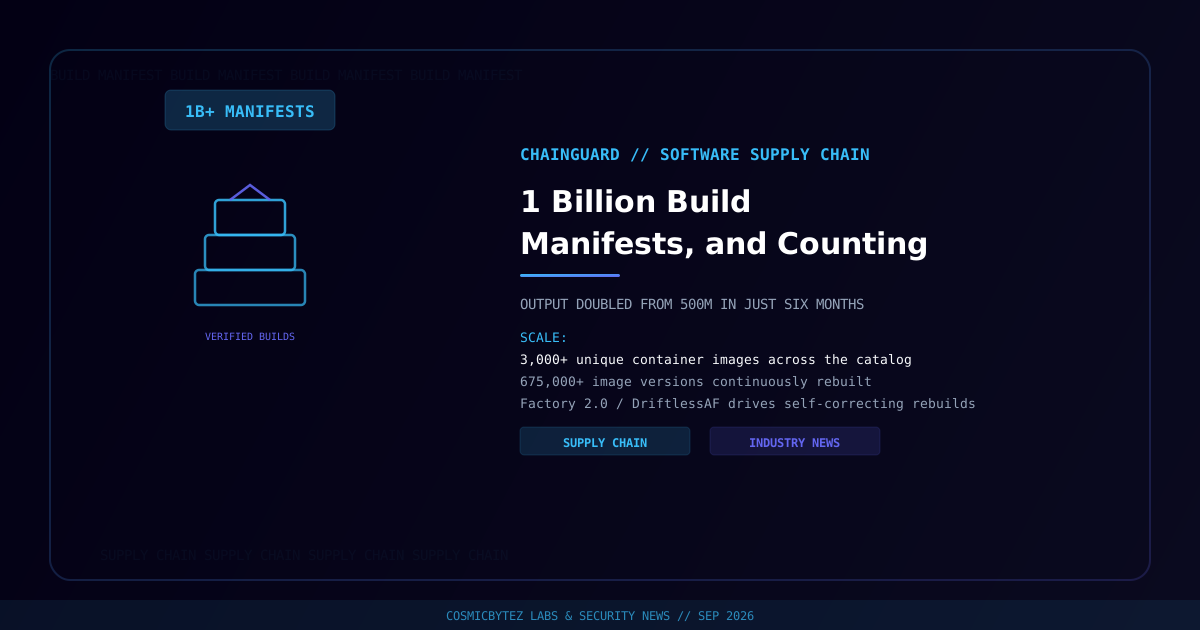
Doubling Output in Half a Year
Container security company Chainguard has crossed 1 billion build manifests produced by its image factory, doubling its output from 500 million manifests just six months earlier. Over the same period, the company's catalog grew to more than 3,000 unique container images and 675,000 individual image versions.
A build manifest is Chainguard's unit of account for every verifiable artifact its factory produces — a fresh image build, a rebuild triggered by a security patch, an architecture variant, or a regenerated SBOM following a dependency change. The metric is less a vanity number than a proxy for how comprehensively the entire catalog is kept current against new vulnerabilities and dependency updates.
Growth Snapshot
| Metric | Figure |
|---|---|
| Build manifests (current) | 1,000,000,000+ |
| Build manifests (six months prior) | ~500,000,000 |
| Unique container images | 3,000+ |
| Image versions in catalog | 675,000+ |
What's Behind the Numbers
Chainguard attributes the acceleration to two pieces of infrastructure:
- Chainguard OS — a purpose-built Linux distribution for cloud-native workloads, built around rolling releases rather than a traditional six-month cadence, giving the company continuous rather than periodic control over its supply chain.
- Factory 2.0, powered by an open-source agentic framework called DriftlessAF, which replaces the company's prior event-driven rebuild system with self-correcting automation. Rather than reacting to individual triggers, the system continuously compares desired state against actual state, assigns reconciliation work to bots, and calls on AI for judgment calls in more complex cases — while still producing verifiable, auditable outputs. Failed tasks are retried automatically rather than requiring manual intervention.
Why It Matters for Supply Chain Security
Chainguard frames the milestone around a shift in the threat model: as attackers increasingly use AI to accelerate vulnerability discovery and exploit development, defenders need to compress how quickly a patched, verified image reaches production across an entire dependency graph — not just for a handful of flagship images. A catalog of 3,000+ images and 675,000+ versions only stays meaningfully secure if all of it, not just the popular subset, can be rebuilt and reverified quickly after a new CVE drops.
That's the underlying argument for treating rebuild velocity at scale — rather than headline vulnerability counts — as the metric worth watching in the "hardened base image" space that Chainguard, and competitors, occupy.