A New Category of Alert
As organizations roll out coding agents and employees quietly adopt consumer AI tools, security operations centers are seeing a genuinely new class of alert emerge — one that legacy detection logic wasn't built to classify. These alerts don't represent attacks against AI systems; they're the ordinary, everyday footprint of a workforce using AI tools for development, research, and daily tasks.
The Numbers
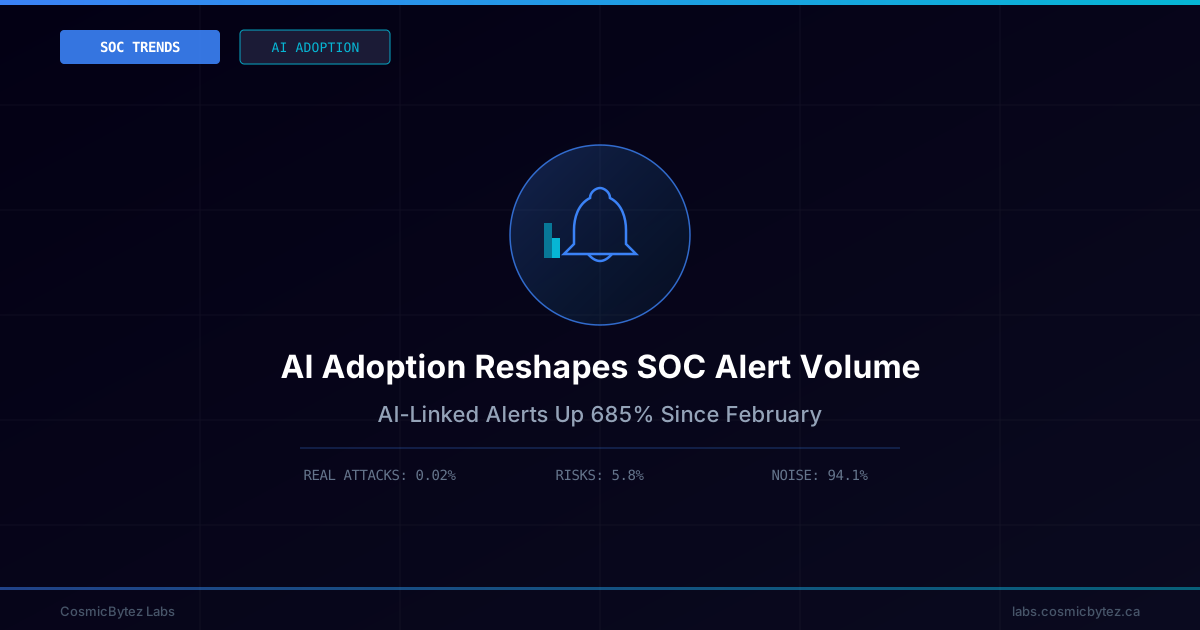
New research quantifying this trend across enterprise SOCs found a striking paradox: AI-related alerts currently make up only 0.43% of all SOC alerts, yet that volume is climbing every month, up 685% between February and June 2026. The current share is small, but the growth curve means it can't be ignored for long.
Breaking Down the Alert Composition
The research splits AI-generated alerts into three categories, and the split matters enormously for how security teams should respond:
| Category | Share | What It Actually Is |
|---|---|---|
| Real Attacks | 0.02% | Genuine malicious activity — largely absent from organizations' own AI agents |
| Security Risks | 5.8% | Real exposures: coding agents run with safeguards disabled, reverse tunnels opened to the public internet, corporate data sent to third-party models via OAuth consent |
| Noise | 94.1% | Legacy detections misfiring on routine, legitimate agent behavior |
The "real attacks" category is dominated not by compromised AI agents but by attackers exploiting AI brand recognition — phishing campaigns impersonating OpenAI, Google Gemini, and Anthropic to trick employees into clicking malicious links.
Concrete Examples of Noise
- Claude Desktop installers triggering "Ransomware Operations Detected" alerts across multiple customer environments
- AI-powered IDE agents legitimately reading local files being flagged for dumping macOS keychains
- Routine automation scripts misidentified as reverse shells
Each of these consumes analyst time without representing any real threat — the classic alert fatigue problem, now with an AI-shaped long tail.
The Actual Risk Category
Setting aside noise and misattributed phishing, the genuine 5.8% "security risk" bucket is where SOC attention should concentrate:
- Coding agents operating with permission safeguards disabled, potentially able to execute unreviewed commands or access sensitive resources
- Reverse tunnels opened from internal systems to the public internet to enable remote AI tool access, expanding the attack surface
- Corporate data flowing to third-party AI platforms through OAuth consent grants that bypass normal data governance review
Recommendations for Security Teams
- Tune legacy detections specifically to recognize and suppress false positives generated by known-legitimate AI agent behavior, rather than accepting the noise as a cost of doing business
- Define explicit policies on what corporate data may or may not be shared with third-party AI platforms, and enforce them technically where possible (e.g., DLP rules, OAuth app allow-listing)
- Run AI tools in isolated environments — Docker containers or VMs — to constrain what agents can access and to make agent-driven activity easier to distinguish from ordinary user activity in logs
Why This Matters
The core insight isn't that AI agents are introducing a wave of new attacks — the data shows the opposite, with real AI-driven attacks still vanishingly rare. The actual challenge is teaching detection systems to recognize legitimate AI behavior before alert volume becomes unmanageable, and before analysts start reflexively dismissing an entire alert category as noise — which is exactly when the rare genuine incident gets missed.
As AI tool adoption continues to climb, SOCs that don't proactively re-tune detections for AI-shaped behavior risk both alert fatigue and blind spots in the same 5.8% category that actually matters.