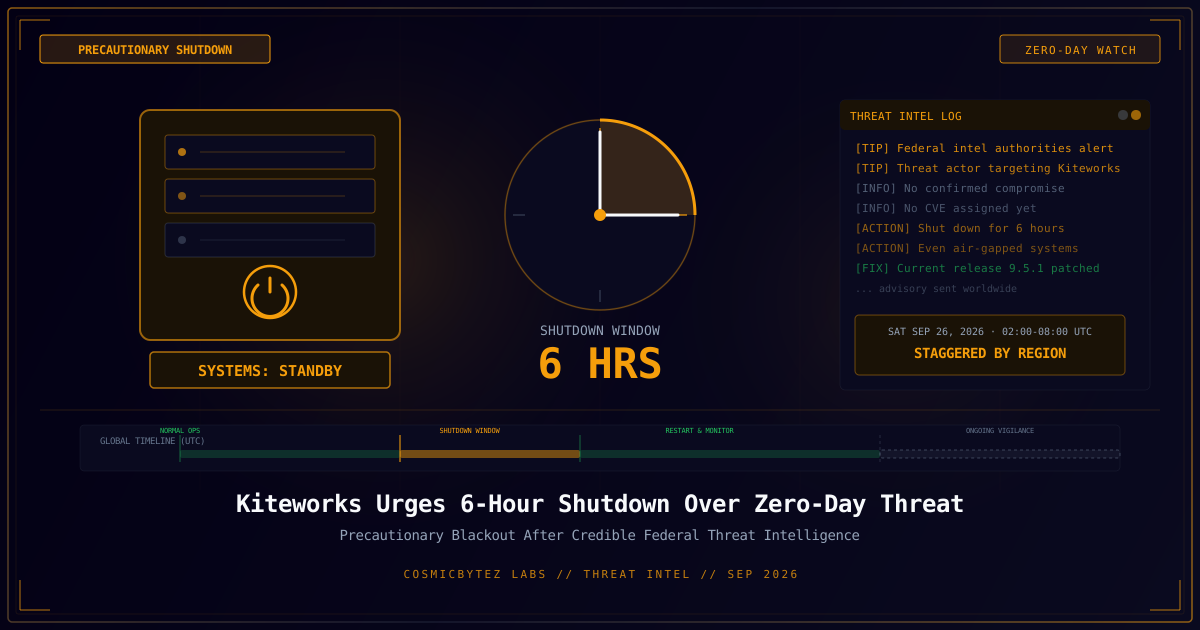
Kiteworks Tells Customers Worldwide to Power Down for Six Hours
Kiteworks, maker of a secure file-sharing and communications platform used by government agencies, financial institutions, and large enterprises, urged customers globally to shut down their Kiteworks servers for a six-hour window on Saturday, September 26, 2026. The company said the request followed "credible threat intelligence from federal intelligence authorities" indicating that a threat actor "may attempt to target some Kiteworks systems for customers." No compromise has been confirmed, and Kiteworks has not disclosed which country's intelligence agencies issued the tip.
Details
| Attribute | Value |
|---|---|
| Company | Kiteworks |
| Product | Kiteworks secure file-sharing / managed file transfer platform |
| Shutdown date | Saturday, September 26, 2026 |
| Shutdown duration | 6 hours (staggered by region — roughly 02:00-08:00 UTC) |
| Reason | Credible threat intelligence from federal intelligence authorities warning of a possible attack |
| CVE / confirmed vulnerability | None identified or assigned as of publication |
| Status of patch/fix | Current release, version 9.5.1, already addresses "all known vulnerabilities" per Kiteworks |
| Confirmed compromise | None — Kiteworks says it is "not aware of any compromise" |
What's Known About the Potential Zero-Day
Kiteworks has not confirmed a specific vulnerability or CVE. In its notification, the company told customers that "all known vulnerabilities are addressed in our current release, 9.5.1," which suggests the concern is not a patchable, already-disclosed flaw. Customer support communications instead framed the shutdown as protection "against any potential zero-day attacks" — meaning Kiteworks is acting on intelligence about an actor's intent or capability rather than a proven exploit chain.
The company's Chief Information Security Officer told customers directly: "We strongly recommend you shut down your Kiteworks system for six hours." Kiteworks was explicit that the move is preventative: "We are not aware of any compromise of Kiteworks systems, and this advisory is preventative rather than a response to a confirmed breach."
Because no CVE has been published and no proof-of-concept or in-the-wild exploitation has been documented, the shutdown functions as a blunt-force mitigation — removing systems from potential attacker reach for a fixed window rather than patching a known flaw. This is a notable departure from the typical zero-day playbook, where a vendor confirms a vulnerability, ships a patch, and asks customers to update. Here, Kiteworks is asking customers to act on the strength of an intelligence tip alone.
What Kiteworks Told Customers to Do
Kiteworks' guidance to customers centered on a single action: power down Kiteworks systems for the full six-hour window, even instances that are not directly accessible from the internet. The rationale is that if the threat intelligence points to a supply-chain or infrastructure-level issue rather than a purely network-facing one, internal-only deployments could still be at risk.
Because the six-hour window falls at different local times depending on region, Kiteworks published staggered schedules — for example, 04:00-10:00 local time in Central Europe and 10:00 p.m. Friday to 4:00 a.m. Saturday in New York, with equivalent windows stretching from Australian Eastern Standard Time through Pacific Daylight Time. All of the regional windows align to the same underlying six-hour block, roughly 02:00-08:00 UTC on September 26.
Beyond the shutdown itself, customers were pointed toward confirming they are running the current 9.5.1 release, which Kiteworks says already incorporates fixes for every known vulnerability. Organizations still on older builds face two overlapping risks during this event: exposure to whatever unconfirmed issue prompted the alert, plus any already-patched flaws they have not yet remediated.
A Familiar Playbook for File-Transfer Platforms
Kiteworks sits in the same category of secure file-transfer and managed-file-transfer (MFT) software that has repeatedly drawn the attention of the Clop extortion gang, which has run mass-exploitation campaigns against platforms including MOVEit, Accellion, GoAnywhere MFT, SolarWinds Serv-U, and Cleo. Each of those incidents followed a similar shape: a previously unknown vulnerability in an internet-facing file-transfer product was exploited at scale before a patch existed, exposing sensitive data at hundreds of downstream organizations.
Proactive, precautionary shutdowns ahead of a confirmed exploit are uncommon in the industry — vendors more typically disclose a CVE and patch simultaneously, or scramble a patch out after exploitation is already detected. Kiteworks' decision to ask its entire customer base to go dark for six hours, without a named vulnerability, reflects both the sensitivity of the data these platforms typically hold (governments, defense contractors, financial institutions, law firms) and the lasting shadow the MOVEit and Cleo incidents have cast over the MFT/secure-file-sharing category.
Impact Assessment
| Impact Area | Description |
|---|---|
| Availability | Planned outage of Kiteworks systems for up to six hours per customer, globally |
| Confidentiality | No confirmed data exposure at time of publication |
| Trust / Reputation | Precautionary but disruptive action for customers in regulated sectors (government, finance) |
| Operational | Customers must coordinate downtime windows across time zones and internal-only deployments |
| Industry Signal | Reinforces MFT/secure file-sharing platforms as a persistent high-value target class |
Recommendations
For Kiteworks Administrators
- Follow the shutdown window provided by Kiteworks for your region, including systems not exposed to the internet.
- Confirm you are running version 9.5.1 before and after the shutdown — Kiteworks states this release addresses all currently known vulnerabilities.
- Review access and audit logs covering the days before and after the shutdown for anomalous authentication or data-transfer activity.
- Maintain direct contact with Kiteworks support for updates in case the advisory is extended or a specific CVE is later disclosed.
For Security Teams
- Treat MFT/secure file-sharing platforms as high-value infrastructure regardless of vendor, given the Clop-era precedent of mass exploitation.
- Segment and monitor file-transfer services so that a compromise cannot pivot easily into broader internal networks.
- Prepare an incident-response runbook specific to file-transfer platforms, given how quickly past MFT zero-days have been mass-exploited once public.
For End Users of Kiteworks-Dependent Services
- Expect temporary unavailability of file-sharing or portal services that rely on Kiteworks during the announced window.
- Avoid submitting sensitive documents through alternate, unofficial channels if the primary platform is offline — wait for the service to resume.
Key Takeaways
- Kiteworks asked customers globally to shut down servers for six hours on Saturday, September 26, 2026, based on threat intelligence from federal intelligence authorities.
- No CVE or confirmed vulnerability has been named — Kiteworks says its current release, 9.5.1, addresses all known issues, framing this as a precaution against a possible zero-day rather than a response to one.
- Kiteworks states it is "not aware of any compromise" of its systems; the shutdown is explicitly preventative.
- The shutdown window is staggered by region but aligns to a single global roughly six-hour block (approximately 02:00-08:00 UTC).
- Customers were told to power down systems even if not internet-facing, and to verify they are on the patched 9.5.1 release.
- The response echoes heightened industry sensitivity around secure file-transfer platforms following Clop's history of mass-exploiting MOVEit, Accellion, GoAnywhere, Serv-U, and Cleo.