Jury Finds Facebook Violated New Mexico Law Nearly 44 Million Times
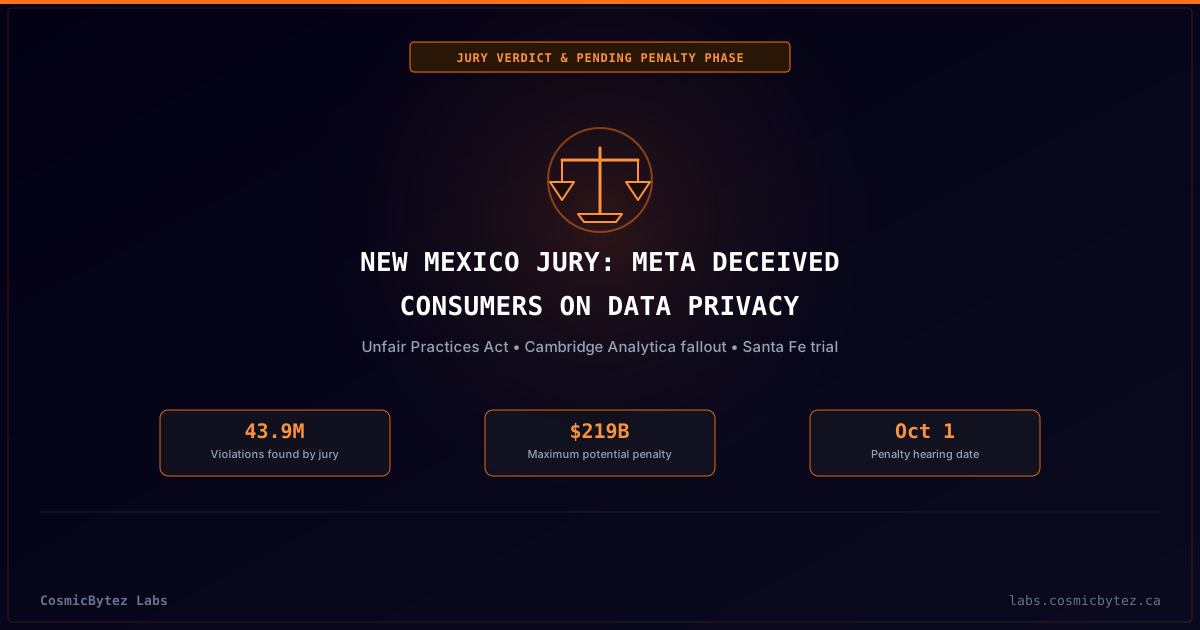
A Santa Fe, New Mexico jury returned a verdict on September 25, 2026, finding that Facebook — owned by Meta Platforms — violated the state's Unfair Practices Act (UPA) 43,899,725 times by making false and misleading statements to consumers about how it collected, protected, shared, and used their personal data, and about its efforts to police misinformation and hate speech. The two-week trial, brought by New Mexico Attorney General Raúl Torrez, marks the first state-led case of its kind to reach a jury verdict, and it exposes Meta to a civil penalty that could run into the hundreds of billions of dollars once a judge rules on damages at an October 1 hearing.
Jurors reviewed 34 separate public statements Facebook made about its data-protection and content-moderation practices and found the company had deceived consumers in nearly all of them. The panel determined the deceptive statements reached New Mexico's entire population of more than two million residents, which — combined with the number of statements at issue — produced the nearly 44-million-violation total.
Case Details
| Attribute | Value |
|---|---|
| Defendant | Facebook / Meta Platforms Inc. |
| Plaintiff | State of New Mexico, represented by Attorney General Raúl Torrez |
| Law at Issue | New Mexico Unfair Practices Act (UPA) |
| Lawsuit Filed | 2021 (originally under then-AG Hector Balderas) |
| Trial Location | First Judicial District Court, Santa Fe, New Mexico |
| Trial Length | Two weeks |
| Verdict Date | September 25, 2026 |
| Violations Found | 43,899,725 |
| Statements Reviewed | 34 public statements on data privacy and content policy |
| Maximum Penalty | $5,000 per violation (statutory cap under the UPA) |
| Potential Exposure | Approximately $219 billion |
| Penalty Hearing | October 1, 2026 (before a judge, not the jury) |
| Case Type | Civil consumer-protection enforcement (liability phase concluded; damages pending) |
What the Lawsuit Alleged
Misrepresenting Data Collection and Sharing
The lawsuit centered on claims that Facebook told users they controlled how their personal information was shared and that the company did not buy or sell users' private data, particularly to advertisers. The state's evidence traced these misrepresentations back to the fallout from the Cambridge Analytica scandal, in which a third-party personality quiz app harvested data from roughly 87 million Facebook profiles and passed it to the political consulting firm Cambridge Analytica, whose clients included the 2016 Trump presidential campaign. Prosecutors argued Facebook continued making reassuring statements about data controls and oversight of third-party app developers even after learning the scope of that harvesting.
Misleading Claims on Hate Speech and Misinformation
Jurors also found that Facebook's public statements about content moderation were "willfully deceptive." According to the Attorney General's office, the jury determined Facebook falsely claimed it did not profit from misinformation or hate speech, that it deleted harmful misinformation from the platform, that it did not tolerate hate speech, and that it had no incentive to retain hateful content — findings the state argued contradicted the company's actual content-ranking and enforcement practices.
One Area Where the State Fell Short
The verdict was not a complete sweep for the state. Jurors found prosecutors did not prove that Facebook made false claims about removing harmful content, including misinformation related to the COVID-19 pandemic — one of the few points where the defense prevailed.
Meta's Trial Defense
Meta's attorneys argued the state's evidence was outdated, noting that despite five years of discovery since the 2021 filing, New Mexico investigators found only one other data-handling incident beyond the Cambridge Analytica matter. The company also told jurors it now removes 99 percent of content that violates its standards and has substantially revised its data and moderation policies since the lawsuit was filed.
Impact Assessment
| Impact Area | Description |
|---|---|
| Financial Exposure | Up to $219 billion if the judge imposes the maximum $5,000 statutory penalty per violation, though the final figure is discretionary and could be far lower |
| Legal Precedent | First state-led consumer-protection case against Meta over data privacy to reach a jury verdict, potentially encouraging similar suits by other state attorneys general |
| Regulatory Momentum | Builds on a separate 2026 New Mexico judgment of $942 million against Meta over child-safety protections, reinforcing state-level scrutiny of the company's practices |
| Public Trust | Reinforces long-standing consumer skepticism about Meta's handling of personal data following the 2018 Cambridge Analytica disclosures |
| Fiscal Use of Proceeds | Attorney General Torrez said any penalty collected would go into a fund supporting New Mexico's education system |
| Uncertain Business Impact | Legal observers note that even a large penalty may not meaningfully affect Meta's operations or policies given the company's overall profitability |
Recommendations
For Consumers
- Review app and platform permissions regularly, particularly for third-party apps that request access to Facebook or Meta account data
- Treat platform privacy statements as marketing claims, not guarantees, and consult independent privacy assessments or regulator findings when deciding how much personal data to share
- Use platform privacy controls (ad preferences, off-platform activity settings, data download tools) to limit data shared with advertisers where possible
For Businesses and Platform Operators
- Audit public-facing privacy and content-moderation statements against actual internal practices; discrepancies between marketing claims and operational reality are now demonstrably actionable under state consumer-protection statutes
- Document data-sharing and third-party app vetting processes, since regulators are treating gaps in enforcement of developer agreements as evidence of deceptive practice
- Monitor state-level consumer-protection enforcement, not just federal privacy law, as state UPA-style statutes can carry substantial per-violation penalties that scale with user base
For Legal and Compliance Teams
- Track this case's damages ruling on October 1, as the judge's approach to calculating penalties per violation could shape exposure calculations in other state consumer-protection actions
- Reassess representations made in privacy policies, terms of service, and public statements for consistency with actual data practices, since juries appear willing to find deception across a broad range of public statements, not just formal policy documents
- Prepare for multi-state litigation trends, as other attorneys general may look to New Mexico's UPA theory as a template for their own consumer-protection statutes
Key Takeaways
- A Santa Fe jury found Facebook violated New Mexico's Unfair Practices Act 43,899,725 times by deceiving consumers about data privacy and content-moderation practices.
- The case traces back to the 2018 Cambridge Analytica scandal, in which data from roughly 87 million profiles was harvested and used for political ad targeting.
- Jurors found deception in nearly all of 34 statements reviewed, though the state fell short on claims tied to COVID-19 misinformation removal.
- Meta faces a potential penalty of up to $219 billion, calculated from the statutory maximum of $5,000 per violation, with a judge to rule at an October 1, 2026 hearing.
- This is the first state-led case of its kind to reach a jury verdict, and it follows a separate $942 million New Mexico judgment against Meta earlier in 2026 over child-safety protections.
- Meta says it disagrees with the verdict and will continue defending itself, arguing its policies have changed substantially since the 2021 filing.
Sources
- The Record: New Mexico jury finds Meta deceived consumers about data privacy practices
- New Mexico Attorney General's Office: Jury Finds Facebook Violated New Mexico Consumer Protection Law, Faces Billions in Potential Civil Penalties
- Fortune: New Mexico jury finds Facebook liable for over 43 million violations
- Source New Mexico: New Mexico jury overwhelmingly sides with state, says Facebook at fault