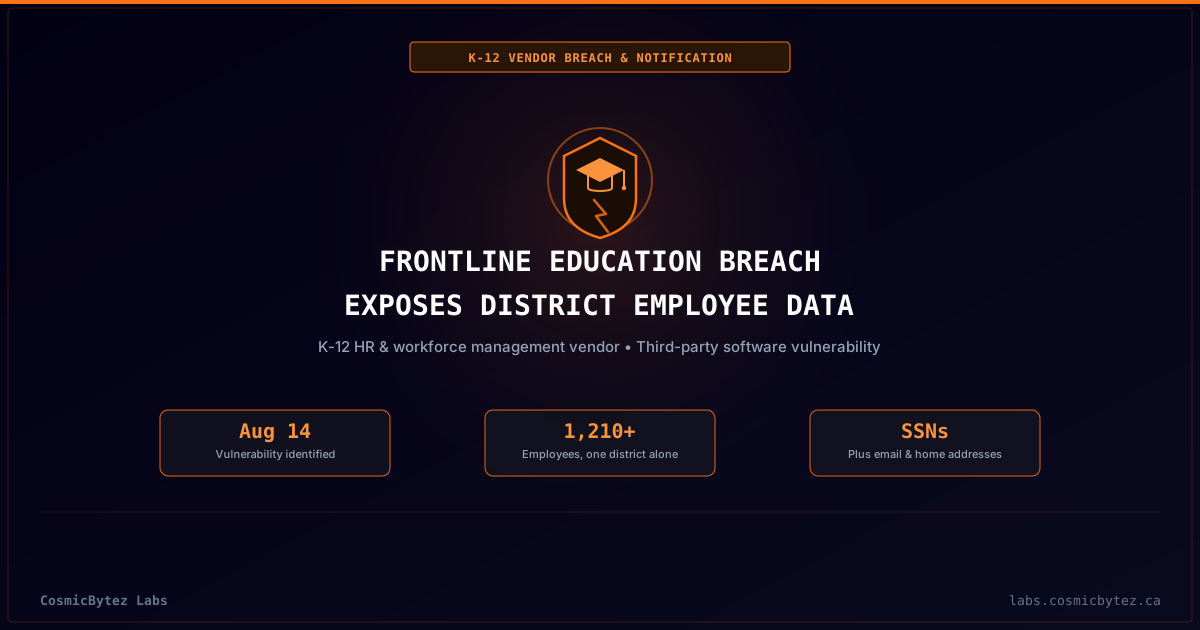
Frontline Education Notifies School Districts of Employee Data Theft
Frontline Education, a K-12 workforce-management software vendor used by more than 7,000 school districts across the United States for absence tracking, HR, and employee-document management, is notifying affected districts that attackers stole current and former employees' personal data — including Social Security numbers, email addresses, and home addresses. In a breach notification letter sent to impacted districts, Frontline said: "On August 14, 2026, our security team identified a vulnerability in a third-party software product we use that allowed unauthorized access to a portion of the environment." The company has not disclosed which third-party product was exploited, nor confirmed when the unauthorized access actually began, only when it was discovered. Notification letters began reaching district officials on October 1, 2026, and reports on the K12SysAdmin community suggest multiple districts nationwide received similar letters, though Frontline has not disclosed the total number of districts or individuals affected.
Incident Details
| Attribute | Value |
|---|---|
| Company | Frontline Education (Frontline Technologies Group LLC) |
| Sector | K-12 education technology — absence management, HR/HCM, payroll support, document management |
| Customer base | 7,000+ school districts across the US (per Frontline marketing materials) |
| Vulnerability discovered | August 14, 2026 |
| Root cause | Unauthorized access via a vulnerability in an undisclosed third-party software product used in Frontline's environment |
| Notification letters sent | Beginning October 1, 2026 |
| Confirmed impact (one district) | 1,210 employees — all employees at that district |
| Total districts/individuals affected | Not disclosed by Frontline as of publication |
| Data exposed | Social Security numbers, email addresses, physical/home addresses |
| Notification sender | frontline@notifications.cyberscout.com (CyberScout, a TransUnion breach-response brand) |
| District opt-out deadline | October 16, 2026 |
| Identity protection offered | 2 years free credit monitoring/identity theft protection (adults, via TransUnion); cyber monitoring services (minors) |
| Law enforcement | Engaged by Frontline during the investigation |
| Vendor comment | BleepingComputer contacted Frontline Education; no reply received as of publication |
How It Happened
Discovery via a third-party software flaw
Frontline's notification letter attributes the breach to a vulnerability in a third-party software product running inside its environment, discovered by its internal security team on August 14, 2026. The company has declined to name the affected product or disclose the specific CVE, if one applies, leaving open whether the flaw was a known, patchable vulnerability or something more novel. Critically, Frontline's statement describes when the vulnerability was identified — it does not say when unauthorized access began, meaning the attackers' actual dwell time in Frontline's systems remains unknown.
Containment and investigation
According to the letter, Frontline "promptly investigated the issue with the assistance of an independent cybersecurity firm, remediated the vulnerability, engaged with law enforcement, and took steps to further reinforce the security of our systems." No further technical detail — such as the remediation timeline, affected system names, or indicators of compromise — has been made public.
Scope of the data theft
For at least one impacted district, Frontline confirmed that all 1,210 employees associated with that district had their Social Security numbers, email addresses, and home addresses exposed. Because Frontline has not published an aggregate victim count, the true scale of the incident — spanning however many of its 7,000+ district customers were affected — is still unknown outside the company. District administrators posting in the K12SysAdmin community have reported receiving comparable notifications, suggesting the breach is not limited to a single district.
A confusing notification rollout
Several district officials initially questioned the legitimacy of the breach notice because it arrived from an external domain — frontline@notifications.cyberscout.com — rather than a frontlineeducation.com address. CyberScout is a TransUnion-owned breach-response brand commonly used to administer large-scale notification campaigns, and multiple administrators later confirmed the notice was genuine after direct contact with their Frontline account representatives. The episode is a reminder that breach notifications routed through third-party response vendors can look indistinguishable from phishing — a problem compounded when the underlying breach itself already undermines trust in the notifying organization's security.
Impact Assessment
| Impact Area | Description |
|---|---|
| Identity theft risk | High — Social Security numbers combined with names, email addresses, and home addresses are sufficient for tax fraud, synthetic identity creation, and account-takeover attempts against affected school employees |
| Phishing and social engineering | High — the breach itself, plus the external-domain notification process, creates ideal cover for attackers to send convincing fake "Frontline/TransUnion" follow-up phishing emails to already-anxious employees |
| Third-party/supply-chain risk | Significant — the root cause sits in software Frontline depends on rather than code it wrote itself, illustrating how a single vendor vulnerability can cascade into personal-data exposure for employees across thousands of downstream customers |
| Regulatory/compliance exposure | Moderate to high — state data-breach notification laws require affected-individual and state attorney general notifications; Frontline says it will handle both on behalf of districts that do not opt out by October 16 |
| Operational burden on districts | Moderate — HR and IT staff at affected districts must verify notification legitimacy, field employee questions, and coordinate with Frontline on an opt-out decision with real financial consequences |
| Vendor reputational/business impact | Significant — Frontline has not disclosed the exploited product, the total scope, or responded to press inquiries, which is likely to draw continued scrutiny from districts and education-sector security researchers |
Recommendations
For school district IT and HR administrators
- Verify notification legitimacy through a known channel. If your district receives a letter from
frontline@notifications.cyberscout.com, confirm it independently with your Frontline account representative before acting — do not rely solely on the email's sender address. - Decide on the opt-out question before October 16, 2026. Districts that opt out of Frontline-managed notifications via
www.frontline-transunion.comor833-516-8792take on the cost and legal responsibility of notifying affected employees and state regulators themselves — weigh this carefully with legal counsel. - Confirm which of your employees are affected. Frontline has disclosed per-district employee counts to at least one customer (1,210 employees in one case); request your district's specific impact figures directly from Frontline.
- Prepare internal communications for affected staff, including guidance on free credit monitoring enrollment and how to distinguish legitimate follow-up communications from opportunistic phishing.
For affected school district employees
- Enroll in the free credit monitoring and identity theft protection offered through TransUnion if your district participates in Frontline's notification program — this service is provided at no cost for two years.
- Place a credit freeze or fraud alert with the major credit bureaus given the exposure of Social Security numbers, regardless of whether you enroll in monitoring.
- Watch for tax-season fraud indicators, including rejected e-filed returns or IRS notices about returns you did not file — SSN exposure is frequently monetized through tax-refund fraud.
- Treat unsolicited "Frontline" or "TransUnion" emails with caution. Verify any request for personal information or login credentials directly with your district's HR department before responding.
For security teams evaluating EdTech and HR vendors
- Inventory third-party software dependencies in vendor environments. This incident underscores that a vendor's own security posture is only as strong as the third-party products it runs internally — ask vendors handling employee PII what third-party application risk management looks like.
- Push vendors for CVE-level disclosure. Frontline's decision not to name the exploited product limits the ability of other organizations running the same software to assess their own exposure; request specificity in vendor security questionnaires and contracts.
- Review data-processing agreements for breach notification obligations, including who bears the cost of individual notification and state AG filings, before an incident occurs rather than during opt-out negotiations.
Key Takeaways
- Frontline Education, which serves more than 7,000 US school districts, is notifying customers that attackers stole employee Social Security numbers, email addresses, and home addresses after exploiting a vulnerability in an undisclosed third-party software product.
- The vulnerability was identified on August 14, 2026, but Frontline has not disclosed when unauthorized access actually began, leaving the true dwell time unknown.
- At least 1,210 employees at one district were confirmed affected, with all employees at that district impacted — the total number of districts and individuals affected nationwide remains undisclosed.
- Notifications are being sent via CyberScout, a TransUnion breach-response brand, which caused some district officials to initially mistake legitimate breach notices for phishing.
- Districts must decide by October 16, 2026 whether to let Frontline manage notifications and cover costs, or opt out and handle notification obligations themselves.
- Affected adults are offered two years of free credit monitoring via TransUnion; minors are offered cyber monitoring services, reflecting the presence of dependent or minor data in some district HR records.