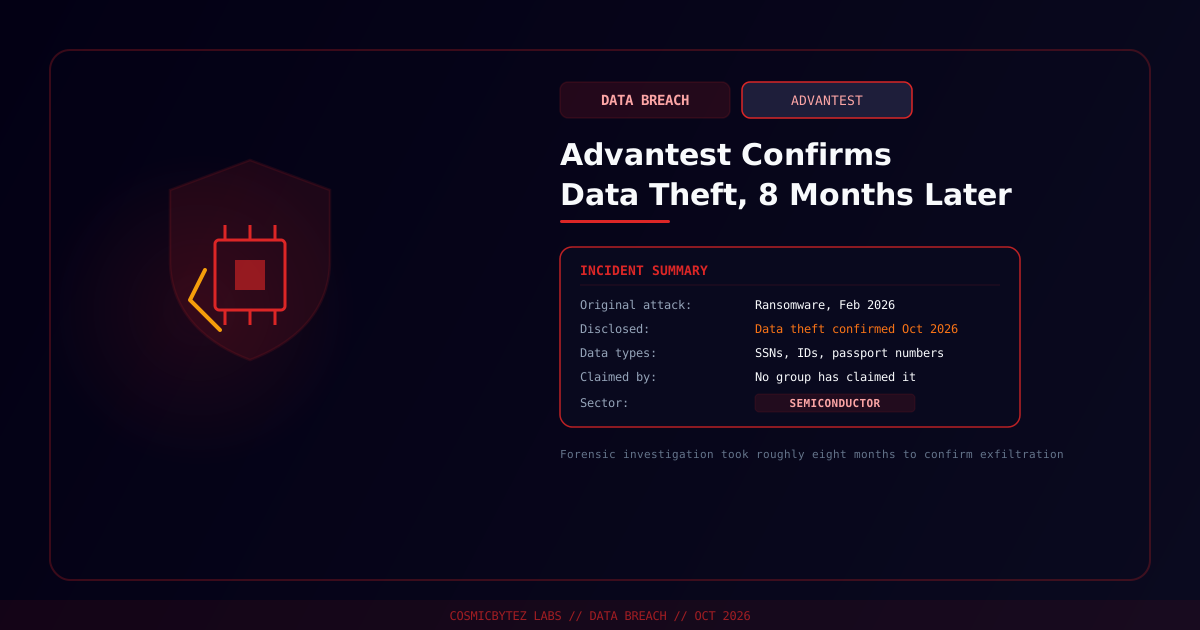
A Long Delay Between Attack and Confirmation
Advantest, the Japanese chip-testing equipment giant, has confirmed that hackers stole personal information in the ransomware attack it first disclosed in February 2026 — nearly eight months after the original incident.
Advantest publicly disclosed the attack on February 19, 2026, reporting that an intruder had accessed its network starting around February 15. At the time, the company said it was "still working to determine whether any sensitive information had been exfiltrated." No ransomware gang has claimed responsibility for the attack, either at initial disclosure or in the months since.
What Was Confirmed
| Detail | Value |
|---|---|
| Original intrusion | ~February 15, 2026 |
| Initial disclosure | February 19, 2026 |
| Data theft confirmed | October 6, 2026 |
| Attacker | Unclaimed — no ransomware group has taken credit |
| Data types stolen | Names, dates of birth, contact information, Social Security numbers, passport and driver's license numbers, national ID numbers, medical and financial information |
| Affected population | Not disclosed by Advantest; state filings confirm at least several hundred individuals in multiple US states |
It remains unclear from Advantest's disclosure whether the affected individuals are primarily employees, customers, business partners, or some mix — the company's notification did not specify.
Why It Took Eight Months
Advantest's explanation centers on forensic investigation timelines: confirming whether, and exactly what, data was exfiltrated from a compromised enterprise network can take many months, particularly when attackers use living-off-the-land techniques or when log retention limits what investigators can reconstruct after the fact. The company maintains it has "no information suggesting that your PII has been disclosed publicly or otherwise misused," but acknowledged the breach increases victims' risk of identity theft and fraud.
Regulatory breach notifications have surfaced in at least three US states — California (500+ residents), Vermont (8 residents, filed October 5), and Massachusetts (14 residents) — with the Vermont filing being the first to publicly confirm the specific categories of data involved. No SEC filing or Japanese regulatory action has been identified as of this writing, and no class-action litigation has been reported yet.
Why This Matters
Advantest is one of the world's largest suppliers of semiconductor test equipment, used across the chip industry's manufacturing and quality-assurance pipeline. A breach touching a company this embedded in global chip supply chains is notable less for scale — the confirmed victim count so far is modest compared to the mega-breaches of 2026 — and more for what it illustrates about disclosure timelines: companies can legally and plausibly sit on "we don't yet know if data was stolen" for the better part of a year while forensic work continues, leaving affected individuals unaware of concrete risk for that entire window.
The lack of a claiming ransomware gang is also unusual. Most 2026 ransomware incidents are quickly followed by extortion demands or leak-site postings; silence here could mean a quieter extortion negotiation, a gang that folded or rebranded before following through, or a breach that was more opportunistic data theft than a classic ransomware-and-leak play.
Recommended Actions
- Affected individuals (if notified) should enroll in any offered credit monitoring and watch for SSN or identity-based fraud given the breadth of data types involved (SSNs, passport numbers, national IDs)
- Organizations in semiconductor and industrial supply chains should treat this as a reminder that breach forensics on large enterprise networks routinely take many months — build that timeline into incident communication planning rather than promising rapid certainty
- Security teams should monitor for any future claim or data leak associated with this incident, since the absence of a claiming group doesn't rule out quiet extortion or delayed data sale
- Procurement and vendor-risk teams working with Advantest or similar equipment suppliers should request updated attestations on what categories of data (employee vs. customer vs. partner) were in scope