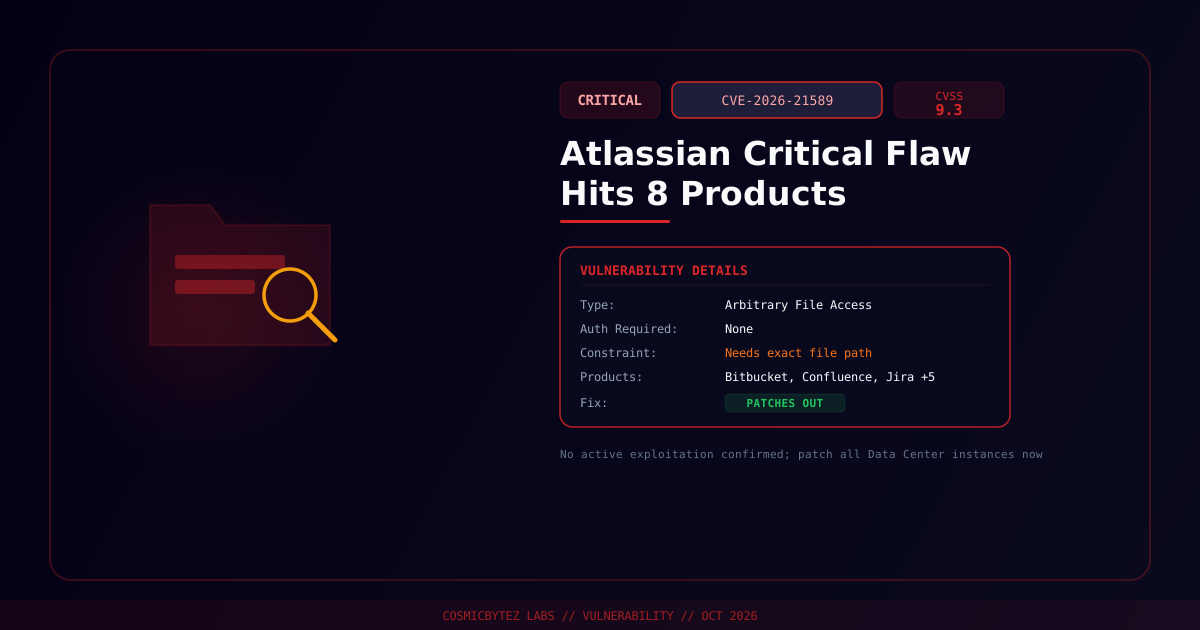
Critical Flaw Spans the Atlassian Data Center Lineup
Atlassian has released patches for a critical arbitrary file access vulnerability, tracked as CVE-2026-21589 with a CVSS score of 9.3, affecting eight separate Data Center products. The flaw allows an unauthenticated attacker to access specific files located in the web application's root directory — though exploitation comes with an important constraint.
Technical Details
| Field | Value |
|---|---|
| CVE ID | CVE-2026-21589 |
| Severity | Critical (CVSS 9.3) |
| Type | Arbitrary file access |
| Authentication | None required |
| Key Constraint | Attacker must know the exact target file's name and path — directory listing/enumeration is not possible |
Atlassian's advisory is explicit that this bug does not allow attackers to browse or enumerate directory contents; the attacker needs to already know (or guess) the precise path of a file they want to read. That narrows — but does not eliminate — the practical risk, since many Atlassian deployments use predictable file layouts and configuration file names that a motivated attacker could guess or learn from public documentation.
Affected Products and Fixed Versions
| Product | Fixed Version(s) |
|---|---|
| Bitbucket Data Center | 9.4.26, 10.2.8, 10.5.1 |
| Bamboo Data Center | 10.2.24, 12.1.12 |
| Confluence Data Center | 9.2.26, 10.2.19 |
| Crowd Data Center | 6.3.7, 7.0.3, 7.1.7, 7.2.4 |
| Crucible | 4.9.15 |
| Fisheye | 4.9.15 |
| Jira Service Management Data Center | 5.12.40, 10.3.26, 11.3.12 |
| Jira Software Data Center | 5.12.40, 10.3.26, 11.3.12 |
Why This Matters
Atlassian's Data Center products sit at the center of software development and IT service workflows for large organizations — source control (Bitbucket), CI/CD (Bamboo), documentation and wikis (Confluence), identity (Crowd), and ticketing (Jira). An arbitrary file read on any of these can expose:
- Application configuration files containing database credentials or API keys
- Source code or build artifacts stored outside the version-controlled repository
- License files, internal documentation, or user data cached on disk
While Atlassian has not observed active exploitation of CVE-2026-21589 to date, the advisory notes that similar file-access and path-traversal vulnerabilities in Atlassian products have previously been exploited by ransomware groups and APT actors, making this a high-priority patch rather than a routine one.
Recommended Actions
- Identify every Atlassian Data Center instance in your environment across all eight affected products
- Apply the listed fixed version for each product as soon as possible — Data Center deployments often sit behind change-control processes, so start the approval cycle immediately
- Review file-access logs on affected instances for unusual requests targeting configuration or credential files
- Rotate credentials stored in configuration files if you cannot rule out prior exploitation before patching