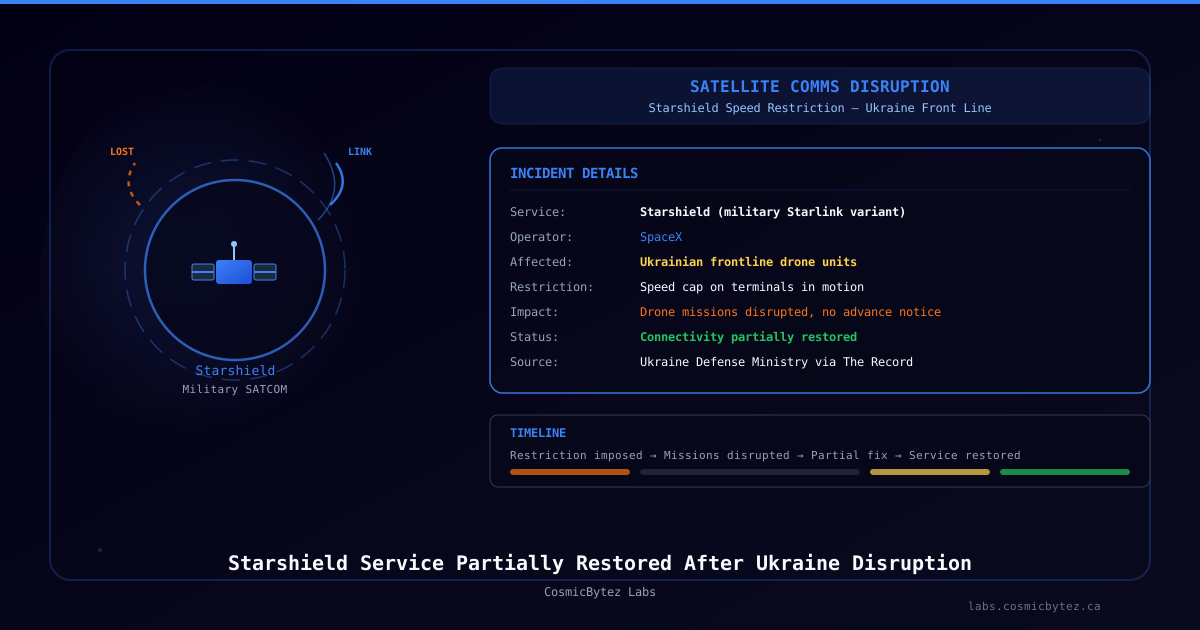
Starshield Connectivity Restored After Unannounced Speed Restrictions Disrupted Ukrainian Drone Missions
Ukraine's military can again use SpaceX's Starshield satellite service while on the move, a Defense Ministry source told Recorded Future News (The Record) on Thursday, days after sudden, unannounced restrictions on the service disrupted drone operations along the front line. The source confirmed that Starshield connectivity for terminals in motion "has now been restored" and is operational — closing out an incident that briefly degraded a communications link Ukrainian forces depend on for reconnaissance, strike, and counter-drone missions.
The episode is a pointed reminder that frontline military operations increasingly ride on a single commercial satellite provider's infrastructure — and that an undocumented configuration change made far from the battlefield can have an immediate, physical effect on combat operations.
Incident Details
| Attribute | Value |
|---|---|
| Service affected | Starshield (SpaceX's government/military-grade Starlink variant) |
| Operator | SpaceX |
| Affected party | Ukrainian Armed Forces, including the 7th Air Assault Corps |
| Nature of change | Undisclosed speed restriction on terminals operating while in motion |
| Onset | Imposed overnight, without advance notice to Ukrainian defense forces |
| Primary symptom | Connection drops of 10–20 seconds at speeds of 110–120 km/h |
| Operational impact | Drone reconnaissance, strike, and counter-drone missions disrupted |
| Interim mitigation | Connectivity usable up to roughly 160 km/h before full restoration |
| Resolution | Defense Ministry confirms in-motion connectivity restored |
| Reported by | Recorded Future News / The Record |
How the Disruption Unfolded
The restriction appears with no warning
New speed limits were introduced on Starshield terminals that prevented them from maintaining a connection while moving at speeds the units had relied on previously. Ukrainian officials and defense-focused commentators said the change arrived overnight and without advance coordination — Ukrainian military communications advisor Serhii Beskrestnov said plainly that "our defense forces received no advance warning" before units began losing connectivity mid-mission.
Frontline units report mission failures
The 7th Air Assault Corps, operating along the southeastern front, reported that connections dropped for 10 to 20 seconds at speeds of just 110–120 km/h — well below any officially disclosed threshold. Beskrestnov warned that the restriction threatened Ukraine's ability to intercept Russian drones and specifically flagged medium-range strike drones as vulnerable during takeoff, the phase where a stable link matters most for control and target acquisition. Drones that lost signal mid-flight became harder to steer, and operators who slowed their systems to try to hold the connection made those same drones easier for Russian air defenses to intercept.
A political dimension, without official confirmation
Beskrestnov said the timing of the restriction "cannot be a coincidence" and tied it to the broader political backdrop. Separately, activist and former defense ministry adviser Serhii Sternenko suggested the cutoff was connected to pressure from the Trump administration, though he offered no supporting evidence for that claim. SpaceX founder Elon Musk responded by stating that Starshield's policy — including speed and usage restrictions — is controlled by the U.S. government, not SpaceX directly, while officials in the Trump administration denied directing the change and said they would investigate its cause.
A partial fix, then full restoration
By October 10, the effective speed ceiling for maintaining a connection had been raised to roughly 160 km/h, even though the formal restriction reportedly remained technically in place. Ukraine's Defense Ministry has now confirmed to The Record that in-motion Starshield connectivity is fully restored and operational, and said it is coordinating with SpaceX, the United States, and NATO partners to prevent a recurrence and to review backup communications arrangements.
Starshield vs. Consumer Starlink
Starshield is SpaceX's government and military-grade variant of the consumer Starlink network, built for defense customers who need encrypted, hardened satellite connectivity. For Ukraine, Starshield terminals mounted on vehicles and drones are what allow units to stay connected while actively moving — a capability that consumer-grade Starlink dishes, which are generally used while stationary, were never designed to guarantee at speed.
That distinction matters here: this was not a case of Russian jamming, cable damage, or a hardware failure. It was a policy-level configuration change imposed on the military tier of the service by the provider itself (or, per Musk's account, by the U.S. government entity that governs Starshield policy) — an availability failure introduced from the top of the supply chain rather than from an adversary on the battlefield.
Why This Matters for Military and Infrastructure Security
Availability is a security property, not just a convenience
For a reconnaissance or strike drone, a dropped link for even 10–20 seconds can mean a failed mission, a lost target, or a destroyed airframe. Satellite connectivity here isn't a productivity tool — it is a weapons-system dependency. Any disruption to that link, regardless of cause, has the same operational effect as an attack on the communications layer itself.
Single-vendor concentration risk
Ukraine's reliance on one company's satellite architecture for a capability this critical means that a unilateral, undocumented change by that vendor — made for political, commercial, or regulatory reasons entirely unrelated to combat conditions — can degrade frontline capability as effectively as electronic warfare. This is the same class of risk security teams flag when a single cloud provider, CDN, or identity platform underpins an organization's entire operation: concentration creates a single point of failure that is outside the defender's control.
No advance notice turns a policy change into an incident
Beskrestnov's complaint that there was no warning is the crux of the security failure. A planned, communicated change allows the affected party to adjust tactics, switch to a backup, or pause missions. An unannounced change during active combat operations behaves exactly like an outage — it removes an organization's ability to prepare, and in this case it reportedly did remove functioning capability mid-mission.
Impact Assessment
| Impact Area | Description |
|---|---|
| Military operations | Drone reconnaissance, strike, and counter-drone intercept missions disrupted during the restriction window |
| Tactical risk | Reduced speed to preserve connectivity reportedly increased drone vulnerability to interception |
| Communications resilience | Exposed Ukraine's dependence on a single commercial satellite provider for a mission-critical capability |
| Political/diplomatic | Raised questions about U.S. government influence over Starshield policy amid a disputed "energy ceasefire" |
| Trust and predictability | Undermined confidence that Starshield policy changes will be communicated in advance to operational users |
Recommendations
For military and defense communications planners
- Document and demand change-notification commitments from satellite and critical-comms vendors for any configuration change affecting operational terminals, especially speed, bandwidth, or geofencing restrictions.
- Maintain a tested communications fallback (mesh relay, alternate satellite provider, terrestrial backup) that does not depend on a single commercial vendor's policy decisions.
- Instrument and log link performance (drop frequency, duration, speed thresholds) so that a sudden policy-driven degradation can be distinguished quickly from jamming or hardware failure.
For security teams assessing vendor concentration risk
- Map single-vendor dependencies for any mission-critical service — satellite, cloud, identity, DNS — and quantify what happens operationally if that vendor changes terms or access without warning.
- Push for contractual notice periods on configuration or policy changes that affect availability, particularly for services supporting safety- or mission-critical functions.
- Treat vendor-side policy changes as an incident class, with the same detection and response playbooks used for outages or attacks, since the operational effect is identical.
For organizations relying on commercial satellite connectivity generally
- Avoid baking a single provider's current behavior into operational assumptions — speed thresholds, latency, and coverage can change without notice.
- Establish a direct escalation channel with the vendor for mission-critical accounts rather than relying on public statements or social media for status updates.
Key Takeaways
- SpaceX's Starshield — the military-grade variant of Starlink used by Ukraine on moving vehicles and drones — had an undisclosed speed restriction imposed on it with no advance warning to Ukrainian forces.
- The restriction caused 10–20 second connection drops at 110–120 km/h, disrupting drone reconnaissance, strike, and counter-drone missions along the front line.
- A partial fix raised the usable speed threshold to roughly 160 km/h by October 10, and Ukraine's Defense Ministry has now confirmed full in-motion connectivity is restored.
- Elon Musk said Starshield policy is set by the U.S. government rather than SpaceX; Trump administration officials denied directing the restriction and said they would investigate.
- The incident underscores that availability is a security property for mission-critical satellite links — an unannounced vendor-side policy change can degrade capability as effectively as jamming or an outage.
- It highlights the operational risk of concentrating a mission-critical capability in a single commercial provider, a risk pattern security teams should treat the same way as any other single point of failure.
Sources
- Ukraine says Starshield working again after disruption — The Record / Recorded Future News