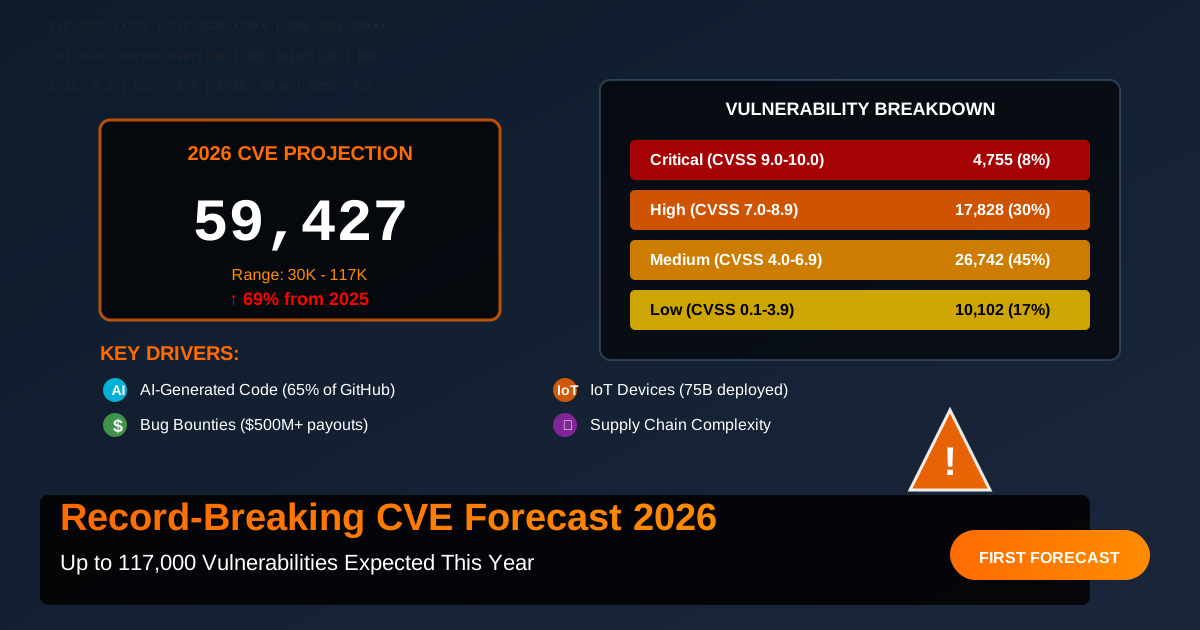
Record-Breaking Vulnerability Disclosures Expected
The Forum of Incident Response and Security Teams (FIRST) has released its 2026 Vulnerability Forecast, predicting a median of approximately 59,427 new Common Vulnerabilities and Exposures (CVEs) will be disclosed this year.
The forecast includes a 90% confidence interval ranging from a conservative 30,012 to an unprecedented 117,673 CVEs, with realistic scenarios suggesting 70,000 to 100,000 vulnerabilities are entirely possible.
This would shatter the previous record of approximately 35,000 CVEs disclosed in 2025.
Breaking Down the Numbers
Historical Context
CVE disclosure rates have grown exponentially:
| Year | CVEs Published | % Increase | Notable Events |
|---|---|---|---|
| 2020 | 18,362 | - | COVID remote work surge |
| 2021 | 21,957 | +19.6% | Supply chain focus (Log4j) |
| 2022 | 25,228 | +14.9% | Cloud vulnerability focus |
| 2023 | 28,902 | +14.6% | AI/ML security research begins |
| 2024 | 32,456 | +12.3% | IoT and embedded systems |
| 2025 | 35,104 | +8.2% | AI code generation adoption |
| 2026 | 59,427 | +69.3% | AI-generated code explosion |
Statistical Analysis
Forecast Breakdown:
Pessimistic:  30,012 CVEs (10th percentile)
Likely:       50,000-70,000 CVEs (40th-60th percentile)
Median:       59,427 CVEs (50th percentile)
Realistic:    70,000-100,000 CVEs (60th-80th percentile)
Optimistic:   117,673 CVEs (90th percentile)
Daily Disclosure Rate (median scenario):
- 163 CVEs per day (up from 96/day in 2025)
- 1,142 CVEs per week
- 4,952 CVEs per month
What's Driving the Explosion?
1. AI-Generated Code Proliferation
GitHub Copilot Statistics (2026):
- 65% of code on GitHub now AI-assisted
- 40% fully AI-generated functions/modules
- 15B+ lines of AI code pushed in 2025
Security implications:
# AI-generated code may include:
- Copied vulnerable patterns from training data
- Insecure default configurations
- Missing input validation
- SQL injection vulnerabilities
- Authentication bypass issuesExamples of AI-introduced vulnerabilities:
- Hardcoded credentials in generated code
- Race conditions in concurrent code
- Improper error handling
- Missing security headers
- Insecure deserialization
2. Increased Security Research
Contributing factors:
- $500M+ in bug bounty payouts (2025)
- 2,500+ active bug bounty programs worldwide
- Automated vulnerability scanning at scale
- AI-powered fuzzing tools finding bugs faster
- Open source security initiatives (OpenSSF, Alpha-Omega)
Top Bug Bounty Platforms (2026 payouts):
- HackerOne: $180M
- Bugcrowd: $95M
- YesWeHack: $45M
- Intigriti: $38M
- Synack: $32M
3. Software Supply Chain Complexity
Modern application dependencies:
# Example Node.js project
npm install express
  ├─ 56 dependencies
  │  ├─ 347 sub-dependencies
  │  │  └─ 1,892 total packages

# Each dependency = potential CVEs
# Each CVE = security patches
# Each patch = regression testingStatistics:
- Average web app: 1,200+ dependencies
- Average mobile app: 800+ dependencies
- Average enterprise app: 3,500+ dependencies
4. IoT and Embedded Systems
Connected device growth:
- 75 billion IoT devices deployed globally (2026)
- 45% lack basic security patches
- 60% run outdated firmware
Vulnerable device categories:
- Smart home devices (cameras, locks, thermostats)
- Industrial control systems (ICS/SCADA)
- Medical devices (infusion pumps, monitors)
- Automotive systems (infotainment, ADAS)
- Network infrastructure (routers, switches, firewalls)
5. Cloud and Container Vulnerabilities
Cloud-native complexity:
Microservices Architecture:
  ├─ 50+ containerized services
  │  ├─ Each with base image vulnerabilities
  │  ├─ Each with unique dependencies
  │  └─ Each with configuration issues
  └─ Orchestration platform (K8s)
     ├─ API server vulnerabilities
     ├─ Network plugin issues
└─ Storage driver bugs2025 cloud vulnerability statistics:
- 328 CVEs in Kubernetes ecosystem
- 892 CVEs in container base images
- 1,456 CVEs in cloud provider services
Severity Distribution (Projected)
Based on FIRST analysis and historical trends:
| CVSS Score | Severity | Projected Count | % of Total |
|---|---|---|---|
| 9.0-10.0 | Critical | 4,755 | 8% |
| 7.0-8.9 | High | 17,828 | 30% |
| 4.0-6.9 | Medium | 26,742 | 45% |
| 0.1-3.9 | Low | 10,102 | 17% |
Critical vulnerabilities requiring immediate attention: ~4,755 High + Critical requiring urgent patching: ~22,583
Industry Impact Analysis
Security Team Burden
Vulnerability management workload:
2025: 96 CVEs/day = ~2-3 hours triage time
2026: 163 CVEs/day = ~4-6 hours triage time

Requirement: 75% increase in security staff or automation
Average security team composition:
- Small org (500 employees): 1-2 security analysts (overwhelmed)
- Mid-market (5,000 employees): 5-10 security analysts (struggling)
- Enterprise (50,000 employees): 50-100 security analysts (still challenged)
Patch Management Crisis
Median time to patch:
- Critical CVEs: 7-14 days
- High CVEs: 30-60 days
- Medium CVEs: 60-90 days
- Low CVEs: Often never patched
The math doesn't work:
163 new CVEs per day
+ 500+ existing unpatched CVEs (average org)
+ 100+ patch releases per month
= Impossible to keep up manually
Solution required: Automation or accept risk
Cyber Insurance Impact
Insurance carriers are responding:
- Premium increases: 35-50% for organizations with poor patching
- Coverage restrictions: Excluding ransomware if critical CVEs unpatched
- Mandatory controls: EDR, patch management, MFA requirements
- Higher deductibles: $500K-$2M for large enterprises
Most Vulnerable Software Categories (2026 Projection)
Top 10 by CVE Count
- Operating Systems: 8,500 CVEs (Windows, Linux, macOS, mobile)
- Web Applications: 7,200 CVEs (PHP, JavaScript, Python frameworks)
- Network Equipment: 6,100 CVEs (routers, switches, firewalls)
- Databases: 4,900 CVEs (MySQL, PostgreSQL, MongoDB, Oracle)
- Cloud Services: 4,200 CVEs (AWS, Azure, GCP services)
- IoT Devices: 3,800 CVEs (cameras, sensors, controllers)
- Container/Orchestration: 3,200 CVEs (Docker, Kubernetes, containerd)
- Enterprise Software: 2,900 CVEs (ERP, CRM, collaboration tools)
- Security Products: 2,400 CVEs (ironic but true - firewalls, IDS/IPS)
- Development Tools: 2,100 CVEs (IDEs, compilers, CI/CD pipelines)
Vendor-Specific Projections
Highest CVE counts (estimated):
- Microsoft: 1,200+ CVEs (Windows, Office, Azure, .NET)
- Linux Kernel: 800+ CVEs (across all distributions)
- Google: 700+ CVEs (Android, Chrome, Cloud)
- Apple: 600+ CVEs (iOS, macOS, Safari)
- Oracle: 550+ CVEs (Java, database products)
Automated Vulnerability Discovery
AI-Powered Fuzzing
Tools leading the charge:
- OSS-Fuzz: 10,000+ bugs found in open source projects
- ClusterFuzz: Google's infrastructure fuzzing platform
- AFL++: Advanced mutation-based fuzzing
- LibFuzzer: LLVM's coverage-guided fuzzer
- Jazzer: Fuzzing for Java applications
AI enhancements:
Traditional Fuzzing:
  Generate random inputs → Test → Analyze crashes

AI-Enhanced Fuzzing:
  ML models predict high-value inputs →
  Evolutionary algorithms optimize test cases →
  Neural networks identify patterns →
Automated root cause analysisStatic Analysis at Scale
Code scanning statistics (2026):
- 85% of GitHub repos use automated scanning
- 42% of GitLab projects have SAST enabled
- CodeQL scans: 500M+ per month
- Semgrep rules: 2,000+ security patterns
Zero-Day Vulnerabilities
Zero-Day Market Trends
Pricing (2026 estimates):
| Target | Vulnerability Type | Price Range |
|---|---|---|
| iOS | RCE + Sandbox Escape | $2M - $5M |
| Android | RCE + Root | $1M - $3M |
| Windows | RCE + LPE | $500K - $2M |
| Chrome | RCE + Sandbox Escape | $1M - $3M |
| RCE (no interaction) | $3M - $8M |
2025 zero-day statistics:
- 97 zero-days exploited in the wild (record high)
- 23% increase from 2024
- Median time to patch: 4.2 days (improving)
- Median time exploited before discovery: 18 months (concerning)
Recommendations for Organizations
Immediate Actions
1. Implement Automated Vulnerability Management
Tool Requirements:
  - Continuous asset discovery
  - Automated CVE correlation
  - Risk-based prioritization
  - Integration with patch management
- Compliance reportingTop tools (2026):
- Tenable.io
- Qualys VMDR
- Rapid7 InsightVM
- Wiz (cloud-native)
- Snyk (developer-first)
2. Adopt Risk-Based Patching
Stop trying to patch everything—prioritize based on:
Risk Score = (CVSS * Exploitability * Asset_Criticality) / Remediation_Difficulty

Patch order:
1. Actively exploited + Critical assets
2. Public exploits + Critical assets
3. High CVSS + Critical assets
4. Everything else (when possible)3. Implement Virtual Patching
When patching isn't immediately possible:
- Web Application Firewall (WAF): Block exploit attempts
- Runtime Application Self-Protection (RASP): Inline protection
- Network segmentation: Limit blast radius
- IPS signatures: Detect and block known exploits
Long-Term Strategy
✅ DevSecOps Integration: Shift security left, fix vulnerabilities in development ✅ Software Composition Analysis (SCA): Track all dependencies ✅ Container Security: Scan images before deployment ✅ API Security: API-specific vulnerability scanning ✅ Supply Chain Security: SBOM generation and verification ✅ Security Champions Program: Embed security in development teams
The Future of Vulnerability Management
Trends to Watch (2027-2030)
1. AI-Driven Patch Prediction
- Models predict which CVEs most likely to be exploited
- Automated testing of patches in production-like environments
- Self-healing systems that auto-patch and rollback if issues occur
2. Continuous Verification
- Move beyond point-in-time scans
- Real-time vulnerability detection
- Automated remediation workflows
3. Quantum-Ready Cryptography As quantum computers advance:
- New CVEs for non-quantum-resistant algorithms
- Migration to post-quantum cryptography (PQC)
- Hybrid classical/quantum approaches
4. Vulnerability Disclosure Reform
- Calls for standardized disclosure timelines
- Coordinated vulnerability disclosure (CVD) as default
- Improved CVE assignment process
- Better vendor response accountability
Conclusion
The projected surge to 59,000+ CVEs in 2026 represents both a crisis and an opportunity:
The Crisis:
- Traditional manual vulnerability management is dead
- Security teams are overwhelmed
- Attackers weaponize vulnerabilities faster than ever
- Patch debt compounds monthly
The Opportunity:
- Force adoption of automation and AI-driven tools
- Risk-based approaches replace "patch everything"
- DevSecOps becomes mandatory, not optional
- Security investment becomes board-level priority
Bottom Line: Organizations that embrace automation, risk-based prioritization, and DevSecOps will thrive. Those that don't will drown in an ocean of CVEs.
The question isn't whether you'll have vulnerabilities—you will, thousands of them. The question is: how effectively will you manage them?