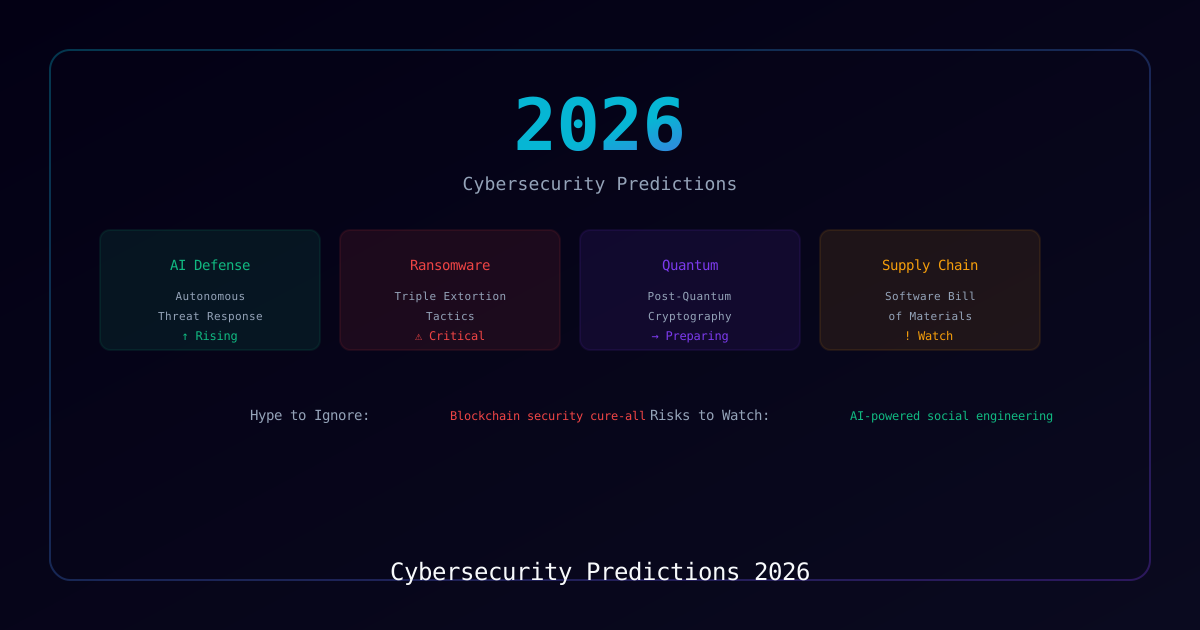
Cybersecurity Predictions 2026: What Really Matters
As we enter 2026, the cybersecurity landscape continues to evolve at a breakneck pace. Industry experts have weighed in on what organizations should prioritize—and what they can safely deprioritize.
The Trends That Matter
1. AI-Powered Attacks Go Mainstream
Prediction: AI will fundamentally change the attacker-defender balance in 2026.
What we're already seeing:
- 54% click-through rates on AI-crafted phishing emails
- Automated vulnerability discovery at scale
- Deepfake voice calls for BEC attacks
- Polymorphic malware generation
"The democratization of AI means that sophisticated attack techniques are no longer limited to nation-state actors. A lone attacker with ChatGPT-style tools can now create campaigns that rival APT groups from five years ago." — Threat Intelligence Researcher
What to do: Invest in AI-powered defenses, update security awareness training, implement phishing-resistant MFA.
2. Ransomware Evolution
Prediction: Ransomware attacks will become more destructive, not just disruptive.
| Trend | Impact |
|---|---|
| Data destruction | Corruption instead of just encryption |
| Backup targeting | Systematic elimination of recovery options |
| Operational impact | Targeting OT/ICS systems |
| Extortion escalation | Customers, partners, regulators notified |
What to do: Immutable backups, tested recovery procedures, network segmentation, incident response planning.
3. Supply Chain Attacks Intensify
Prediction: Software supply chain will be the primary initial access vector for sophisticated attacks.
Recent examples:
- Compromised developer tools injecting backdoors
- Typosquatting attacks on package repositories
- CI/CD pipeline compromises
- Third-party credential theft
What to do: SBOM implementation, dependency scanning, vendor security assessments, zero-trust for build systems.
4. Cloud Misconfiguration Remains Top Risk
Prediction: Despite years of warnings, cloud misconfigurations will cause more breaches than sophisticated exploits.
Common issues:
- Publicly accessible S3 buckets/Azure blobs
- Overly permissive IAM policies
- Exposed Kubernetes dashboards
- Unencrypted data stores
- Missing logging/monitoringWhat to do: Cloud security posture management (CSPM), infrastructure-as-code security scanning, continuous compliance monitoring.
5. Identity Becomes the Perimeter
Prediction: With traditional network perimeters dissolved, identity will be the primary security boundary.
Focus areas:
- Privileged access management (PAM)
- Just-in-time access
- Continuous authentication
- Machine identity management
What to do: Deploy comprehensive identity governance, implement zero-trust architecture, consolidate identity providers.
The Hype to Ignore
1. "Quantum Computing Will Break Everything"
Reality check: Quantum computers capable of breaking modern encryption are still years away. While organizations should begin planning for post-quantum cryptography, it's not a 2026 emergency.
Sensible approach: Inventory cryptographic dependencies, monitor NIST post-quantum standards, plan multi-year migration.
2. "AI Will Replace Security Teams"
Reality check: AI augments security teams but cannot replace human judgment, creativity, and contextual understanding.
Sensible approach: Use AI to automate routine tasks, freeing analysts for complex investigations and strategic work.
3. "Blockchain Will Solve Security"
Reality check: Blockchain introduces its own security challenges and is not a silver bullet for data integrity or identity.
Sensible approach: Evaluate blockchain for specific use cases where decentralization and immutability are genuinely required.
Industry-Specific Predictions
Healthcare
- Continued ransomware targeting (93% experienced attacks in 2025)
- Medical device security scrutiny increases
- Patient data extortion tactics evolve
- Regulatory enforcement intensifies
Financial Services
- Real-time payment fraud escalates
- Cryptocurrency regulation impacts security requirements
- Third-party risk management becomes board-level concern
- AI-powered fraud detection becomes essential
Critical Infrastructure
- Nation-state targeting of OT/ICS systems
- Convergence of IT/OT security
- Increased regulatory requirements (NERC CIP, TSA)
- Supply chain security for industrial components
Manufacturing
- Ransomware targeting production systems
- IP theft via compromised suppliers
- IoT/IIoT device security challenges
- Just-in-time inventory disruption attacks
Budget Recommendations
Where to invest in 2026:
| Priority | Investment Area | Budget % |
|---|---|---|
| Critical | Identity & Access Management | 20% |
| Critical | Detection & Response (XDR/MDR) | 20% |
| High | Cloud Security (CSPM/CWPP) | 15% |
| High | Security Awareness Training | 10% |
| Medium | Application Security (SAST/DAST) | 15% |
| Medium | Network Security | 10% |
| Ongoing | Compliance & GRC | 10% |
Key Metrics for 2026
Track these metrics to measure security program effectiveness:
Detection & Response:
- Mean Time to Detect (MTTD): Target < 24 hours
- Mean Time to Respond (MTTR): Target < 4 hours
- False Positive Rate: Target < 20%

Vulnerability Management:
- Critical Vuln Remediation: Target < 7 days
- Known Exploited Vuln Remediation: Target < 48 hours
- Patch Coverage: Target > 95%

User Security:
- Phishing Click Rate: Target < 3%
- MFA Adoption: Target > 99%
- Security Training Completion: Target 100%

Third-Party Risk:
- Vendor Assessment Coverage: Target 100%
- High-Risk Vendor Remediation: Target < 30 daysExecutive Summary
The bottom line for 2026:
- AI changes everything - Both attack and defense will be AI-augmented
- Identity is critical - Invest heavily in IAM and zero-trust
- Basics still matter - Patching, MFA, and backups prevent most breaches
- Prepare for disruption - Ransomware will be more destructive
- Supply chain focus - Know your dependencies and suppliers
References
- The Hacker News - Cybersecurity Predictions 2026
- BankInfoSecurity - 2026 Predictions
- Help Net Security - 2026 Outlook
- Gartner Security & Risk Management Summit
Last updated: January 5, 2026