Europe's Semiconductor Ambitions Take Shape
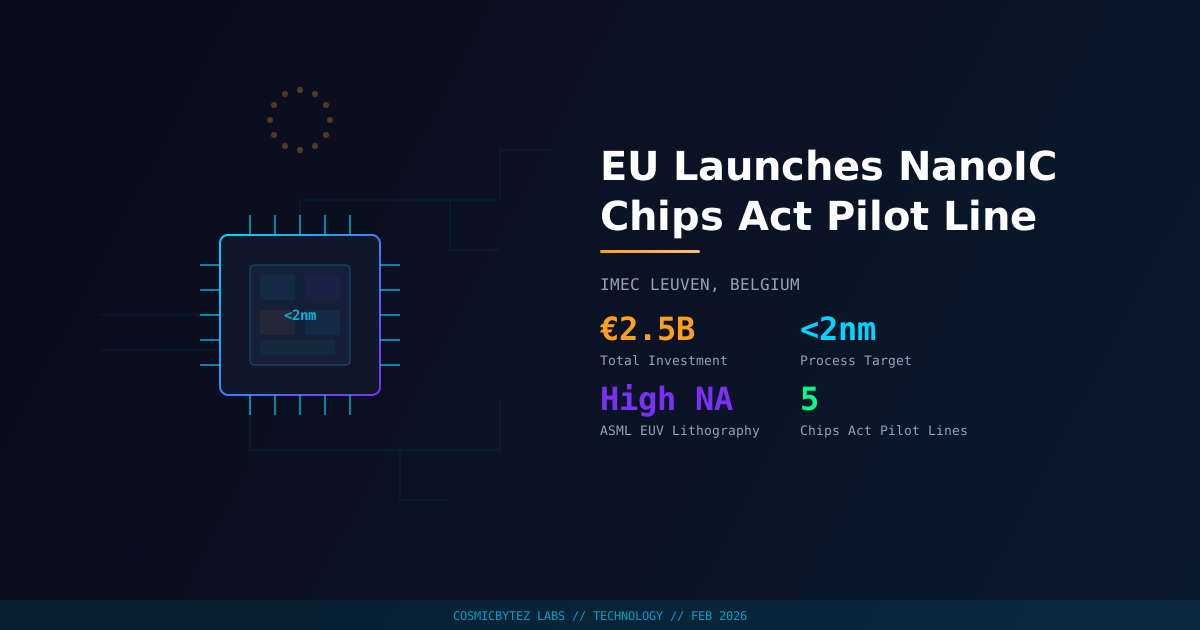
The European Union has officially opened NanoIC, its largest Chips Act pilot line, at IMEC's campus in Leuven, Belgium. The facility represents a €2.5 billion investment and marks a major milestone in Europe's bid to reduce dependence on Asian semiconductor manufacturing.
The announcement, made on February 9, 2026, positions NanoIC as the first European facility capable of developing chips at sub-2nm process nodes — technology critical for next-generation AI accelerators, autonomous vehicles, and 6G communications.
Investment Breakdown
| Source | Amount |
|---|---|
| EU Chips Act funding | €700 million |
| National and regional governments | €700 million |
| ASML and industry partners | €1.1 billion |
| Total | €2.5 billion |
This makes NanoIC the single largest investment under the EU Chips Act to date.
What NanoIC Can Do
Key Capabilities
| Feature | Details |
|---|---|
| Process node target | Sub-2nm (beyond current leading-edge) |
| Lithography | ASML High NA EUV (0.55 NA) |
| Focus areas | AI chips, 6G, automotive, healthcare |
| Cleanroom space | 10,000 m² Class 1 cleanroom |
| Operational model | Open-access pilot line for EU companies and research institutions |
NanoIC is the first facility in Europe to deploy ASML's most advanced High Numerical Aperture Extreme Ultraviolet lithography system. This machine enables the printing of circuit features smaller than 2 nanometers — a capability previously exclusive to TSMC and Samsung's most advanced fabs.
The Open-Access Model
Unlike commercial fabs owned by single companies, NanoIC operates as an open-access pilot line. European chipmakers, startups, and research institutions can use the facility to prototype and validate chip designs before committing to full-scale manufacturing. This lowers the barrier to entry for European semiconductor innovation.
The Broader Chips Act Context
NanoIC is one of five pilot lines funded under the EU Chips Act, collectively representing €3.7 billion in combined EU and national investment:
| Pilot Line | Focus | Location |
|---|---|---|
| NanoIC | Sub-2nm logic chips | Leuven, Belgium |
| FAMES | Advanced packaging | Multiple EU sites |
| APECS | Photonics and electronics convergence | Multiple EU sites |
| WBG | Wide-bandgap semiconductors (SiC, GaN) | Multiple EU sites |
| PIXEurope | Photonic integrated circuits | Multiple EU sites |
Why This Matters for Tech and Security
AI Hardware Independence
The global AI boom has created unprecedented demand for advanced chips. Currently, over 90% of leading-edge semiconductors are manufactured in Taiwan (TSMC) and South Korea (Samsung). NanoIC gives Europe a path to domestic AI chip prototyping, reducing supply chain risk.
Security Implications
Semiconductor supply chain security is now a national security issue. The ability to design and validate chips domestically means:
- Reduced exposure to geopolitical disruption in the Taiwan Strait
- Trusted silicon for defense and critical infrastructure applications
- IP protection for European chip designs during the prototyping phase
- Inspection capability for hardware-level security verification
6G and Beyond
NanoIC's sub-2nm capability is specifically designed to support 6G research, expected to require chips that operate at terahertz frequencies with extreme power efficiency — capabilities that demand the most advanced process nodes.
Industry Reactions
ASML CEO Christophe Fouquet described the opening as "a pivotal moment for European technology sovereignty," while European Commission Executive Vice-President Henna Virkkunen called it "proof that the Chips Act is delivering results."
IMEC CEO Luc Van den hove noted that NanoIC bridges "the gap between Europe's world-class research and industrial-scale manufacturing."
Timeline
| Date | Milestone |
|---|---|
| September 2023 | EU Chips Act enters into force |
| March 2024 | NanoIC approved as Chips Act pilot line |
| Q2 2025 | ASML High NA EUV system installation begins |
| February 9, 2026 | NanoIC officially opens |
| H2 2026 | First sub-2nm test chips expected |
| 2027 | Full operational capacity |