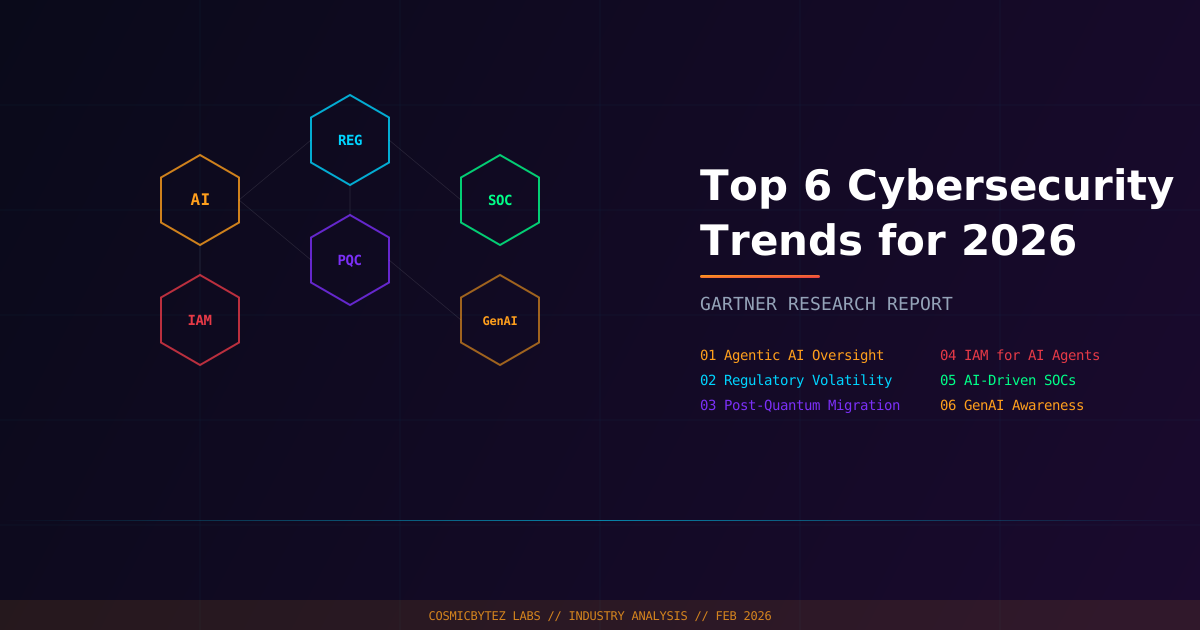
Six Trends Defining the 2026 Threat Landscape
Gartner has released its annual cybersecurity trend report, identifying six forces that will reshape how organizations defend themselves in 2026. The driving factors: the chaotic rise of AI, intensifying geopolitical tensions, regulatory volatility, and an accelerating threat landscape.
1. Agentic AI Demands Cybersecurity Oversight
Agentic AI — autonomous systems that take actions without human approval — is rapidly being adopted by employees and developers, creating entirely new attack surfaces. Unlike traditional AI assistants that suggest actions, agentic AI executes them: booking infrastructure, deploying code, and modifying configurations.
The Risk
| Concern | Impact |
|---|---|
| Autonomous code deployment | Agents may deploy vulnerable code without review |
| Credential access | Agents require API keys and service accounts that expand the attack surface |
| Prompt injection | Malicious inputs can redirect agent behavior |
| Shadow AI agents | Employees deploying unauthorized agents outside IT governance |
Gartner recommends establishing AI governance frameworks that include agent-specific policies, runtime monitoring, and kill switches for autonomous systems.
2. Global Regulatory Volatility Drives Cyber Resilience
Shifting geopolitical landscapes and evolving mandates have made cybersecurity a board-level business risk. Regulators are increasingly holding executives personally liable for compliance failures.
Key Regulatory Developments in 2026
| Regulation | Region | Impact |
|---|---|---|
| NIS2 Directive enforcement | EU | Mandatory incident reporting within 24 hours |
| SEC cyber disclosure rules | US | Material breach disclosure within 4 business days |
| DORA compliance deadline | EU (Financial) | ICT risk management framework required |
| Critical Infrastructure Act | Australia | Mandatory security standards for 11 sectors |
Inaction can result in substantial penalties, lost business, and irreversible reputational damage.
3. Post-Quantum Computing Moves into Action Plans
Gartner predicts advances in quantum computing will render the asymmetric cryptography organizations rely on unsafe by 2030. The window for migration is narrowing.
Migration Priority Matrix
| Data Type | Migration Urgency | Rationale |
|---|---|---|
| Government classified | Immediate | Already targeted by "harvest now, decrypt later" |
| Healthcare records | High | 50+ year retention requirements |
| Financial transactions | High | Regulatory compliance requirements |
| General enterprise | Medium | Standard business data lifecycle |
Post-quantum cryptography alternatives — specifically NIST's ML-KEM (FIPS 203), ML-DSA (FIPS 204), and SLH-DSA (FIPS 205) — must be adopted now. Google has already rolled out ML-KEM in Chrome 134.
4. Identity and Access Management Adapts to AI Agents
The rise of AI agents introduces challenges to traditional IAM strategies, particularly around machine identity governance.
New IAM Requirements
- Identity registration — How do you provision identity for an autonomous agent?
- Credential automation — Agents need credentials that rotate, expire, and are scoped
- Policy-driven authorization — Authorization decisions must account for agent context, not just user context
- Behavioral baselines — Agent actions need anomaly detection separate from human user patterns
Failure to address these issues will lead to greater risk of access-related incidents as autonomous agents become more prevalent across enterprise environments.
5. AI-Driven Security Operations Centers
AI-enabled SOCs are introducing new levels of operational capability, but Gartner cautions that people still matter.
"To realize the full potential of AI in security operations, cybersecurity leaders must prioritize people as much as technology."
SOC Evolution Path
| Generation | Approach | Analyst Role |
|---|---|---|
| Traditional SOC | Rule-based alerts, manual triage | Tier 1-3 analysts handle all |
| AI-Assisted SOC | AI triage + human investigation | Analysts focus on complex cases |
| AI-Driven SOC (2026) | Autonomous detection + response | Analysts govern AI and handle edge cases |
| Autonomous SOC (Future) | Full AI loop with human oversight | Security architects and policy designers |
The key risk: organizations that over-invest in AI tooling while under-investing in analyst training will see worse outcomes, not better.
6. GenAI Breaks Traditional Cybersecurity Awareness
Existing security awareness programs are failing as GenAI adoption accelerates. A Gartner survey of 175 employees (May–November 2025) revealed:
| Finding | Percentage |
|---|---|
| Use personal GenAI accounts for work | 57% |
| Input sensitive information into unapproved tools | 33% |
| Believe their GenAI usage is compliant | 72% |
| Have received GenAI-specific security training | 12% |
The Gap
Traditional phishing simulations and annual compliance training cannot address the nuanced risks of GenAI misuse. Gartner recommends shifting to adaptive behavioral programs that include AI-specific scenarios: data leakage through prompts, hallucination-driven decision errors, and shadow AI governance.
What Security Teams Should Do Now
- Audit agentic AI deployments across the organization
- Map regulatory exposure to upcoming compliance deadlines
- Begin post-quantum cryptographic inventory of all systems using RSA, ECDH, or ECDSA
- Extend IAM policies to cover machine and agent identities
- Evaluate SOC tooling for AI integration maturity
- Update security awareness programs with GenAI-specific modules